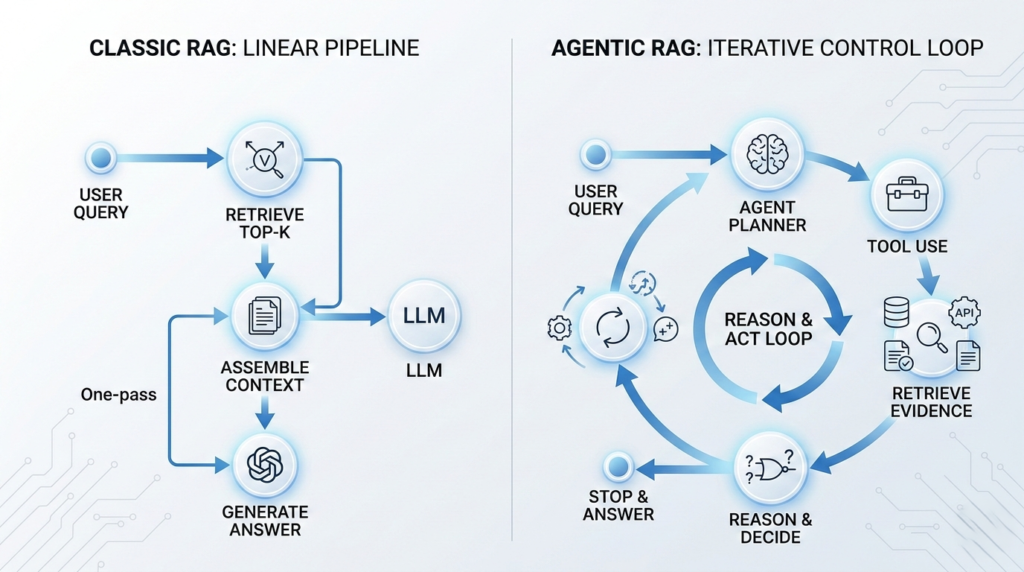
The landscape of Artificial Intelligence is shifting. For the past year, Retrieval-Augmented Generation (RAG) has been the gold standard for grounding Large Language Models (LLMs) in external data. However, as enterprise demands grow more complex, the industry is moving away from static “one-pass” systems toward dynamic, iterative workflows.
The debate of Agentic RAG vs Classic RAG isn’t just about technical jargon; it represents a fundamental change in how AI systems reason. While Classic RAG follows a linear pipeline—query, retrieve, generate—Agentic RAG introduces a “control loop” that allows the system to pause, evaluate its own evidence, and try again if the initial results are insufficient.
In this comprehensive guide, we will break down the architectural differences, explore when to upgrade your stack, and provide actionable insights for deploying these systems in production.
What is Classic RAG? The Linear Pipeline
Classic RAG is built on a “one-shot” philosophy. When a user asks a question, the system searches a vector database, pulls the top results, and stuffs them into the LLM’s context window to generate a response.( Agentic RAG vs Classic RAG)
How the Classic Pipeline Works:
- Query: The system receives a user input.
- Retrieve: A single search is performed (usually vector or hybrid search).
- Assemble: The top-k document chunks are formatted into a prompt.
- Generate: The model produces an answer based solely on that specific context.
This approach is highly efficient for simple lookup tasks, such as “What is the company’s holiday policy?” or “Find the API endpoint for user authentication.” Because there are no loops, the latency and cost are predictable and low.
Defining Agentic RAG: The Rise of the Control Loop
Agentic RAG vs Classic RAG finds its biggest differentiator in the “Reason and Act” (ReAct) pattern. Instead of accepting the first set of search results, an agentic system treats retrieval as a tool. If the first search doesn’t provide a clear answer, the agent can decide to rewrite the query, check a different data source, or decompose a complex question into smaller sub-tasks.
The Agentic Control Loop:
- Planning: The agent breaks down the query (e.g., “Compare Q3 sales in India vs Germany”).
- Action: It calls a retrieval tool for India’s data, then another for Germany’s.
- Reasoning: It checks if it has enough info to answer. If not, it loops back to search for currency conversion rates.
- Self-Correction: If the retrieved text is irrelevant, the agent “realizes” this and attempts a different search strategy.
Agentic RAG vs Classic RAG: A Head-to-Head Comparison
Choosing the right architecture requires balancing performance against operational overhead. The following table highlights the core trade-offs:
| Feature | Classic RAG | Agentic RAG |
| Workflow | Linear Pipeline | Iterative Control Loop |
| Complexity | Low (Easy to debug) | High (Requires state management) |
| Cost | Predictable | Variable (Depends on loop depth) |
| Multi-Hop Reasoning | Limited/Weak | Strong/Native |
| Latency | Low & Consistent | Higher (p95 grows with iterations) |
| Failure Modes | Retrieval/Prompt errors | Loop “thrashing” or tool cascades |
When Should You Choose Agentic RAG?
While Agentic RAG vs Classic RAG is often framed as a “better vs. worse” scenario, the reality is that many use cases do not require the complexity of agents. Use the following criteria to decide:( Agentic RAG vs Classic RAG)
Use Classic RAG if:
- You are building a standard FAQ bot or internal documentation search.
- Low latency is a critical requirement for your user experience.
- Your budget for tokens is strictly capped.
- The answers are usually contained within a single document or chunk.
Use Agentic RAG if:
- Users ask “multi-hop” questions that require connecting dots across different sources.
- Your data is messy or spread across multiple silos (SQL databases, PDFs, and live APIs).
- You need the system to “self-correct” when it retrieves irrelevant information.
- The cost of an incorrect answer is high enough to justify the extra processing time.
Operational Challenges: The Hidden Costs of Loops
Transitioning to an agentic model introduces “tail behavior” that developers must manage. Unlike a pipeline where every request takes roughly the same time, an agentic loop can vary wildly.(Agentic RAG vs Classic RAG)
- Retrieval Thrashing: The agent might get stuck in a loop, searching for the same information repeatedly without success.
- Context Bloat: As the agent gathers more evidence through multiple steps, the prompt grows larger, which can lead to the model “forgetting” instructions or increasing costs significantly.
- Tool Cascades: One tool call might trigger an unexpected chain reaction of secondary actions, leading to unpredictable latency spikes (p95 latency).
Actionable Insight: Implementing a “Second Pass”
()A practical middle ground between Agentic RAG vs Classic RAG is the “conditional loop.” Instead of a full agent, run a classic pipeline first. If the model detects a “low confidence” score or a lack of citations in the output, only then trigger an agentic second pass to refine the answer.
The Future of Retrieval: Moving Toward Autonomy
As we look toward 2026 and beyond, the industry is moving toward “Agentic AI” as a standard. Gartner predicts that a third of enterprise software will include agentic workflows within the next few years. The shift from Agentic RAG vs Classic RAG isn’t just a trend—it’s the necessary evolution for AI to handle the nuance and complexity of real-world business logic.
By understanding the strengths of the linear pipeline and the flexibility of the control loop, you can build systems that are not just smart, but truly reliable.(Agentic RAG vs Classic RAG)