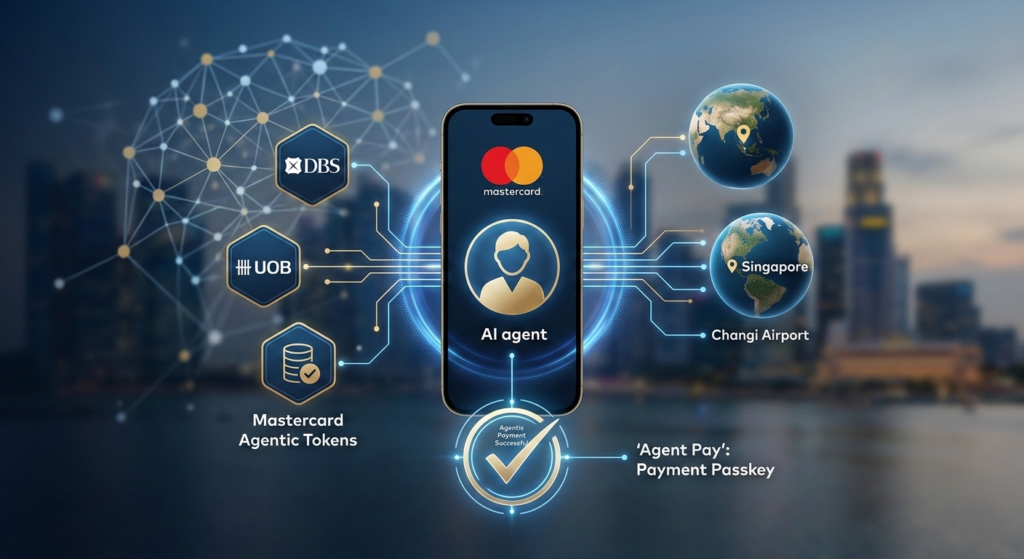
The landscape of digital finance is shifting from “click-to-pay” to “think-to-pay.” Mastercard has officially ushered in a new era of autonomous finance by completing its first live, authenticated agentic payments transaction in Singapore. In a landmark collaboration with banking giants DBS and UOB, this pilot demonstrates how AI agents can now handle complex, real-world purchases with minimal human intervention, all while maintaining the highest standards of security.
As Singapore continues to solidify its position as a global AI hub, the introduction of agentic payments represents more than just a technological curiosity—it is a fundamental change in how consumers interact with the digital economy. This article explores the mechanics of this breakthrough, the role of Mastercard’s new AI Center of Excellence, and what it means for the future of global commerce.
What Are Agentic Payments?
To understand the significance of this milestone, we must first define the concept. Traditional digital payments require a human to initiate every step: opening an app, selecting a service, choosing a card, and clicking “confirm.”
Agentic payments flip this script. In an agentic ecosystem, an AI agent—powered by large language models (LLMs)—acts as a digital proxy for the consumer. It can understand a request (e.g., “Book me a ride to the airport”), browse options, select the best provider, and execute the financial transaction autonomously using secure, tokenized credentials.
The Singapore Pilot: A Real-World Success
In the recent Singapore demonstration, an AI agent facilitated by CardInfoLink successfully booked a ride to Changi Airport through the global mobility provider hoppa. The transaction was not merely a simulation; it was a live, authenticated payment processed through Mastercard’s “Agent Pay” framework, supported by the banking infrastructures of DBS and UOB.
The Core Technology: How Mastercard Secures AI Transactions
The primary concern with autonomous AI is security. How do we ensure an AI agent doesn’t overspend or fall victim to “prompt injection” attacks? Mastercard has addressed these concerns by embedding security directly into the payment rail.
Mastercard Agent Pay Framework
The “Agent Pay” framework is the backbone of these agentic payments. It utilizes several layers of protection:
- Mastercard Agentic Tokens: Unlike traditional card numbers, these are unique tokens issued specifically to an AI agent. They are restricted to certain types of merchants or spending limits, ensuring the agent cannot exceed its mandate.
- Payment Passkeys: To ensure the human remains in control, Mastercard uses Payment Passkeys. This biometric-based authentication captures explicit consumer consent before the AI finalizes a high-value or first-time transaction.
- Issuer-Controlled Flows: Banks like DBS and UOB maintain oversight of the transaction, applying real-time fraud monitoring and risk assessment just as they would for a human-led payment.
Why Singapore? The Role of DBS, UOB, and the AI Center of Excellence
Singapore is the ideal testing ground for agentic payments due to its advanced regulatory environment and high consumer tech adoption. According to recent data, nearly 77% of Singapore residents already use generative AI tools in their daily lives.
Strategic Partnerships
Mastercard’s collaboration with DBS and UOB is pivotal. As the “World’s Best Digital Bank,” DBS has been a vocal advocate for integrating AI into the banking experience. Similarly, UOB’s focus on regional connectivity and future-ready frameworks makes them a natural partner for scaling agentic payments across Southeast Asia.
The New AI Center of Excellence
Coinciding with this pilot, Mastercard announced the establishment of a regional AI Center of Excellence in Singapore. This facility will be Mastercard’s largest innovation space in the region, focusing on:
- Governance: Developing ethical frameworks for AI-led transactions.
- Scalability: Ensuring that agentic payments can handle millions of transactions across diverse industries.
- Collaboration: Working with LLM providers to refine how AI agents communicate with payment gateways.
Comparing Traditional vs. Agentic Payments
The shift toward agentic payments will dramatically reduce “friction” in the customer journey. The table below highlights the key differences:
| Feature | Traditional Digital Payments | Mastercard Agentic Payments |
| Initiator | Human User | AI Agent (Proxy) |
| Authentication | Manual (OTP, Password) | Passkeys & Agentic Tokens |
| Decision Making | Human selects provider/price | AI optimizes based on preferences |
| Security Layer | Standard Tokenization | Dedicated Agent-Specific Tokens |
| Speed | 2–5 minutes (manual entry) | Near-instantaneous |
Actionable Insights for Businesses and Financial Institutions
The move toward agentic payments isn’t just for tech enthusiasts; it has massive implications for merchants and banks.
1. Merchants Must Adapt for “Machine Customers”
As AI agents begin making purchasing decisions, merchants need to optimize their APIs. Your website is no longer just for humans to read; it must be “machine-readable” so that an AI agent can quickly extract pricing, availability, and terms of service to complete agentic payments.
2. Banks Must Enhance Identity Verification
The role of the bank is shifting from a passive vault to an active guardian. Financial institutions should invest in “Intent-Driven Safeguards,” which allow them to verify that a transaction initiated by an AI truly aligns with the cardholder’s historical behavior and explicit instructions.
3. Focus on “Passive Commerce”
The ultimate goal of agentic payments is to make commerce “passive.” For industries like utilities, subscriptions, and logistics, the ability to automate payments via AI agents will lead to higher retention rates and fewer failed transactions due to expired cards or manual errors.
The Road Ahead: Travel, Retail, and Beyond
While the Singapore pilot focused on transportation, Mastercard plans to expand agentic payments into several high-growth sectors:
- Travel and Hospitality: AI agents could autonomously manage flight cancellations, rebooking tickets and processing refunds without the user ever picking up a phone.
- Retail and Grocery: Imagine an AI agent that monitors your fridge and executes agentic payments for groceries when supplies are low, choosing the merchant with the best loyalty rewards.
- Entertainment: Booking cinema tickets or concert passes based on your calendar and favorite artists.
Mastercard has already conducted similar trials in Australia, New Zealand, and India, proving that the appetite for agentic payments is global. By building a trusted foundation in Singapore, they are setting the gold standard for how the world will transact in an AI-first economy.
Conclusion: A Trusted Foundation for AI Commerce
The successful execution of agentic payments in Singapore by Mastercard, DBS, and UOB marks a turning point. It proves that AI can be more than just a chatbot; it can be a functional, secure participant in the global economy. As we move forward, the focus will remain on “Responsible Innovation”—ensuring that while the agents do the work, the human remains the ultimate authority.
By integrating dedicated tokens, passkeys, and robust banking governance, Mastercard is ensuring that the future of agentic payments is not just automated, but inherently trusted.