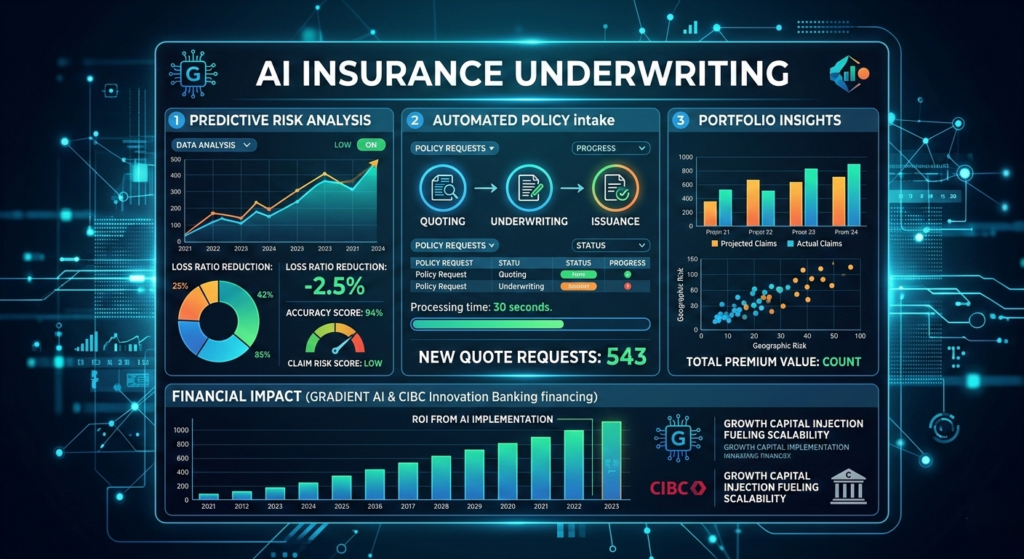
The insurance industry is currently undergoing a tectonic shift. For decades, risk assessment was a slow, manual process governed by static actuarial tables and human intuition. However, a new era has arrived where data-driven precision is the gold standard. At the forefront of this movement is AI insurance underwriting, a technology that is no longer just a futuristic concept but a multi-billion-dollar reality.
The recent announcement that Boston-based insurtech leader Gradient AI secured growth capital financing from CIBC Innovation Banking is a watershed moment. It signals that institutional lenders—not just venture capitalists—are now betting heavily on the scalability of artificial intelligence to solve the industry’s most “unsolvable” problems.
In this deep dive, we explore how AI insurance underwriting is moving from “pitch deck” to “production,” what the CIBC investment means for the market, and how insurers can leverage these tools to drive unprecedented profitability.
The Evolution of AI Insurance Underwriting
The core value proposition of AI insurance underwriting lies in its ability to process information that human underwriters simply cannot. While a traditional underwriter might look at a dozen data points, an AI-driven platform can analyze thousands of variables simultaneously.
Why Institutional Capital is Flooding the Sector
The financing from CIBC Innovation Banking, a lender with over 25 years of experience and $11 billion in managed funds, marks a shift in market maturity. Unlike early-stage seed funding, growth capital is designed for companies that have already proven their product-market fit.
AI insurance underwriting is no longer a “test case.” It is an essential infrastructure for any carrier looking to survive in an increasingly volatile economic landscape. According to recent market data, the global AI in insurance sector is projected to grow to a staggering $154 billion by 2034.
How Gradient AI’s Platform Reshapes the Underwriting Lifecycle
Gradient AI doesn’t just provide a tool; it provides an ecosystem. Their SaaS platform is built on a massive “data lake” containing tens of millions of policies and claims. By layering this with external signals—such as economic trends, health data, and geographic risks—the system offers a 360-degree view of risk.
1. Accuracy in Risk Prediction
The primary goal of AI insurance underwriting is to improve loss ratios. By identifying high-risk applicants that traditional models might miss—and conversely, spotting “hidden gems” that are safer than they appear—insurers can price their products with surgical precision.
2. Intelligent Automation
Speed is the new competitive advantage. Gradient AI’s solutions allow for a drastic reduction in quote turnaround times. When AI insurance underwriting automates the routine cases, human experts can focus their energy on complex, high-value accounts that require a nuanced touch.
3. Claims Cost Reduction
Underwriting and claims are two sides of the same coin. By using AI insurance underwriting techniques at the point of intake, insurers can predict which claims are likely to become “runaway” cases or “large losses” before they spiral out of control.
The Financial Impact: By the Numbers
To understand why CIBC and other major players are invested in AI insurance underwriting, one only needs to look at the efficiency gains reported by industry leaders like BCG.
| Metric | Impact of AI Integration |
| Efficiency Gains | Up to 36% improvement in complex lines |
| Loss-Ratio Improvement | 2 to 3 percentage point reduction |
| Projected Market Value | $13.45 Billion by 2026 |
| Annual Growth Rate (CAGR) | 35.7% through 2034 |
These numbers demonstrate that AI insurance underwriting is not a marginal improvement—it is a structural transformation of the insurance P&L statement.
Actionable Insights: Implementing AI in Your Underwriting Workflow
If you are an insurance executive or a broker, the question is no longer if you should adopt AI, but how quickly you can integrate it. Here is a roadmap for successfully deploying AI insurance underwriting capabilities:
- Prioritize Data Quality: As Gradient AI CEO Stan Smith has noted, your AI is only as good as your data. Ensure your internal data is clean and look for partners that provide access to external “data lakes.”
- Focus on Explainability: With regulators in the US and Europe pushing for transparency, choose AI insurance underwriting platforms that offer “glass-box” models. You must be able to explain why a certain decision was made.
- Augment, Don’t Replace: The most successful implementations of AI insurance underwriting are those that empower human underwriters with “superpowers,” allowing them to make better decisions faster.
- Start with High-Volume Lines: Workers’ compensation and group health are excellent starting points for AI, as they generate large volumes of data where patterns are easily detectable by machine learning.
Addressing the Challenges of Modern Underwriting
Despite the excitement, the path to full AI adoption isn’t without hurdles. Insurers are becoming more sophisticated, but they still face rising claims costs and social inflation.
Gradient AI’s approach to AI insurance underwriting addresses these challenges by providing real-time benchmarks. For instance, their “ClaimVector” solution allows brokers to compare claims performance against real industry data, turning raw information into a strategic asset.
The CIBC financing will specifically fund the enhancement of these platforms, ensuring that AI insurance underwriting continues to evolve alongside the risks it is meant to mitigate. Whether it’s climate change affecting property risk or shifting demographic health trends, AI is the only tool capable of keeping pace with the “new normal.”
The Future: A New Standard for Risk Assessment
The partnership between Gradient AI and CIBC Innovation Banking is a signal to the entire insurtech world: the “experimentation phase” is over. We are entering the “execution phase.”
In the coming years, AI insurance underwriting will move from being a “competitive advantage” to a “regulatory and operational requirement.” Carriers that fail to adopt these technologies will find themselves saddled with adverse selection—taking on the risks that AI-powered competitors knew to avoid.
By leveraging a vast industry data lake and sophisticated predictive analytics, Gradient AI is proving that AI insurance underwriting is the most effective way to achieve a better return on risk.
Conclusion
The insurance industry is at a crossroads. On one hand, traditional methods are struggling to keep up with a rapidly changing world. On the other, AI insurance underwriting offers a path toward greater profitability, faster service, and more accurate pricing.
The growth capital provided by CIBC to Gradient AI is more than just a loan; it’s a validation of a data-driven future. As we look toward 2026 and beyond, AI insurance underwriting will remain the focal point of innovation, helping the industry navigate the unknown with confidence.