The age of simple chatbots is over. We have entered the agentic era, a period defined by AI agents that don’t just summarize text but reason, plan, and execute complex workflows autonomously. For IT leaders, this shift presents a monumental challenge: the legacy blueprints of the past are no longer sufficient to support a “digital nervous system” driven by autonomous intelligence.
To remain competitive, organizations must prioritize enterprise architecture as the foundation for this transformation. Whether you choose to evolve your current systems or rebuild from the ground up, the way you structure your technology will determine your ability to scale AI from simple pilots to bottom-line impact.
Why Enterprise Architecture is the Backbone of the Agentic Era
In previous technology cycles, enterprise architecture was often viewed as a map of static assets—servers, databases, and applications. In the agentic era, it must become a dynamic coordination fabric. Agentic AI requires a seamless flow of data and the ability to “talk” to legacy systems through APIs. Without a robust architectural strategy, organizations risk “agent sprawl,” where disconnected AI tools create conflicting outputs and security vulnerabilities.
By rethinking your enterprise architecture, you move beyond siloed AI experiments. You create a composable environment where agents can access institutional memory, collaborate across departments, and adapt to real-time business changes.
Two Paths to Modernization: Incremental vs. Comprehensive
McKinsey identifies two primary strategies for updating your enterprise architecture to support autonomous agents. The right choice depends on your risk tolerance, budget, and the state of your current tech stack.
1. Incremental Integration: Leveraging What You Have
For many established firms, a “rip and replace” strategy is too risky. Incremental integration involves layering agentic capabilities onto existing systems.
- The Benefit: It protects “tech equity”—the decades of business rules and domain expertise embedded in legacy systems.
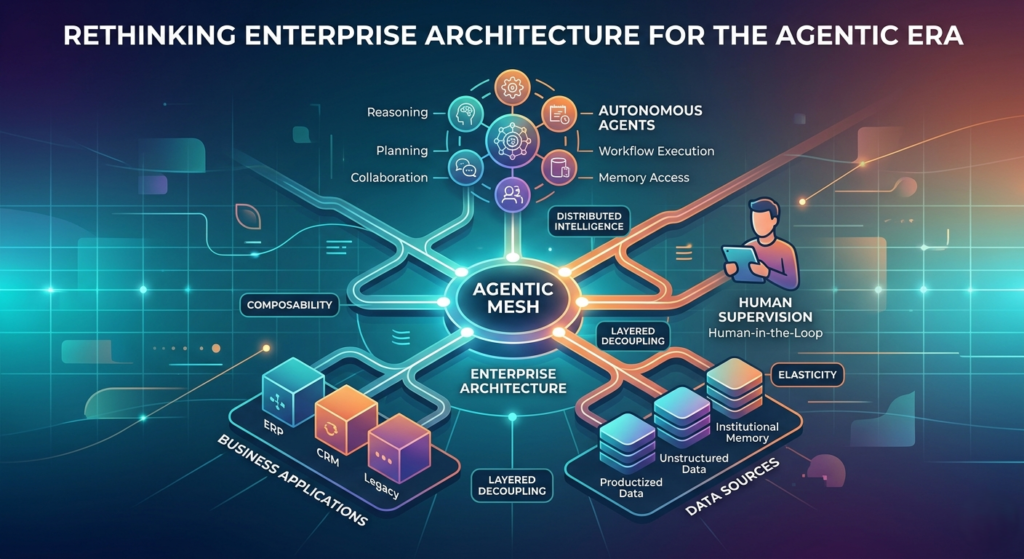
- The Enabler: The Agentic Mesh. This orchestration layer acts as a translator between new AI agents and old-school ERP or CRM systems.
2. Comprehensive Transformation: Building AI-Native
Younger, “digital-native” companies or those with high technical debt may choose a full-scale overhaul.
- The Benefit: It eliminates technical clutter and creates a “native-agent” environment where workflows are designed for AI first, not humans.
- The Challenge: This requires massive compute power and a rare breed of AI engineering talent.
Key Design Principles for an Agentic Enterprise Architecture
To succeed in this new era, your enterprise architecture should follow five core design principles that ensure flexibility and scalability:
- Composability: Every agent and tool should be “pluggable.” You should be able to swap out an LLM or a data source without rebuilding the entire system.
- Distributed Intelligence: Tasks should be decomposed so that a network of cooperating agents can solve them, rather than relying on one monolithic “god-agent.”
- Layered Decoupling: Separate the user interface, orchestration logic, and memory functions. This modularity prevents the system from becoming a “black box.”
- Institutional Memory Access: Agents are only as good as the data they can reach. Your architecture must unlock unstructured data and legacy “hidden” knowledge.
- Elasticity: Because agents are digital, your architecture must allow execution capacity to expand or contract based on real-time workloads.
Comparing Traditional vs. Agentic Architecture
| Feature | Traditional Architecture | Agentic Enterprise Architecture |
| Logic | Hard-coded business rules | Probabilistic reasoning and planning |
| Workflows | Sequential handoffs | Parallel, autonomous execution |
| Data Usage | Structured, siloed databases | Productized data & unstructured memory |
| Integration | Point-to-point APIs | Centralized Agentic Mesh |
| Scalability | Limited by human headcount | Elastic, machine-speed execution |
Actionable Insights: Preparing Your Tech Stack for Agents
Rethinking your enterprise architecture isn’t just a technical exercise; it’s a strategic one. Here are four steps your organization can take today:
1. Build an “Agentic Mesh”
Don’t let agents operate in isolation. Implement a coordination layer—a mesh—that enforces business rules and maintains a “shared source of truth.” This prevents two different agents from making contradictory decisions, such as one agent cutting costs while another prioritizes expensive express shipping for customer satisfaction.
2. Transition to Data Productization
Agents fail when they have to hunt for data. Your enterprise architecture must shift toward “data products”—ready-to-use, governed data sets that agents can query instantly. This includes extending governance to unstructured data like PDFs, emails, and call transcripts.
3. Focus on Human-in-the-Loop (HITL) Design
As agents gain autonomy, your enterprise architecture must include clear “hand-off” points where humans can intervene. Define different levels of autonomy for agents: from “task automators” who need constant approval to “domain orchestrators” who operate with high independence but report anomalies.
4. Reskill the Architecture Team
Your architects need to move from managing servers to managing “agentic flows.” This involves learning how to design prompt-based workflows and understanding how to govern autonomous decision-making boundaries.
The Risk of Inaction: The “Agentic Gap”
Organizations that fail to modernize their enterprise architecture will soon face an “agentic gap.” While competitors use agents to accelerate execution and personalize customer experiences at machine speed, laggards will remain stuck in manual, sequential processes.
The goal is to create a more “composable” enterprise—a set of interoperable building blocks that can evolve as fast as AI technology does. By centering your enterprise architecture on the needs of autonomous agents, you aren’t just upgrading your IT; you are rewiring your business for a new era of growth and resilience.
Conclusion: Designing for Autonomy
The shift to the agentic era is the largest paradigm shift since the digital revolution. Success requires a bold rethink of enterprise architecture. By choosing between incremental or comprehensive paths, applying core design principles like composability, and building a robust agentic mesh, leaders can unlock the true value of AI.
The future belongs to the “agentic organization”—one where humans and virtual agents work together seamlessly to create value. Is your architecture ready to support them?