In 2010, the world watched in awe as Warren Buffett and Bill Gates launched a “disarmingly simple” campaign that promised to change the face of global wealth. The Giving Pledge was a moral commitment, a public vow by the world’s wealthiest individuals to donate the majority of their fortunes to charitable causes. It was the ultimate “rich person’s pact,” signaling a new era of compassionate capitalism.
Fast forward to March 2026, and the narrative has shifted dramatically. Recent reports, including a deep dive by TechCrunch, reveal a startling trend: the “billionaire promise” is fraying at the edges. Not only has the pace of new sign-ups plummeted—from 113 in its peak years to a mere 14 in 2025—but several high-profile signatories are now looking for the exit or quietly pivoting away from their original commitments.
The Giving Pledge is facing a crisis of confidence. But why are the world’s elite suddenly hesitant to give away the money they once so publicly renounced?
The Erosion of a Moral Compact
At its core, the Giving Pledge was never a legal contract. It was a “soft power” tool designed to create a social norm among the ultra-wealthy. For over a decade, it worked as a status symbol. However, without enforcement mechanisms or transparency requirements, the pledge relied entirely on the honor system.
Today, that honor system is being tested by a combination of economic volatility, changing political winds, and a fundamental shift in how the “New Guard” of billionaires views their responsibility to society.
Why the Giving Pledge is Losing Momentum
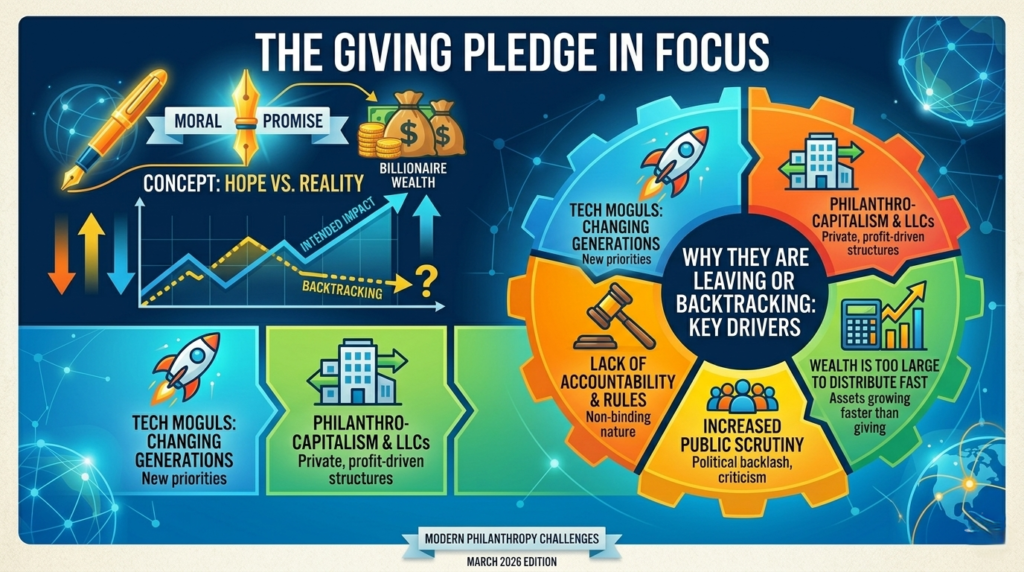
- Wealth Outpacing Generosity: Statistics show that the original signatories who are still alive are, on average, 283% wealthier today than when they signed. Their assets are growing faster than they can (or choose to) give them away.
- Lack of Accountability: Because there are no “rules” on how or when the money must be spent, many billionaires have used the Giving Pledge as a PR shield while their capital remains parked in tax-advantaged foundations.
- The Rise of “Philanthro-Capitalism”: Newer billionaires prefer LLC structures (like Mark Zuckerberg’s CZI) over traditional 501(c)(3) foundations, allowing them to invest in for-profit companies and influence policy without the same disclosure requirements.
The Data: A Promise Unfulfilled?
To understand the scale of the issue, we must look at the “graduation rate” of those who have passed away. Of the 22 original signatories who are no longer with us, only eight have been confirmed to have fully met their pledge to donate the majority of their wealth.
| Metric | Status as of March 2026 |
| Total Signatories | ~260 globally |
| 2025 Sign-up Growth | -87% compared to peak years |
| Average Wealth Growth | 283% since signing |
| Fulfilled Pledges (Deceased) | ~36% |
This data suggests that the Giving Pledge has become more of a “statement of intent” than a reliable predictor of actual philanthropic distribution.
The “New Guard” and the Pivot to Privacy
The tech-heavy billionaires of the mid-2020s are different from the Buffett-Gates generation. While the founders of the Giving Pledge viewed public commitment as a way to inspire others, today’s moguls are increasingly wary of the “donor backlash.”
Public philanthropy often invites public scrutiny. In an era of intense polarization, every dollar donated to a climate fund or an educational initiative is analyzed through a political lens. For many, the Giving Pledge has become a liability rather than an asset.
The Shift Toward LLCs and Dark Philanthropy
Instead of joining the Giving Pledge, many modern billionaires are opting for:
- Donor-Advised Funds (DAFs): These allow for immediate tax breaks while keeping the ultimate destination of the money private.
- Family Offices with Social Arms: Moving philanthropy in-house to avoid the transparency required by public-facing pledges.
- Political Lobbying: Investing in “systems change” through policy influence rather than direct charitable grants.
Actionable Insights: What This Means for the Social Sector
The “retreat” from the Giving Pledge isn’t just a billionaire gossip story; it has real-world implications for non-profits and global NGOs that have spent years building strategies around these promised windfalls.
- Diversify Funding Streams: Non-profits can no longer “wait for the windfall” from the ultra-wealthy. Organizations must pivot toward grassroots fundraising and corporate social responsibility (CSR) budgets.
- Demand Transparency: There is a growing movement to legislate mandatory payout rates for foundations and DAFs. If billionaires won’t honor the Giving Pledge voluntarily, the law may eventually force their hand.
- Redefine Impact: The focus is shifting from “how much was given” to “what was achieved.” Future philanthropy will likely be judged by measurable outcomes rather than the size of a pledged check.
The Future of the Giving Pledge: Reform or Irrelevance?
If the Giving Pledge is to survive, it needs a reboot. Critics argue that the pledge should require annual reporting or a minimum payout percentage to remain a member. Without these changes, the “billionaire promise” risks becoming a relic of a more optimistic, less skeptical era of capitalism.
As Bill Gates moves toward the 2045 sunset of his foundation and Warren Buffett nears the end of his storied career, the moral anchors of the Giving Pledge are fading. The question remains: will the next generation of billionaires step up to the plate, or will they continue to seek the exit?
Conclusion
The Giving Pledge was a beautiful experiment in human altruism. It proved that, for a time, the world’s wealthiest could be shamed—or inspired—into thinking about the “greater good.” But as we see some signatories looking for a way out in 2026, it is clear that a “moral commitment” is no match for the complexities of modern wealth management and political scrutiny.
The era of the “celebrity billionaire donor” may be ending, but the need for systemic solutions to global inequality has never been more urgent. Whether through a reformed Giving Pledge or new tax regulations, the promise of redistributing extreme wealth remains a critical challenge for the decade ahead.