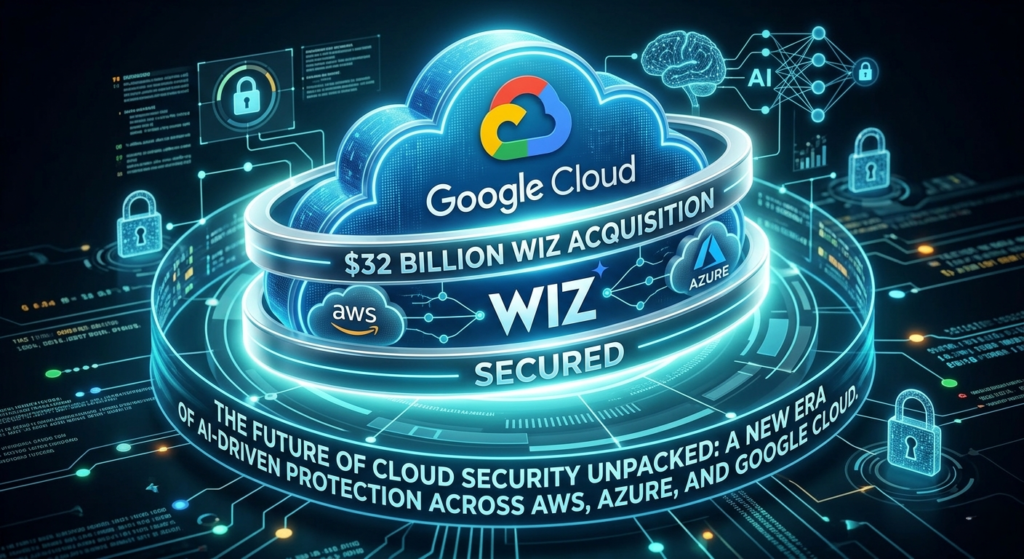
The tech world was set ablaze on March 11, 2026, when Google officially finalized its $32 billion acquisition of the cloud security powerhouse, Wiz. This isn’t just another corporate merger; it is the largest acquisition in Google’s history, dwarfing its 2012 purchase of Motorola Mobility. By writing a check for $32 billion, Google has signaled a seismic shift in how it views the “Cloud Wars.”
But what does this mean for the average enterprise, the cybersecurity market, and the future of AI-driven protection? In this deep dive, we unpack the Google’s $32 billion Wiz acquisition, exploring why Google paid a massive premium, how it reshapes multi-cloud security, and the actionable takeaways for business leaders navigating the modern digital landscape.
The Strategic Logic Behind Google’s $32 Billion Wiz Acquisition
The journey to this historic deal was anything but a straight line. In early 2024, Google parent Alphabet initially approached Wiz with a $23 billion offer. In a move that shocked many, Wiz CEO Assaf Rappaport walked away, betting that the company’s growth trajectory was worth far more.
His gamble paid off. By the time the deal closed in March 2026, Wiz had surpassed $1.2 billion in annual recurring revenue (ARR) with a staggering 70-90% year-over-year growth rate. Google returned to the table with a sweetened $32 billion all-cash offer—a 39% premium over Wiz’s last private valuation.
Key Milestones of the Acquisition
- March 2024: Initial $23B offer rejected by Wiz.
- March 2025: Definitive agreement reached at $32B.
- November 2025: U.S. Department of Justice clears antitrust hurdles.
- February 2026: European Union provides unconditional approval.
- March 11, 2026: Deal officially closes, integrating 2,700 Wiz employees into Google Cloud.
Impact of the Google’s $32 Billion Wiz Acquisition on the Multi-Cloud Market
To understand the price tag, you have to understand the product. Wiz isn’t just another antivirus or firewall. It is a Cloud-Native Application Protection Platform (CNAPP) that revolutionized security by being “agentless.” Instead of installing software on every individual server—a nightmare for large enterprises—Wiz scans cloud environments from the outside, providing a “single pane of glass” view of risks across AWS, Azure, and Google Cloud.
1. Strengthening the Multi-Cloud Strategy
Most modern enterprises don’t use just one cloud provider. They spread workloads across multiple platforms to avoid vendor lock-in. Historically, this created massive security blind spots. The Google’s $32 billion Wiz acquisition allows Google to become the “neutral” security layer for companies, even if those companies are primarily using Amazon or Microsoft.
2. AI-Powered Threat Detection
In the era of generative AI, hackers are moving faster than ever. Wiz uses AI to prioritize vulnerabilities, separating actual threats from “noise.” By integrating Wiz’s tech with Google’s Vertex AI and Mandiant’s threat intelligence, Google is building an autonomous security engine that doesn’t just find bugs but predicts attacks before they happen.
3. Boosting Enterprise Credibility
Google Cloud has long fought for second place against Microsoft Azure, with both trailing AWS. By acquiring a brand trusted by over half of the Fortune 100, Google gains immediate “street cred” with Chief Information Officers (CIOs) who were previously hesitant to migrate sensitive workloads to GCP.
Strategic Comparison: Google vs. The Competition
The Google’s $32 billion Wiz acquisition completely resets the competitive landscape. Below is a look at how Google now stacks up against its primary rivals in the cloud security space.
| Feature | Google (Post-Wiz) | Microsoft Azure | Amazon Web Services (AWS) |
| Primary Security Focus | Multi-Cloud CNAPP & AI | Ecosystem-wide Integration | Infrastructure & Network |
| Market Positioning | Comprehensive “Neutral” Layer | Best for Windows/Office Shops | Best for Scale & Compliance |
| Core Acquisition | Wiz ($32B), Mandiant ($5.4B) | RiskIQ, Mover.io | Fig Leaf, Wickr |
| Visibility | Full visibility across all clouds | Primarily Azure-centric | Primarily AWS-centric |
Actionable Insights for Business Leaders
If you are a CTO, CISO, or business owner, the Google’s $32 billion Wiz acquisition isn’t just a headline—it’s a roadmap for where technology is headed. Here are three ways to apply these insights to your own strategy:
Consolidate Your Security Stack
The era of “point solutions”—using 50 different tools for 50 different problems—is over. Google’s move proves that the market is shifting toward unified platforms. Auditing your current security tools and moving toward a platform that offers cross-cloud visibility can reduce “alert fatigue” and lower operational costs.
Prioritize “Security-as-Code”
Wiz’s success was built on moving security “left”—finding vulnerabilities during the development phase rather than after the software is live. Emulate the Google’s $32 billion Wiz acquisition logic by integrating security checks directly into your developer pipelines.
Prepare for AI-Driven Attacks
As Sundar Pichai noted during the acquisition announcement, attackers are now using AI to operate with unprecedented speed. If your security posture relies on manual human reviews, you are already behind. Invest in automated, AI-driven detection tools that can keep pace with machine-speed threats.
The “Loss-Making” Debate: Is It Worth It?
Skeptics point out that Google paid a price-to-sales (P/S) ratio of over 45x for Wiz. In a market where mature players like CrowdStrike trade at 15-25x, the Google’s $32 billion Wiz acquisition looks expensive on paper. However, analysts suggest that for Google, this wasn’t just a financial transaction; it was a survival tactic.
To compete in the enterprise cloud market, Google needed a “silver bullet.” Wiz provides that by offering a superior product that competitors’ customers (on AWS and Azure) are already paying for. This gives Google a “Trojan Horse” into rival ecosystems, providing data and visibility that was previously impossible to obtain.
Looking Ahead: The Post-Wiz Era
Wiz will continue to operate under its own brand within the Google Cloud ecosystem. This is a critical detail. Google has a history of allowing its most successful acquisitions—like YouTube and Android—to maintain their unique cultures while benefiting from Google’s massive scale.(Google’s $32 billion Wiz acquisition)
The Google’s $32 billion Wiz acquisition marks the end of the “wild west” phase of cloud security. We are now entering an era of consolidation where the big three—Google, Microsoft, and Amazon—will battle not just on the strength of their servers, but on the resilience of their security blankets.
Final Thoughts
The Google’s $32 billion Wiz acquisition is a watershed moment for the tech industry. It validates the critical importance of cloud-native security and underscores the massive premium companies are willing to pay for AI-integrated solutions. For Google, the $32 billion check is a bet on the next decade of computing. For everyone else, it’s a clear signal that in the cloud, security is no longer a feature—it is the product.
Frequently Asked Questions (FAQ)
Why did Google buy Wiz?
Google bought Wiz to dominate the multi-cloud security market and provide a unified, AI-powered platform that protects workloads across AWS, Azure, and Google Cloud.(Google’s $32 billion Wiz acquisition)
How much did Google pay for Wiz?
Google paid $32 billion in an all-cash deal, making it the largest acquisition in the company’s history.
Will Wiz still work on AWS and Azure?
Yes. As part of the Google’s $32 billion Wiz acquisition agreement, Wiz will remain cloud-agnostic and continue to support all major cloud providers.
Who were the big winners in the deal?
Major investors like Index Ventures and Sequoia Capital saw multi-billion dollar returns, with some early investors seeing over 200x on their initial capital.(Google’s $32 billion Wiz acquisition)