The enterprise software landscape just experienced a seismic shift. For years, SaaS (Software-as-a-Service) giants like Salesforce, Workday, and ServiceNow have reigned supreme, charging “per seat” for human access to their tools. But on February 5, 2026, OpenAI fundamentally rewrote the rules with the launch of OpenAI Frontier.
OpenAI Frontier isn’t just another version of ChatGPT. It is a purpose-built enterprise AI agents platform designed to act as a “Semantic Operating System” for the modern business. By allowing companies to build, deploy, and govern autonomous agents that can navigate across siloed corporate systems, OpenAI is moving from being a mere model provider to becoming the central nervous system of enterprise operations.
If you’re wondering how enterprise AI agents will change your business—and why SaaS stocks took a double-digit dive following this announcement—you’re in the right place. Here is everything you need to know about the frontier of autonomous work.
What is OpenAI Frontier?
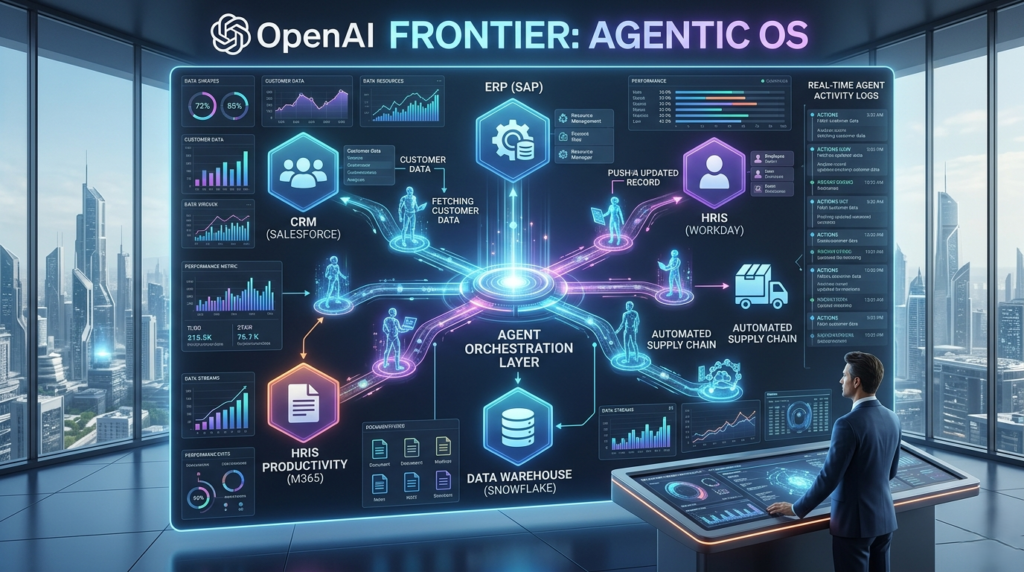
At its core, OpenAI Frontier is an orchestration layer. While ChatGPT Enterprise provides a “chat companion” for individual employees, Frontier provides a “digital workforce.”
These enterprise AI agents are autonomous entities that don’t just talk; they act. They can log into your CRM, pull data from a Snowflake warehouse, analyze a contract, and then update a record in Workday—all without a human clicking a single button.
The Four Pillars of the Frontier Architecture
To make enterprise AI agents reliable enough for Fortune 500 companies, OpenAI built Frontier on four structural pillars:
- Semantic Layer: This acts as a translator. Instead of building messy custom integrations for every tool, every data source (Salesforce, SAP, internal databases) connects once to this layer. This gives agents a unified understanding of company data.
- Agent Identity & Access Management (Agent IAM): Every agent is treated like a digital employee. They have their own IDs, specific permissions (least privilege principle), and a full audit trail of every action they take.
- Sandboxed Execution Environment: Agents operate in isolated “containers.” If an agent makes a mistake or runs into a bug, it cannot crash your broader systems.
- Evaluation & Optimization: Built-in feedback loops allow human managers to track “task completion rates” and provide feedback, ensuring enterprise AI agents get smarter over time.
Why OpenAI Frontier is a “SaaS Killer”
The traditional SaaS model is built on “seats”—you pay for the number of humans using the software. However, enterprise AI agents change the math. When one autonomous agent can do the data entry, lead qualification, and forecasting previously handled by twenty junior reps, the need for twenty software licenses disappears.
Comparison: Traditional SaaS vs. OpenAI Frontier
| Feature | Traditional SaaS Model | OpenAI Frontier (Agentic) |
| Pricing Model | Per-seat (User-based) | Outcome-based (Task-based) |
| Integration | Siloed apps with limited APIs | Unified Semantic Layer |
| Workflow | Human-led, manual input | Autonomous, cross-platform |
| Governance | User-level permissions | Agent-specific IAM & Audit Logs |
| Primary Value | Providing a UI for data | Executing end-to-end work |
By focusing on enterprise AI agents, OpenAI is shifting the industry toward Outcome-Based Computing. Companies are no longer paying for “access” to a tool; they are paying for the “result” of a completed workflow.
Actionable Insights: How to Prepare Your Organization
Transitioning to a workforce of enterprise AI agents isn’t as simple as flipping a switch. It requires a fundamental shift in how you manage digital labor.
1. Identify “Action-Heavy” Workflows
Don’t use agents for simple Q&A. Look for processes that involve “Alt-Tabbing” between multiple systems. Use cases like Revenue Operations, Customer Support escalation, and Procurement are prime candidates for enterprise AI agents because they involve moving data across silos.
2. Audit Your Data Governance
Before deploying enterprise AI agents, your internal data must be organized. Frontier’s Semantic Layer is powerful, but it relies on “ground truth.” If your internal documentation is messy, your agents will be confidently wrong.
3. Leverage the “Frontier Alliances”
OpenAI has partnered with the “Big Four” consulting firms—McKinsey, BCG, Accenture, and Capgemini. These firms are deploying Forward Deployed Engineers (FDEs) to help companies move from AI pilots to full-scale production. If you are a large enterprise, these partnerships are your roadmap to implementation.
The Strategic Shift: From Chatbots to Coworkers
The most significant takeaway from the Frontier launch is the shift in terminology. OpenAI now refers to these entities as “AI Coworkers.”
Unlike a chatbot that waits for a prompt, enterprise AI agents can be persistent. They can monitor a shared inbox 24/7, notice a pattern in customer complaints, and autonomously draft a briefing for the product team. This level of proactivity is what differentiates “Frontier” from the AI tools of 2024.
“The next phase of enterprise AI will be shaped by a shift from asking models for outputs to delegating complex, multi-step workflows.” — OpenAI State of Enterprise AI Report
Security and Trust in the Agentic Age
Security is the biggest barrier to adopting enterprise AI agents. To solve this, Frontier includes “Zero-Trust” models where agents are only granted the specific permissions needed for a single task.
- Auditable Actions: Every click or data retrieval an agent makes is logged.
- Human-in-the-Loop (HITL): For high-stakes decisions (like approving a $50,000 invoice), Frontier allows for mandatory human sign-off before the agent executes.
- Compliance Standards: Frontier is built to meet SOC 2 Type II, ISO/IEC 27001, and GDPR standards, making it viable for highly regulated industries like banking and healthcare.
Conclusion: The Era of Digital Labor
The launch of OpenAI Frontier marks the end of the “AI as a toy” era and the beginning of the “AI as infrastructure” era. By providing a platform to manage enterprise AI agents with the same rigor we manage human employees, OpenAI is positioning itself as the central platform for 21st-century business.
For IT leaders and CIOs, the message is clear: the “build vs. buy” debate has shifted. You are no longer just buying software; you are hiring digital labor. Organizations that successfully integrate enterprise AI agents into their core infrastructure will gain a compounding advantage in speed, cost, and operational intelligence.