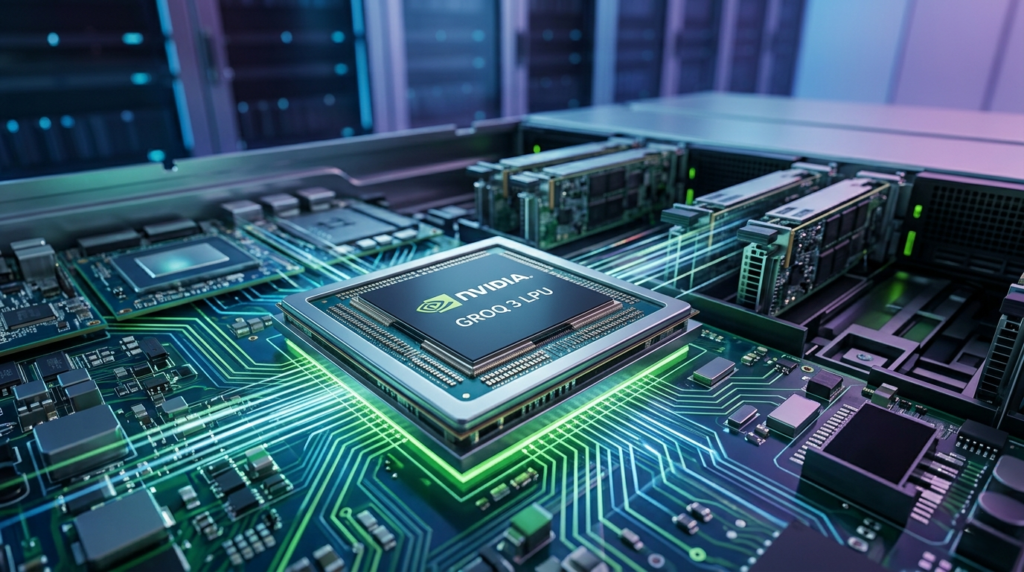
The artificial intelligence landscape just shifted on its axis at GTC 2026. While the world was busy eyeing the sheer brute force of the new Rubin GPU architecture, NVIDIA CEO Jensen Huang dropped a bombshell that specifically targets the most frustrating part of using AI: the wait time. By integrating the revolutionary Groq 3 LPU into its data center ecosystem, NVIDIA is promising to slash latency and deliver a level of AI chatbot performance that makes today’s systems look like dial-up modems.
If you’ve ever sat watching a chatbot generate text word-by-word, you know the bottleneck isn’t just about raw power—it’s about how fast that power can be applied to language. This is where the Language Processing Unit (LPU) enters the fray.
In this deep dive, we’ll explore how this new hardware partnership will redefine AI chatbot performance, why the Groq 3 LPU is the missing piece of the inference puzzle, and what it means for the future of “Agentic AI.”
The Inference Inflection: Why AI Chatbot Performance Matters Now
For years, the industry’s primary focus was training—building the massive models like GPT-4 or Claude 3. However, Jensen Huang declared at GTC 2026 that the “inference inflection has arrived.” Training a model is a one-time event; inference (running the model for users) happens trillions of times a day.
When we talk about AI chatbot performance, we are usually measuring “tokens per second.” A token is roughly equivalent to a word or a part of a word. To achieve a natural, human-like flow, an AI needs to generate tokens faster than we can read them. But as models grow to trillions of parameters, keeping that speed up requires a fundamental change in hardware architecture.
The Problem with GPUs in the Age of Agents
While NVIDIA’s GPUs are the undisputed kings of AI, they were originally designed for parallel processing of graphics. When it comes to the sequential nature of language—where one word leads to the next—traditional GPU architectures can hit memory bandwidth bottlenecks. This is exactly where the Groq 3 LPU steps in to optimize AI chatbot performance.
What is the Groq 3 LPU?
The Groq 3 LPU (Language Processing Unit) is the first major fruit of NVIDIA’s $20 billion asset deal with Groq. Unlike a GPU, which manages vast amounts of data across various cores, the LPU is a “software-defined assembly line” for AI workloads.
Key Features of the Groq 3 LPU:
- SRAM-Packed Architecture: By moving data directly between on-chip memory modules, the LPU avoids the latency of external memory.
- Ultra-High Bandwidth: The Groq 3 offers a staggering 40 petabytes per second of memory bandwidth.
- Dedicated to Inference: It doesn’t try to be a “jack of all trades.” It is laser-focused on running models with maximum speed.
- Integration with Vera Rubin: The LPU isn’t replacing the GPU; it’s joining it. In the new Vera Rubin supercomputer, the GPU handles the heavy data computation while the LPU manages the ultra-fast AI responses.
This division of labor is the key to the massive jump in AI chatbot performance we are seeing this year.
By the Numbers: Performance Gains at GTC 2026
NVIDIA didn’t just announce a chip; they announced a new standard for throughput. During the keynote, the numbers shared for the Vera Rubin platform—when bolstered by the Groq 3 LPU—were nothing short of astronomical.
| Feature | Blackwell (Previous Gen) | Vera Rubin + Groq 3 LPU |
| Inference Throughput | 1x Baseline | 35x Improvement |
| Cost Per Token | Standard | 1/10th the Expense |
| Energy Efficiency | High | 2x Better (LPX Rack) |
| Memory Bandwidth | HBM3e | 40 Petabytes/s (on-chip) |
By reducing the expense per token to one-tenth of previous generations, NVIDIA isn’t just making chatbots faster; they are making them significantly cheaper for enterprises to run at scale. This economic shift is what will finally move AI from a “cool demo” to a ubiquitous “personal assistant” in every app.
The Rise of the AI Agent: Beyond the Chatbot
One of the most exciting takeaways from GTC 2026 is that this boost in AI chatbot performance is designed to support “Agentic AI.”
An AI agent is more than just a chatbot that answers questions. It is a proactive system that can plan, execute workflows, and use tools. For an agent to be effective—for example, an AI that manages your entire calendar, researches a trip, and books the flights—it needs to process information in real-time without lagging.
How the Groq 3 LPU Powers Agents:
- Low Latency: For an agent to “think” through a multi-step problem, it needs to generate internal reasoning tokens instantly.
- Tokens-per-Watt Efficiency: Running “always-on” agents is power-intensive. The LPU’s efficiency makes it sustainable for companies to deploy millions of proactive assistants.
- Hybrid Workloads: With the new NemoClaw stack, developers can use the Groq 3 LPX racks to route simpler tasks to local LPUs while sending complex reasoning to the cloud, ensuring seamless AI chatbot performance regardless of the task’s complexity.
Actionable Insights: How Businesses Can Prepare
The shift to LPU-accelerated hardware means that the speed of AI is no longer a luxury—it’s the new baseline. If you are a developer or a business leader, here is how you should react to the GTC 2026 announcements:
- Optimize for Tokens, Not Just Accuracy: With the cost per token dropping 10x, you can afford to have your models “think out loud” (Chain of Thought) to improve accuracy without blowing your budget.
- Explore NemoClaw: Start experimenting with NVIDIA’s open-source NemoClaw stack to build autonomous agents that can take advantage of the new LPU architecture.
- Prepare for “Real-Time” Interfaces: As AI chatbot performance reaches the level of instantaneous response, user interfaces will shift. We will move away from “loading spinners” toward persistent, voice-first, and proactive AI interactions.
The Road Ahead: $1 Trillion and Beyond
Jensen Huang’s vision is clear: the demand for AI infrastructure is currently outstripping supply by a factor of a million. With $500 billion in orders already on the books, NVIDIA is betting the future of the company on the integration of the Groq 3 LPU and the Rubin architecture.
We are entering an era where AI chatbot performance will be measured not just by how “smart” a bot is, but by how “fast” it can act on our behalf. The Groq 3 LPU isn’t just an upgrade; it is the engine that will turn static chatbots into dynamic, living agents.
Whether you are a casual user of ChatGPT or an enterprise architect building the next great AI factory, the hardware unveiled at GTC 2026 ensures that the “wait time” for the future of AI is officially over.