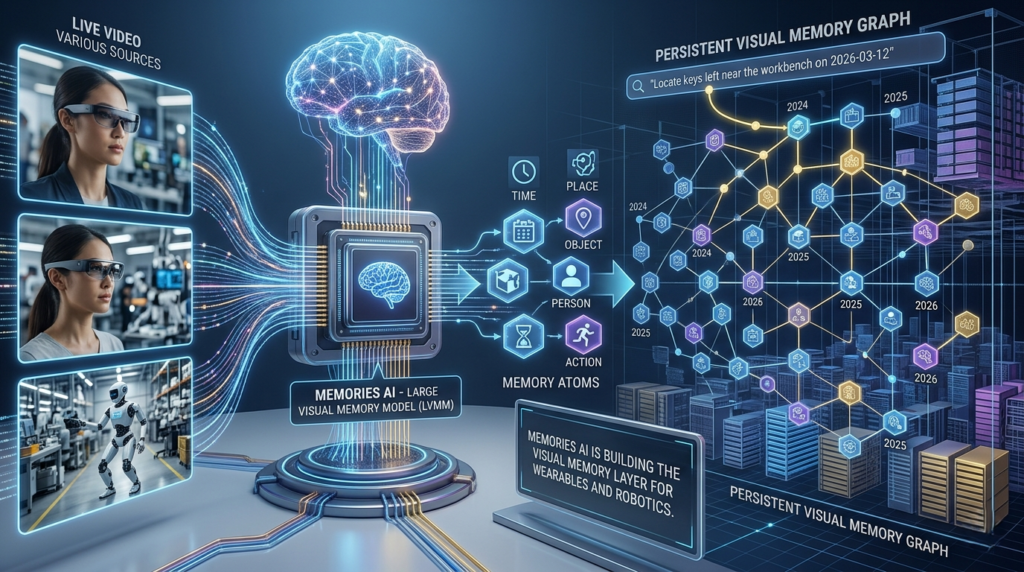
Memories AI is building the visual memory layer for wearables and robotics to solve the “amnesia” problem that has long plagued artificial intelligence. While traditional AI models process video frame-by-frame—effectively “forgetting” what they saw just moments ago—this new infrastructure allows machines to retain, search, and recall months of visual data.
Unveiled at NVIDIA GTC 2026, the Memories AI visual memory layer represents a fundamental shift from reactive computer vision to persistent, reflective intelligence. By utilizing a Large Visual Memory Model (LVMM), this technology transforms raw, unstructured video into a searchable database of “memory atoms.”Memories AI is building the visual memory layer
Imagine a world where your smart glasses don’t just record video, but actually remember where you left your car keys three days ago. Or envision a humanoid robot that doesn’t just follow a programmed path but learns the nuances of a busy warehouse by recalling every past interaction. This is no longer science fiction. At NVIDIA GTC 2026, a groundbreaking startup called Memories AI unveiled its Large Visual Memory Model (LVMM), a technology designed to serve as the “visual memory layer” for the next generation of physical AI.
For years, the “amnesia” of artificial intelligence has been the greatest bottleneck in robotics and wearable tech. While Large Language Models (LLMs) have mastered text, they struggle to retain visual context beyond a few hours of footage. Memories AI visual memory layer for wearables and robotics to bridge this gap, transforming raw video into a persistent, searchable database of experiences.
The Evolutionary Shift: Memories AI Visual Memory Layer in Action
Most current AI models are “stateless.” They see a frame, process it, and move on. Even advanced multimodal models like GPT-4o or Gemini start to lose context once they are fed more than an hour or two of video. This is the “context window” problem.(Memories AI visual memory layer)
A visual memory layer functions differently. Instead of trying to hold an entire video file in active memory, it compresses visual inputs into “memory atoms”—compact embeddings that capture the who, what, when, and where of a scene. These atoms are then indexed into a structured graph, allowing an AI agent to “search” its past much like a human recalls a memory.(Memories AI visual memory layer)
The LVMM Advantage
The Large Visual Memory Model (LVMM) developed by Memories AI is the industry’s first architecture built specifically for continuous visual recall. According to founder Dr. Shawn Shen, a former Meta Reality Labs researcher, the goal is to give machines the ability to connect dots over weeks, months, or even years.
| Feature | Traditional Vision Models | Memories AI (LVMM) |
| Context Limit | 1–3 hours of video | 10 million+ hours |
| Processing Style | Frame-by-frame / Reactive | Persistent / Reflective |
| Searchability | Manual scrubbing | Natural language queries |
| Application | Object detection | Episodic memory & reasoning |
Why Wearables and Robotics Need “Memory”
The hardware is ready, but the brain is still catching up. Companies like Meta, Apple, and Tesla are producing incredible physical devices, but without a visual memory layer, these devices remain tools rather than assistants.
1. Smart Glasses & Wearables
For a wearable to be truly helpful, it needs to understand your life. If you ask your glasses, “Who was that person I met at the networking event last Tuesday?” the device needs to retrieve that specific visual memory. Memories AI enables:(Memories AI visual memory layer)
- Object Tracking: Locating misplaced items (keys, wallets, tools).
- Actionable Recall: Summarizing a week’s worth of meetings or interviews.
- Contextual Assistance: Recognizing patterns in your daily routine to offer proactive suggestions.
2. Humanoid & Industrial Robotics
In robotics, memory is the difference between a machine that executes tasks and one that learns. A warehouse robot equipped with a visual memory layer doesn’t just see a box; it remembers that the box was placed there by a specific operator two hours ago.(Memories AI visual memory layer)
- Fewer Resets: Robots can recover from interruptions by “remembering” where they left off.
- Scene Familiarity: Building a deep understanding of a workspace (e.g., “This shelf is usually empty on Fridays”).
- Explainable AI: A robot can explain its actions based on past visual evidence, such as, “I moved the package because the primary loading dock was obstructed.”
The Technical Backbone: How It Works
Memories AI is building the visual memory layer for wearables and robotics using a multi-layered infrastructure that sits between the camera sensor and the AI application. This approach ensures that the heavy computational lifting happens during ingestion, making the retrieval process near-instant.(Memories AI visual memory layer)
The Ingestion Pipeline
- Compression: The system strips away “noise” (redundant frames) while retaining semantic meaning.
- Structuring: Pixels are turned into “memory cards” containing timestamps, location data, and extracted entities (people, text, objects).
- Indexing: These cards are linked on a timeline, creating a “hot” (recent) and “cold” (long-term) memory storage system.
- Retrieval: A Query Model translates a user’s natural language into vectors to fetch the most relevant memory atom.
Privacy: The Non-Negotiable Layer
Building a system that remembers everything we see raises significant privacy concerns. Memories AI has addressed this by making “on-device processing” a core part of its architecture. By processing and indexing video locally, sensitive data never has to leave the wearable or the robot.(Memories AI visual memory layer)
Key Privacy Controls include:
- Redaction Zones: Automatically blurring faces or computer screens.
- “Do Not Record” Geofencing: Disabling memory capture in sensitive locations.
- Granular Deletion: Allowing users to “forget” specific timeframes or events with a single command.
Conclusion: The Missing Piece of the AI Stack
We are entering the era of “Embodied AI,” where intelligence is no longer confined to a chat box. As we move toward a world of autonomous agents, the need for long-term, contextual understanding becomes critical. Memories AI is building the visual memory layer for wearables and robotics that will finally allow these machines to interact with the world the same way we do—by learning from the past to navigate the future.(Memories AI visual memory layer)
By turning “amnesic” hardware into “reflective” assistants, Memories AI is setting the standard for the next generation of AI infrastructure. Whether it’s a security team searching months of footage in seconds or a home robot that truly knows its way around, the visual memory layer is the bridge between simple perception and true understanding.(Memories AI visual memory layer)