In the fast-paced world of software engineering, internal tools are often the unsung heroes of productivity. However, they are also frequently the victims of deprioritization. How many times has your team relied on a messy spreadsheet or a brittle local script because building a proper dashboard was “too small” for a dedicated sprint?
At QCon London 2026, Spotify engineers Stuart Clark and Mike Lewis unveiled a game-changing solution to this friction: Spotify Portal Studio. By combining the power of an internal developer platform with AI-assisted workflows, Spotify has managed to shrink the development lifecycle of internal tools from months to mere days.
This shift isn’t just about writing code faster; it’s about a fundamental change in how organizations approach platform engineering. In this deep dive, we’ll explore how Spotify Portal Studio works, the role of AI in “prompt-to-production” workflows, and how you can apply these insights to your own engineering culture.
The Crisis of the “Small” Internal Tool
Every engineering organization suffers from the “shadow IT” of small utilities. These are the lightweight dashboards, automation scripts, and infrastructure interfaces that teams need to function. Because these tools don’t qualify as “major products,” they often fall through the cracks.
The result?
- Fragmentation: Each team builds its own siloed solution.
- Maintenance Debt: Tools are owned by individuals, not teams, leading to “orphan code” when someone leaves.
- Security Risks: Ad-hoc scripts often bypass standard security and audit protocols.
Spotify Portal Studio was designed specifically to bridge this gap, providing a standardized environment where these “small” tools can be built, governed, and shared without the traditional overhead.
What is Spotify Portal Studio?
At its core, Spotify Portal Studio is an evolution of Spotify’s famous internal developer portal (built on the open-source Backstage framework). While the portal serves as the frontend for developers to discover services and documentation, the “Studio” serves as the integrated development environment for the portal itself.
Key Features of Portal Studio:
- Local Development & Preview: Engineers can build portal plugins locally and see exactly how they will appear and behave within the live Spotify ecosystem.
- Modular Plugin Architecture: Leveraging Backstage’s modularity, it allows for the creation of isolated features that don’t interfere with the core platform.
- Governance Integration: Every tool built in the studio automatically inherits Spotify’s security, permissions, and ownership metadata.
From Prompt to Production: The AI Advantage
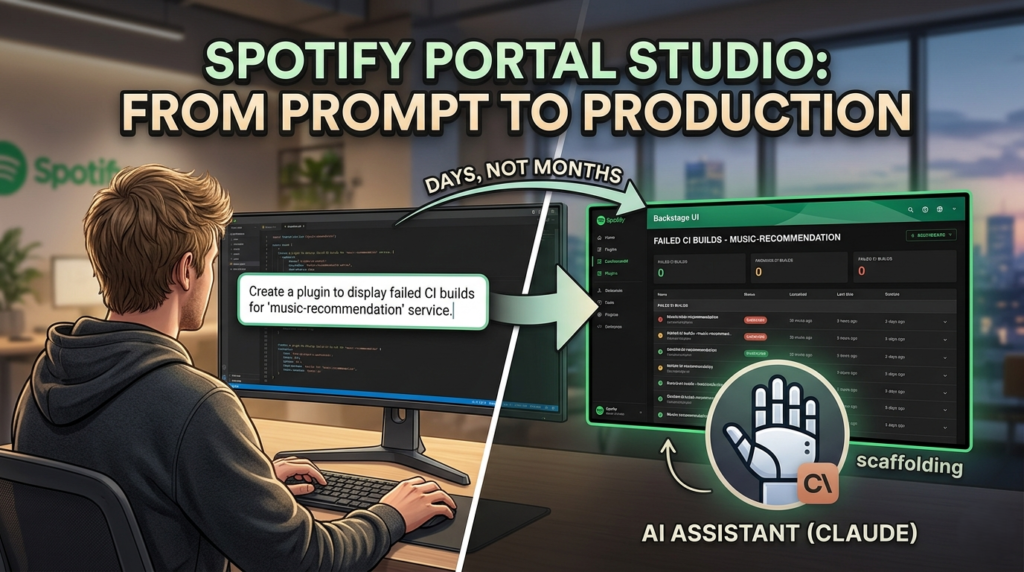
The most striking revelation from the QCon presentation was the integration of AI—specifically Anthropic’s Claude—into the Spotify Portal Studio workflow. This isn’t just “copilot” style autocomplete; it is a “prompt-to-plugin” pipeline.
The AI-Assisted Workflow
Spotify demonstrated a live workflow that follows these three distinct steps:
- Natural Language Prompting: A developer describes the tool they need (e.g., “Create a plugin that displays the last five failed CI builds for a specific service”).
- Scaffolding & Code Generation: The AI generates the boilerplate, the frontend components, and the backend API connections required for the plugin.
- Iteration in Spotify Portal Studio: The developer uses the Studio to refine the generated code, ensuring it meets specific internal requirements before hitting “publish.”
| Traditional Development | AI-Assisted Portal Studio |
| Timeframe: Weeks to Months | Timeframe: Hours to Days |
| Effort: High boilerplate overhead | Effort: Low (AI handles scaffolding) |
| Risk: High (Lack of standardization) | Risk: Low (Standardized templates) |
| Maintenance: Individual-dependent | Maintenance: Platform-integrated |
Why Platform Engineering Needs AI
The marriage of AI and platform engineering is the secret sauce here. AI is excellent at generating code, but code without context is a liability. By housing AI-generated code within Spotify Portal Studio, Spotify provides the “guardrails” that AI lacks.
Spotify Portal Studio ensures that the AI-generated code follows:
- Approved Integrations: The tool can only talk to sanctioned data sources.
- Consistent UI/UX: Every tool looks and feels like a part of the Spotify ecosystem.
- Auditability: Every change is tracked, and ownership is clearly defined from the moment of creation.
Actionable Insights for Engineering Leaders
If you are looking to replicate the success of Spotify Portal Studio in your organization, consider these strategic steps:
1. Centralize Your Portal First
You cannot have a “Studio” without a “Portal.” If you aren’t already using a developer portal like Backstage, that is your first step. Centralization is the prerequisite for automation.
2. Standardize Your Scaffolding
AI works best when it has templates to follow. Create “Golden Paths” for your internal tools so that when an AI model generates code, it is populating a structure that your platform already understands.
3. Lower the Barrier to Entry
The goal of Spotify Portal Studio is to make building a tool easier than making a spreadsheet. Focus on reducing the number of commands a developer needs to run to see their “Hello World” plugin live in a preview environment.
4. Implement Governance as Code
Don’t make security a manual review at the end of the process. Build your permission sets and audit requirements directly into the templates that Spotify Portal Studio uses.
The Future of Developer Productivity
The introduction of Spotify Portal Studio marks a shift from software engineering to software orchestration. As AI takes over the “heavy lifting” of syntax and boilerplate, the role of the developer shifts toward design, logic, and integration.
By reducing the friction of internal tool creation, Spotify is ensuring that their engineers spend less time fighting their own infrastructure and more time delivering value to their millions of users. Spotify Portal Studio is a testament to the idea that when you empower developers with the right tools, “innovation at scale” becomes more than just a buzzword—it becomes a daily reality.
Conclusion: Embracing the New Standard
The “Prompt to Production” model isn’t just for Spotify; it’s a blueprint for any modern engineering org. Spotify Portal Studio proves that when you combine a robust platform with the speed of AI, you don’t just get faster tools—you get a more cohesive, secure, and happy engineering culture.
Are you ready to stop building tools in silos and start leveraging a studio-based approach? The era of the “days-not-months” development cycle is here, and Spotify Portal Studio is leading the charge.