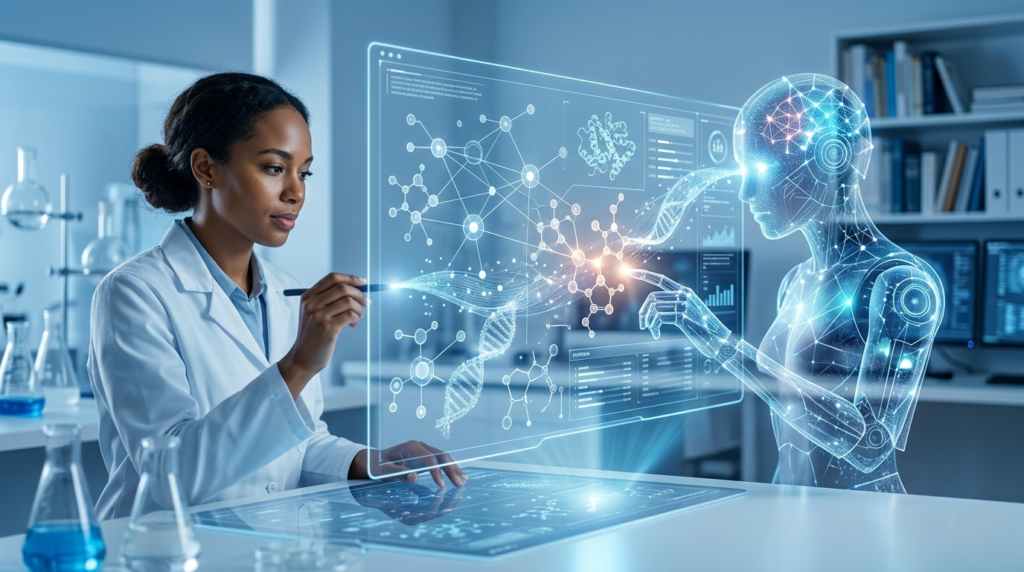
For centuries, the “Eureka!” moment has been the exclusive domain of the human mind—a flash of brilliance born from years of study, trial, and error. But we are entering a new epoch. In a groundbreaking shift documented by Nature Medicine, the laboratory is no longer just a place for humans with pipettes; it is becoming a collaborative space for the AI co-scientist.
This isn’t just about automation or data processing. We have crossed a threshold into what experts call the “fourth generation of AI“—knowledge-generating systems. These tools aren’t just summarizing existing papers; they are proposing novel hypotheses, designing experiments, and acting as a digital “Oracle of Delphi” for researchers across the globe.
In this deep dive, we explore how the AI co-scientist is transforming the scientific landscape, the technology behind these digital researchers, and what this means for the future of human-led discovery.
What is an AI Co-Scientist?
At its core, an AI co-scientist is a sophisticated Large Language Model (LLM) framework specifically engineered to participate in the scientific method. Unlike a standard chatbot, an AI co-scientist is designed to uncover original knowledge and formulate demonstrably novel research proposals.
Imagine a virtual lab meeting that never ends. One agent proposes an idea, another critiques it based on existing literature, and a third refines the protocol to ensure it is feasible. This iterative “multi-agent” approach allows the AI co-scientist to mimic the collaborative spirit of a high-level research team, but at a speed and scale that humans simply cannot match.
The Four Generations of AI in Science
To understand the impact of the AI co-scientist, we must look at the evolution of artificial intelligence in research:
- First Generation (Calculation): Using computers to perform complex mathematical calculations and statistical analysis.
- Second Generation (Pattern Recognition): Machine learning models identifying patterns in massive datasets, such as genomic sequences.
- Third Generation (Prediction): AI systems like AlphaFold that predict the structures of proteins based on amino acid sequences.
- Fourth Generation (Knowledge Generation): The era of the AI co-scientist, where the system generates the ideas and hypotheses themselves.
Gary Peltz, a mouse geneticist at Stanford University, notes that we have officially moved into this fourth generation. By leveraging an AI co-scientist, researchers can now explore “latent” knowledge—connections between disparate studies that no human could reasonably link on their own.
How the AI Co-Scientist Works: The Google “Lab Meeting” Model
One of the most prominent examples of this technology comes from Google’s research division. Their AI co-scientist operates through a structured workflow that mirrors a real-world scientific environment.
1. Hypothesis Generation
The process begins with a prompt—a specific research objective provided by a human scientist. The AI co-scientist then scans millions of academic papers to identify gaps in current knowledge and proposes several potential hypotheses.
2. Adversarial Refinement
This is where the magic happens. The system doesn’t just pick the first “good” idea. It uses an ensemble of models to act as “peer reviewers.” These models challenge the hypothesis, look for logical fallacies, and ensure the proposal doesn’t violate the laws of physics or biology.
3. Protocol Design
Once a hypothesis is validated, the AI co-scientist drafts a detailed experimental protocol. This includes everything from the necessary reagents to the specific steps required to prove or disprove the theory.
Comparison: Human Researcher vs. AI Co-Scientist
| Feature | Human Researcher | AI Co-Scientist |
| Data Processing | Limited to personal reading and memory | Access to nearly all published literature |
| Bias | Prone to cognitive bias and “favourite” theories | Objective analysis based on statistical evidence |
| Speed | Months/Years to develop a novel hypothesis | Seconds to Minutes |
| Creativity | Intuitive, paradigm-shifting leaps | Combinatorial novelty and logical extension |
| Execution | Hands-on laboratory work | Simulation and protocol generation |
Actionable Insights: How Researchers Can Prepare
The arrival of the AI co-scientist doesn’t mean humans are becoming obsolete; rather, our roles are shifting. To stay relevant in this new era, scientists and institutions should focus on the following:
- Mastering “Prompt Engineering” for Science: The quality of the output from an AI co-scientist is only as good as the guidance it receives. Scientists must learn how to define research objectives in a way the AI can effectively process.
- Focus on Verification: While the AI can generate ideas, the human must remain the ultimate arbiter of truth. The role of the scientist will shift toward “Chief Validator,” ensuring that AI-generated hypotheses are ethically sound and practically viable.
- Interdisciplinary Literacy: Because the AI co-scientist can bridge different fields (e.g., biology and materials science), human researchers need to be broader in their understanding to oversee these cross-disciplinary discoveries.
Ethical Challenges and the “Oracle” Problem
While the potential of the AI co-scientist is immense, it brings significant challenges. Gary Peltz’s comparison to the “Oracle of Delphi” is telling. Oracles provide answers, but they don’t always explain their reasoning.
If an AI co-scientist proposes a cure for a rare disease, but the logic behind the molecular interaction is too complex for a human to follow, do we trust it? This “black box” problem is a major hurdle. Furthermore, there are concerns regarding:
- Intellectual Property: Who owns a patent generated by an AI co-scientist?
- Hallucinations: LLMs are known to “hallucinate” or make up facts. In science, a hallucination isn’t just a mistake; it’s a potential disaster.
- Academic Integrity: Will the ease of generating papers lead to a flood of low-quality or AI-generated “junk” science?
The Future: A Symbiotic Relationship
The most likely future is one of symbiosis. The AI co-scientist will handle the “brute force” of ideation and literature review, while humans provide the creative spark, ethical oversight, and physical execution of experiments.
By offloading the cognitive load of hypothesis generation to an AI co-scientist, we may see a dramatic acceleration in breakthroughs for climate change, oncology, and sustainable energy. We are no longer searching for a needle in a haystack; we have a machine that can reorganize the hay to make the needle visible.
The era of the AI co-scientist is not a threat to the human spirit of discovery—it is the ultimate tool to amplify it.