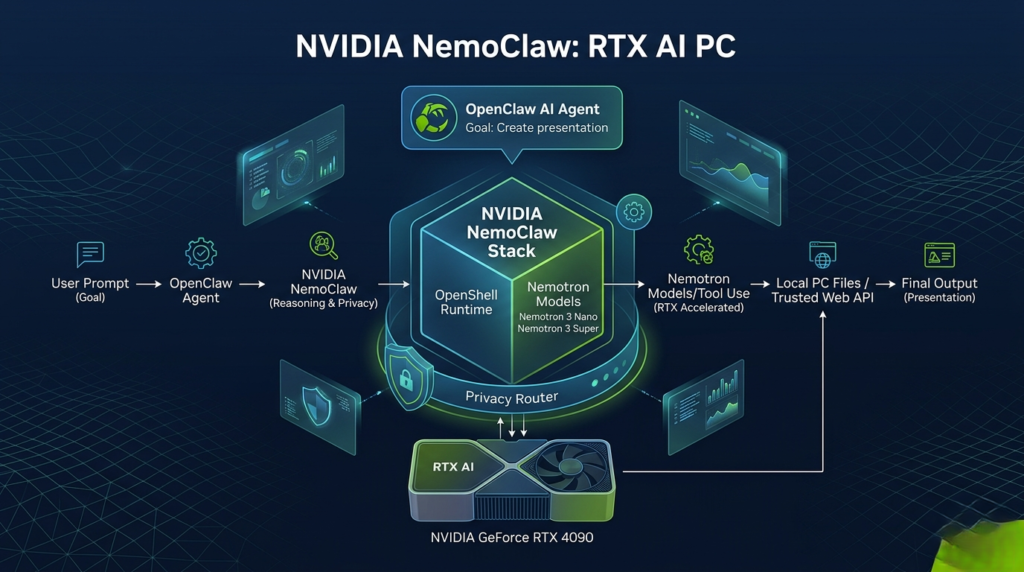
The landscape of artificial intelligence is shifting from models that simply “chat” to agents that “do.” At GTC 2026, NVIDIA CEO Jensen Huang declared that we have reached the “inference inflection point,” where the primary focus of AI has moved from training massive models to deploying autonomous digital workers. Central to this revolution is the introduction of NVIDIA NemoClaw, a production-grade software stack designed to supercharge the OpenClaw ecosystem.
Whether you are a developer looking to build “always-on” assistants or an enterprise seeking to automate complex multi-step workflows, understanding NVIDIA NemoClaw is essential. This guide breaks down the core value of this release, the technical architecture behind it, and how you can start building secure, localized AI agents today.
What is NVIDIA NemoClaw?
NVIDIA NemoClaw is an open-source development stack that simplifies the deployment and management of AI agents—specifically those built on the popular OpenClaw platform. While OpenClaw acts as the “operating system” for agentic computing, NVIDIA NemoClaw provides the infrastructure layer required to run these agents safely, efficiently, and at scale.
With a single command, developers can now stand up a secure environment that integrates NVIDIA’s optimized models, such as the Nemotron-3 family, with robust privacy guardrails. This stack is designed to run everywhere—from high-end GeForce RTX AI PCs and laptops to enterprise-grade DGX Spark and DGX Station supercomputers.
The Core Components of the NemoClaw Stack
To understand why NVIDIA NemoClaw is a game-changer, we must look at the three pillars that support it:
- NVIDIA OpenShell Runtime: This is the secure execution environment (or “sandbox”) where the agent lives. It prevents the agent from accessing unauthorized files or making unapproved network requests.
- NVIDIA Nemotron Models: These are specialized, open-source models optimized for reasoning and tool use. The family includes the compact Nemotron 3 Nano 4B for local tasks and the massive Nemotron 3 Super 120B for complex enterprise logic.
- The Privacy Router: A sophisticated orchestration layer that decides whether a task can be handled locally (for maximum privacy) or needs to be routed to a high-performance cloud model.
Why Developers are Switching to NVIDIA NemoClaw
The primary challenge with autonomous AI agents is trust. If you give an agent the power to manage your email, schedule meetings, or access your local files, you need to know it won’t “hallucinate” its way into a security breach. NVIDIA NemoClaw addresses this by shifting the focus from agent capability to agent control.
Key Benefits of Using NVIDIA NemoClaw
- Single-Command Setup: Developers can install the entire stack, including the runtime and models, with one simple CLI command.
- Enhanced Security: Through OpenShell, agents are air-gapped from sensitive parts of your system, ensuring they only touch what you explicitly allow.
- Zero Token Costs: By running NVIDIA NemoClaw locally on RTX hardware, developers can iterate on agents without incurring the massive API fees associated with cloud-only providers.
- Hybrid Flexibility: Use the privacy router to keep sensitive data on-premises while leveraging frontier models for heavy-duty reasoning.
Comparing OpenClaw vs. NVIDIA NemoClaw
It is helpful to think of OpenClaw as the engine and NVIDIA NemoClaw as the complete, armored vehicle built around it.
| Feature | OpenClaw (Standalone) | NVIDIA NemoClaw Stack |
| Primary Function | Agent logic & task execution | Production-grade security & optimization |
| Runtime | Standard Python/Node environments | NVIDIA OpenShell (Sandboxed) |
| Model Support | Any (requires manual config) | Native support for Nemotron & RTX optimization |
| Privacy | User-managed | Built-in Privacy Router & Guardrails |
| Hardware Target | General Purpose | RTX PCs, DGX Spark, & Cloud Clusters |
How to Get Started with NVIDIA NemoClaw
NVIDIA has made the barrier to entry lower than ever. If you have an NVIDIA GPU, you can begin building “claws” (the term for individual agents) in minutes.
Step 1: Prepare Your Infrastructure
To run NVIDIA NemoClaw effectively, you need hardware capable of handling local inference. While it supports cloud routing, the true power lies in local execution.
- For Individuals: A GeForce RTX 40 or 50 Series GPU with at least 12GB of VRAM.
- For Teams: The DGX Spark is a “desktop data center” that allows you to cluster up to four systems for unified agent training.
Step 2: Install the Stack
The installation is handled through the NVIDIA Agent Toolkit. Open your terminal and run:
nemoclaw setup
This command resolves the necessary blueprints, verifies security digests, and stands up the OpenShell gateway on your local machine.
Step 3: Deploy Your First Agent
Once set up, you can launch a pre-configured agent using the command:
openclaw nemoclaw launch --profile local
This will pull down the Nemotron 3 Nano model and start an interactive session where you can begin granting the agent specific tools, such as file management or web search capabilities.
Actionable Insights: The Strategy for 2026
At GTC 2026, the message was clear: “Every company and nation needs an AI agent strategy.” Here is how you can stay ahead of the curve using NVIDIA NemoClaw:
- Audit Your Workflows: Identify repetitive, multi-step tasks (e.g., sifting through business documents or managing Jira tickets) that can be offloaded to an autonomous agent.
- Prioritize Local First: Use NVIDIA NemoClaw to keep your company’s proprietary data local. Only route to the cloud when you need the “frontier” reasoning of a 100B+ parameter model.
- Leverage AI-Q: Use the new AI-Q hybrid architecture within the stack. This uses Nemotron models for the “search and research” phase of a task—which cuts costs by 50%—and only calls a pricier model for the final orchestration.
The Future of Agentic Computing
The release of NVIDIA NemoClaw marks the end of “AI as a feature” and the beginning of “AI as infrastructure.” By providing a secure, high-performance foundation for OpenClaw, NVIDIA is enabling a world where digital workers operate 24/7 to supercharge human productivity.
As the ecosystem grows, we can expect NVIDIA NemoClaw to integrate even more deeply with physical AI and robotics, eventually allowing these digital “claws” to interact with the real world through platforms like Isaac GR00T.