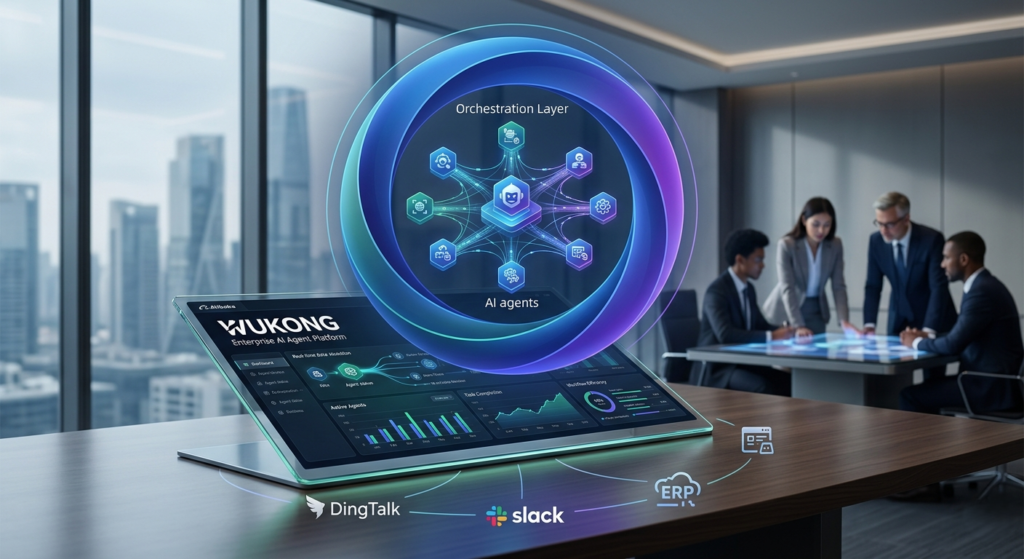
The corporate world is standing at the threshold of an AGI (Artificial General Intelligence) inflection point. For years, businesses have used chatbots to answer questions, but the era of passive assistance is ending. On March 17, 2026, Alibaba Group officially signaled this shift by launching Wukong, a sophisticated enterprise AI agent platform designed to move beyond conversation and into autonomous execution.
Named after the legendary “Monkey King” known for his 72 transformations, Wukong isn’t just another tool; it is a multi-agent orchestration layer. It arrives during a massive “agent craze” in China, fueled by the OpenClaw movement, and marks Alibaba’s most aggressive move yet to dominate the agentic workflow market.
What is the Alibaba Wukong Enterprise AI Agent Platform?
Wukong is a flagship product under Alibaba’s newly formed Alibaba Token Hub (ATH) business group. Unlike traditional LLM interfaces, which rely on human-to-GUI (Graphical User Interface) interactions, Wukong transitions enterprise software toward an AI-native, command-line-style interaction.
The platform allows businesses to deploy and coordinate multiple AI agents that can “talk” to each other and interact directly with system APIs to complete multi-step workflows without constant human oversight.
Key Features of Wukong
- Multi-Agent Coordination: Seamlessly manages different agents—one for research, one for document editing, and another for data analysis—within a single interface.
- Deep Integration: Native support for DingTalk (serving 20 million corporate users) and planned integrations with Slack, Microsoft Teams, and WeChat.
- High-Stakes Security: Features enterprise-grade “sandboxes” to ensure AI agents operate in a secure, isolated environment, preventing data leakage.
- Ecosystem Modularization: Leverages skills from across the Alibaba empire, including Taobao for e-commerce, 1688 for sourcing, and Alipay for payments.
Why “Agentic Workflows” are Replacing Chatbots
To understand the value of an enterprise AI agent platform, we must distinguish between a standard chatbot and an AI agent.
| Feature | Standard AI Chatbot | Agentic AI (Wukong) |
| Interaction | Reactive (Wait for prompt) | Proactive (Takes initiative) |
| Scope | Single-turn Q&A | Multi-step task execution |
| Connectivity | Knowledge-based only | Connected to APIs and File Systems |
| Output | Textual response | Completed work/Process update |
| Efficiency | High human bottleneck | Minimal human intervention |
A chatbot can tell you how to write an invoice; a Wukong agent can draft the invoice, cross-reference it with your CRM, email the client, and update your accounting spreadsheet in one go.
The Strategic Power of the Alibaba Token Hub (ATH)
The launch of Wukong is inseparable from Alibaba’s internal restructuring. Led directly by CEO Eddie Wu, the Alibaba Token Hub consolidates the company’s most vital AI assets:
- Tongyi Laboratory: The research powerhouse behind the models.
- Qwen (Tongyi Qianwen): The foundational LLM family powering the intelligence.
- Model-as-a-Service (MaaS): The infrastructure for scaling.
- Wukong: The application layer where enterprises actually work.
This consolidation is a strategic pivot. By focusing on “tokens”—the units of data AI consumes—Alibaba is preparing for a future where agents consume hundreds of times more data than simple chat sessions. This drives massive revenue back to Alibaba Cloud, creating a “flywheel” effect: better agents lead to more usage, which leads to higher cloud computing demand.
Actionable Insights: How Enterprises Should Prepare
The arrival of the enterprise AI agent platform era means businesses need to rethink their digital architecture. Simply “having AI” is no longer enough; you must have “agentic readiness.”
1. Identify “Agent-Ready” Workflows
Don’t automate everything at once. Look for processes that are high-volume, rule-based, and multi-platform. Common starting points include:
- Meeting Lifecycle: Automated transcription $\rightarrow$ Action item extraction $\rightarrow$ Calendar scheduling.
- Document Management: Researching market trends $\rightarrow$ Drafting a report $\rightarrow$ Formatting into a PowerPoint.
- Customer Support: Identifying a refund request $\rightarrow$ Verifying purchase history $\rightarrow$ Initiating the refund via payment API.
2. Focus on Data Structure
Agents are only as good as the data they can access. Ensure your internal documentation and databases are organized and accessible via API. Wukong excels because it can bridge silos between Slack, spreadsheets, and ERP systems.
3. Prioritize Security Sandboxing
One of the biggest risks of agentic AI is “prompt injection” or agents taking unauthorized actions. When adopting an enterprise AI agent platform, ensure it utilizes technologies like Alibaba’s ACS Agent Sandbox, which uses lightweight virtual machines to isolate agent actions from core system vulnerabilities.
The Competitive Landscape: OpenClaw vs. Wukong
Alibaba isn’t alone in this race. The “OpenClaw craze”—an open-source movement for AI agents—has forced every major Chinese tech firm to step up.
- Tencent has launched user-friendly personal agent products.
- ByteDance is integrating agents into its massive social and commerce apps.
- Zhipu AI has introduced “AutoClaw,” featuring agents pre-loaded with over 50 common business skills.
Wukong’s competitive edge lies in Alibaba’s full-stack execution. Unlike rivals that might rely on third-party logistics or payments, Alibaba owns the cloud, the commerce platform, the payment gateway (Alipay), and the logistics network (Cainiao). This allows a Wukong agent to execute a task “end-to-end” in a way few others can match.
The Technical Backbone: Built on Rust and Tauri 2.x
Unlike many browser-based AI wrappers, Wukong is engineered for high performance and system-level reliability. The platform is written entirely in Rust, leveraging the Tauri 2.x framework. This allows it to function as a lightweight, lightning-fast desktop application that can directly interact with a user’s local file system while maintaining a secure sandbox environment.
The CLI-First Transformation
In a monumental move, the DingTalk team has rewritten its underlying code to prioritize a Command Line Interface (CLI) over a traditional Graphical User Interface (GUI).
- The Problem: Most AI agents today “hallucinate” mouse clicks or fail when a website’s layout changes.
- The Solution: Wukong’s agents interact directly with system APIs. When you tell Wukong to “generate a report from these notes,” it doesn’t “click” buttons—it executes machine-readable commands, ensuring 100% accuracy in task execution.
Conclusion: The AGI Inflection Point
The launch of the Wukong enterprise AI agent platform is a clear signal that the “experimentation” phase of generative AI is over. We are moving into the “execution” phase. For businesses, this means a shift from asking AI for information to delegating entire departments of digital work to autonomous agents.
As Alibaba CEO Eddie Wu noted, billions of AI agents are poised to become the primary interface between humans and the digital world. For the modern enterprise, the choice is simple: start building your agentic workforce today, or risk being outpaced by a competitor who did.