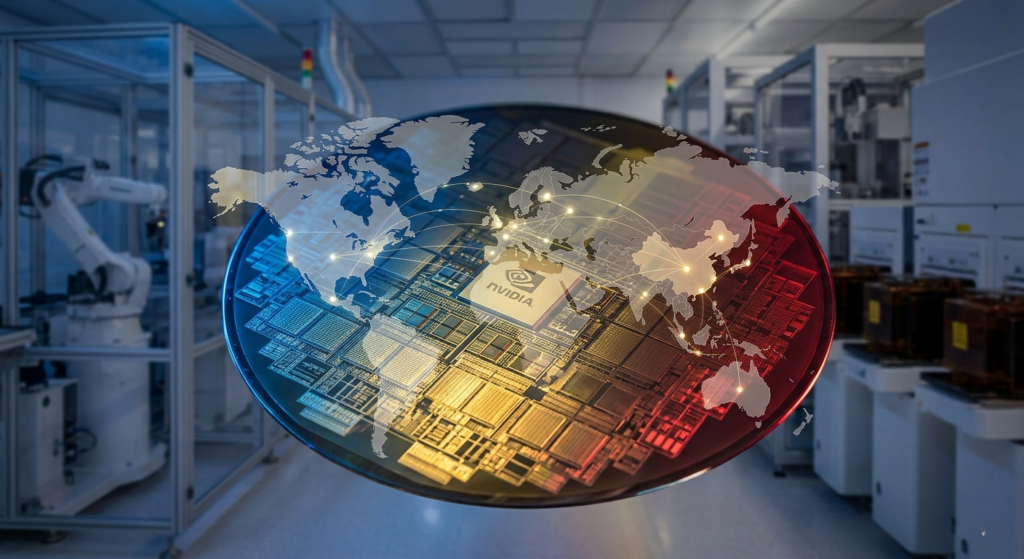
The global semiconductor landscape is shifting beneath our feet. For months, the industry watched as Nvidia, the titan of artificial intelligence, appeared to be hitting a regulatory wall in its most critical growth market: China. Headlines suggested the “China Dream” was over as production of the H200—a chip specifically designed to meet U.S. export standards—ground to a halt amid a complex web of geopolitical tension and shifting trade frameworks.
However, the narrative took a dramatic turn at the GTC 2026 conference. CEO Jensen Huang announced a bold restart of manufacturing for the Chinese market, signaling a resilient pivot in Nvidia’s global strategy. With a forecast of $1 trillion in revenue opportunity for its next-generation Blackwell and Rubin architectures by 2027, Nvidia isn’t just surviving the “Geopolitics of GPUs”—it is rewriting the playbook for how a global tech leader balances compliance with hyper-growth.
The Strategic Pivot: Why Nvidia is Restarting China Production
Nvidia’s decision to resume manufacturing the H200 AI chip marks a significant de-escalation in what many feared was a permanent exit from the Chinese mainland. After a period of “waiting in limbo,” the company has reportedly received the necessary export licenses from the U.S. government to proceed.
Understanding the H200 Framework
The H200 isn’t just another chip; it is a geopolitical compromise. Based on the Hopper architecture, it was engineered to stay below the performance thresholds that trigger U.S. national security bans, while still offering the massive compute power required for modern LLMs (Large Language Models).
- Revenue Sharing: Under a new U.S. framework, Nvidia will share roughly 25% of revenue from these specific exports with the government, a move that allows for market access while satisfying federal oversight.
- Supply Chain Momentum: Huang noted that the “supply chain is getting fired up,” indicating that the previous halt was a tactical pause rather than a strategic retreat.
- Customer Demand: Despite the rise of domestic Chinese competitors, demand for Nvidia’s ecosystem remains high, with over one million units reportedly on order from major Chinese tech players.
From Training to Inference: The Rise of Blackwell and Vera Rubin
While the H200 addresses the immediate regulatory hurdles in China, Nvidia’s long-term dominance rests on its newest architectures: Blackwell and Vera Rubin. These chips are designed to tackle the next big hurdle in AI: Inference.
As AI models move out of the lab and into real-world applications (like ChatGPT or autonomous vehicles), the industry’s focus is shifting from training (building the model) to inference (running the model for users).
Key Technological Breakthroughs
| Feature | Blackwell Architecture | Vera Rubin Architecture |
| Primary Focus | Generative AI Training | High-Speed Inference & Scale |
| Performance | 208 Billion Transistors | 3.5x Faster Training than Blackwell |
| Inference Speed | Industry-leading FP4 | 5x Faster than Blackwell |
| Strategic Goal | Consolidate 90% Market Share | Counter TPU and Groq competition |
The Blackwell chip is a powerhouse of 208 billion transistors, but the Vera Rubin platform (expected to dominate 2026 and 2027) represents a leap in efficiency. By focusing on inference, Nvidia is targeting the exponential growth in “token generation”—the actual data chunks produced every time a user prompts an AI.
Navigating the “Geopolitics of GPUs”
Nvidia’s path forward is not without obstacles. The company faces a “pincer movement” from two directions: U.S. export restrictions and China’s push for semiconductor self-sufficiency.
1. The Domestic Surge in China
Chinese giants like Huawei and SMIC are not standing still. Reports indicate that China aims to triple its AI chip production in 2026. This domestic push has turned Nvidia’s chips from “essential” to “optional” for some state-funded projects, forcing the U.S. firm to compete not just on performance, but on availability and local compliance.
2. The Southeast Asian “Cloud Loophole”
A fascinating development in the Geopolitics of GPUs is the rise of Singapore and Malaysia as AI hubs. Because direct exports to China are restricted, Chinese firms are increasingly renting computing power in Southeast Asian data centers. Singapore has become Nvidia’s second-largest market, accounting for nearly 20% of its revenue, as it serves as a bridge for regional AI development.
Actionable Insights for Investors and Tech Leaders
Nvidia’s ability to navigate these waters offers several key lessons for the broader tech industry:
- Adaptability is the New Alpha: Nvidia’s willingness to re-engineer its flagship products (like the H200) to meet political requirements proves that market access is worth the engineering overhead.
- The Revenue Shift: Keep a close eye on the transition from training revenue to inference revenue. If Nvidia can capture even a third of the inference market while maintaining its 90% training lead, the $1 trillion forecast becomes highly realistic.
- Geopolitical Diversification: Companies must look beyond binary “US vs. China” strategies. The growth of neutral hubs like Singapore provides a blueprint for maintaining global reach in a fractured trade environment.
The “Inference Inflection”: Why 2026 is the Year of the Agent
At GTC 2026, Jensen Huang declared that “the inference inflection has arrived.” For years, the Geopolitics of GPUs was defined by who could train the biggest models. Today, the battle has shifted to who can run them most efficiently for billions of users.
Vera Rubin: Built for Reasoning, Not Just Chatbots
While the Blackwell architecture (released in 2024/25) was the king of generative AI, the Vera Rubin platform—named after the pioneering astronomer—is engineered for “System 2” thinking. This refers to agentic AI that doesn’t just predict the next word but reasons through complex tasks.
The Road Ahead: The $1 Trillion Opportunity
Jensen Huang’s vision for 2027 is clear: the demand for AI compute is not a bubble, but a structural shift in the global economy. By restarting production for China and doubling down on inference-optimized hardware like the Vera Rubin and the new Groq-licensed processors, Nvidia is positioning itself as the indispensable foundation of the “AI Factory.”
While the Geopolitics of GPUs will continue to create volatility, the sheer scale of the Blackwell and Rubin rollout suggests that Nvidia has successfully found the “level playing field” it needs to maintain its lead.