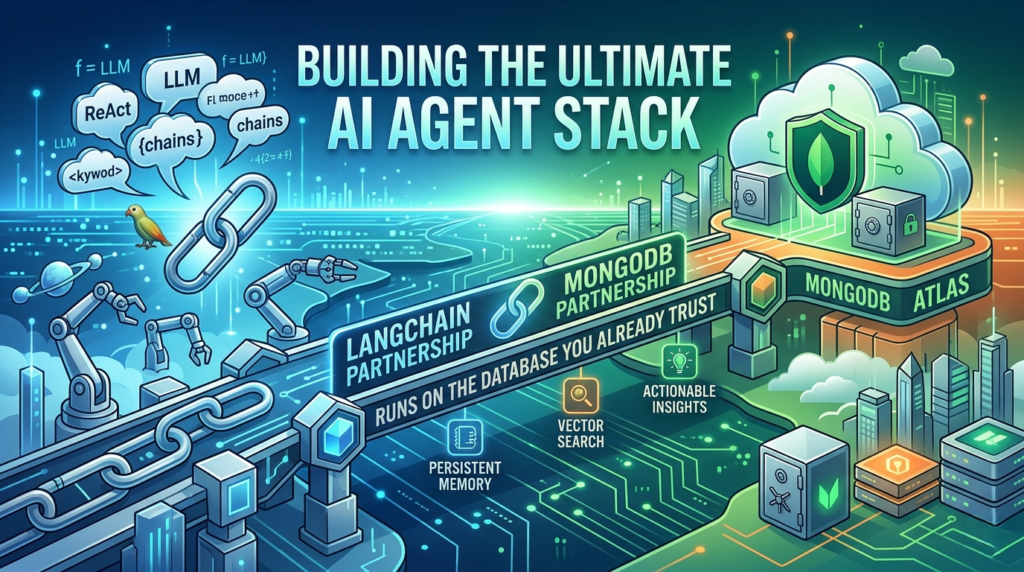
The transition from a “cool” AI prototype to a production-ready application is often where most developers hit a brick wall. You build an agent that works perfectly in a Jupyter notebook, but then reality sets in: How do you handle persistent memory at scale? Where do you store vector embeddings without adding yet another piece of infrastructure? How do you ensure the agent doesn’t “forget” the conversation if the server restarts or a session times out?
The recently announced LangChain MongoDB partnership is designed specifically to tear down these walls. By turning MongoDB Atlas into a complete backend for AI agents, this collaboration allows developers to leverage the database they already trust for operational data to power the next generation of agentic workflows.
In this comprehensive guide, we explore how the LangChain MongoDB partnership provides a unified AI agent stack—combining vector search, persistent memory, and natural-language querying into a single, seamless ecosystem.
Top 5 SEO Keywords for AI Development
To ensure this content reaches the right audience of developers, CTOs, and AI architects, we have identified the following top keywords. The primary focus keyword is “LangChain MongoDB partnership.”
- LangChain MongoDB partnership (Primary)
- AI agent stack
- MongoDB Atlas Vector Search
- LangGraph persistent memory
- Production-grade AI agents
Why the LangChain MongoDB Partnership Changes Everything
Historically, building a sophisticated AI agent required a “Frankenstein” architecture. You needed a primary database for user profiles and transaction history, a specialized vector database for RAG (Retrieval-Augmented Generation), and a separate state store (like Redis) for agent memory. This fragmented approach introduced latency, increased costs, and created massive data synchronization headaches.
The LangChain MongoDB partnership simplifies this by consolidating these disparate needs into the MongoDB Atlas platform.
1. Unified Data Infrastructure
With this integration, your vector data lives alongside your operational data. This eliminates the need for complex “sync jobs” or ETL pipelines between different systems. When a record is updated in your main collection, its corresponding vector embedding can be managed within the same environment, ensuring data consistency across your entire AI agent stack.
2. Persistent Memory and State Management
One of the standout features of this partnership is the MongoDB Checkpointer for LangGraph. In a production environment, agents must be “stateful.” If a user is halfway through a complex multi-step travel booking flow and the system crashes, the agent needs to resume exactly where it left off.
Previously, this required a dedicated database instance for every deployment or complex custom logic. The new checkpointer collapses this into a single, shared Atlas cluster, significantly reducing infrastructure overhead.
3. Developer Velocity
By using a unified stack, teams can stop worrying about “plumbing” and start focusing on “features.” The LangChain MongoDB partnership provides standardized abstractions that allow developers to swap models, update retrieval logic, and scale memory without rewriting their entire backend.
Deep Dive: The Components of the New AI Agent Stack
The collaboration delivers deep technical integrations across the entire LangChain ecosystem, including LangGraph and LangSmith. Let’s break down the core components that make this partnership a game-changer.
Atlas Vector Search as a Native Retriever
Atlas Vector Search is now a drop-in retriever for LangChain. Whether you are using Python or JavaScript, you can perform:
- Semantic Search: Finding information based on the “intent” and “context” rather than just keywords.
- Hybrid Search: Combining the power of BM25 (traditional keyword search) with vector similarity. This is crucial for searching through technical documentation or product IDs.
- GraphRAG: Leveraging relationship-based data retrieval to give agents a deeper understanding of complex data structures.
Text-to-MQL: The Power of Natural Language Queries
Perhaps the most “magical” part of the LangChain MongoDB partnership is the MongoDBDatabaseToolkit. This allows agents to convert natural language into MongoDB Query Language (MQL).
Imagine a user asking, “Show me all orders from the last 30 days that had shipping delays and value over $500.” Instead of a developer writing a custom API endpoint for this specific question, the agent:
- Inspects the collection schema to understand field names and types.
- Generates the correct MQL aggregation pipeline.
- Validates and executes the query securely.
- Returns a conversational answer based on the real-time data.
Full-Stack Observability with LangSmith
Building an agent is only half the battle; debugging it is the other. Every retrieval call, tool invocation, and state transition made through the LangChain MongoDB partnership integrations is traced in LangSmith. This “time-travel debugging” allows teams to replay prior states to see exactly why an agent made a specific decision, making it much easier to refine prompts and retrieval logic.
Comparison: Traditional Stack vs. The Unified AI Agent Stack
| Feature | Traditional AI Stack | LangChain MongoDB Stack |
| Primary Database | Relational (Postgres/MySQL) | MongoDB Atlas |
| Vector Storage | Separate Vector DB (Pinecone/Milvus) | Integrated (Atlas Vector Search) |
| Agent Memory | Managed in Redis or local cache | Integrated (MongoDB Checkpointer) |
| Data Sync | Required (Complex ETL) | Not Required (Native consistency) |
| Scalability | High overhead for multi-DB sync | Horizontal scaling within Atlas |
| Security | Multiple security perimeters | Unified Atlas Security/RBAC |
Actionable Insights: Moving from Prototype to Production
The LangChain MongoDB partnership isn’t just about better tools; it’s about a faster, more reliable path to market. Here is how you can implement these features in your current projects:
Step 1: Implementing Durable State
To move your agents from volatile, session-based memory to durable, persistent state, use the LS_DEFAULT_CHECKPOINTER_BACKEND configuration. By pointing this at your Atlas cluster, you gain:
- Crash Recovery: Agents pick up exactly where they left off after a restart.
- Human-in-the-Loop: You can pause an agent to wait for human approval before it performs a critical action (like sending a payment) and resume it hours later.
- Audit Trails: A full history of agent “thoughts” and actions is stored in your database for compliance.
Step 2: Optimizing with Hybrid Search
Don’t rely solely on vector embeddings. Use the hybrid search capabilities provided by the LangChain MongoDB partnership to combine the precision of keyword filters with the flexibility of semantic embeddings.
Pro Tip: When dealing with specific SKUs, brand names, or technical error codes, keyword filtering is often more accurate than vector similarity. Use MongoDB’s ability to filter by metadata before performing vector search to increase accuracy and reduce compute costs.
Step 3: Secure Querying with Toolkits
When using the MongoDBDatabaseToolkit, always implement a “read-only” user for the agent. This ensures that even if the agent is “tricked” by a prompt injection, it cannot delete or modify your underlying operational data.
Advanced Architecture: Agentic Workflows with LangGraph
The true power of the LangChain MongoDB partnership is realized when building complex, non-linear workflows with LangGraph. Unlike simple “chains,” graphs allow agents to loop back, verify their own work, and call specialized tools.
The Role of Persistence in Graphs
In a LangGraph setup, the state is passed between different nodes (steps). If your agent is performing a multi-day task—such as researching a topic, drafting a report, and waiting for feedback—the state must be saved to a database.
The LangChain MongoDB partnership makes this trivial. Every time the graph moves to a new node, the checkpointer automatically saves a snapshot to MongoDB. This means you can build “long-running agents” that exist for days or weeks without worrying about memory loss.
Scaling to Thousands of Users
Because MongoDB Atlas is built for high-concurrency, scaling your agent to thousands of simultaneous users becomes a matter of horizontal scaling. You don’t need to worry about managing a massive Redis cluster specifically for agent sessions; Atlas handles the load, providing low-latency access to both the vector knowledge base and the agent’s conversation history.
Case Study: Real-World Impact
Companies like Kai Security and various fintech startups have already started reaping the benefits of this partnership. Before the LangChain MongoDB partnership, these teams spent up to 30% of their development cycle just managing the “state” of their agents—writing custom code to save and load conversation history.
By switching to the integrated MongoDB Checkpointer, they reduced that time to near-zero. This allowed them to:
- Ship Features Faster: Focus on the agent’s reasoning logic rather than data persistence.
- Reduce Costs: Consolidate three different database bills into one.
- Improve Reliability: Eliminate the “memory loss” bugs that frequently occur when session data is stored in volatile caches.
Why Choose This Stack for Your Next Project?
The AI landscape is moving incredibly fast, and “vendor lock-in” is a major concern for many enterprises. One of the most compelling aspects of the LangChain MongoDB partnership is the commitment to an open, flexible ecosystem.
- Multi-Cloud Flexibility: MongoDB Atlas runs on AWS, Azure, and GCP. You aren’t tied to a single cloud provider’s AI ecosystem.
- LLM Agnostic: Whether you use OpenAI’s GPT-4, Anthropic’s Claude 3, or open-source models like Llama 3 via Groq or Ollama, the LangChain MongoDB partnership integrations remain the same.
- Scalable Security: You can use the same enterprise-grade security features (encryption at rest, VPC peering, fine-grained access control) that MongoDB is famous for.
The Roadmap Ahead: What’s Next for the Partnership?
The collaboration between LangChain and MongoDB is just getting started. Future updates are expected to include even tighter integrations for:
- Automated Indexing: Letting the agent decide when a piece of new data needs to be vectorized and indexed in Atlas.
- Advanced Semantic Caching: Using MongoDB to cache LLM responses based on semantic similarity, drastically reducing API costs and latency.
- Streaming Analytics: Real-time dashboards in Atlas Charts that track agent performance and user satisfaction based on LangSmith data.
Final Checklist for Building with the LangChain MongoDB AI Agent Stack
Before you push your next AI project to production, ensure you have ticked these boxes to maximize the benefits of the LangChain MongoDB partnership:
- [ ] Consolidate: Have you moved your vector embeddings into Atlas Vector Search to reduce infrastructure complexity?
- [ ] Persist: Is your LangGraph agent using the MongoDB Checkpointer for durable, long-term memory?
- [ ] Empower: Are you using the MongoDBDatabaseToolkit to allow your agents to answer questions about your operational data in real-time?
- [ ] Observe: Is LangSmith enabled to trace every step of your agent’s decision-making process?
- [ ] Secure: Have you applied least-privilege principles to the database users your agents use?
The LangChain MongoDB partnership marks a significant milestone in the evolution of enterprise AI. By bridging the gap between operational data and agentic reasoning, it provides the most stable, scalable, and developer-friendly path for teams looking to deploy high-performance AI agents that users can actually trust.
Frequently Asked Questions: Mastering the LangChain MongoDB Partnership
Navigating the intersection of decentralized agent logic and centralized data persistence can be complex. To help you fully integrate the LangChain MongoDB partnership into your development workflow, we’ve compiled a comprehensive FAQ addressing the most critical technical and strategic questions for 2026.
1. What is the core benefit of the LangChain MongoDB partnership for enterprise AI?
The primary benefit is the consolidation of the AI stack. Traditionally, developers had to manage three distinct data silos: a relational database for user metadata, a standalone vector database (like Pinecone) for RAG, and a caching layer (like Redis) for short-term agent memory.
The LangChain MongoDB partnership eliminates this fragmentation by allowing MongoDB Atlas to serve as the single source of truth. By integrating Atlas Vector Search and the MongoDB Checkpointer, developers gain a unified backend. This reduces “architectural tax”—the time and money spent syncing data between different providers—and ensures that your agent’s long-term memory is as reliable as your primary transactional data.
2. How does the MongoDB Checkpointer differ from standard session caching?
Standard session caching (like using an in-memory store) is volatile. If your server restarts or a Lambda function times out, the agent “forgets” the entire conversation state. In contrast, the MongoDB Checkpointer introduced through the LangChain MongoDB partnership provides durable persistence.
It saves a “snapshot” of the agent’s state—including the message history, internal variables, and next steps in a LangGraph workflow—directly into an Atlas collection. This allows for:
- Multi-day interactions: An agent can wait for a human response for three days and resume perfectly.
- Error Recovery: If a tool call fails, the agent can be re-instantiated from the last successful checkpoint.
- Scalability: You can scale your application horizontally across multiple servers without losing state, as all nodes point to the same MongoDB Atlas cluster.
3. Can I use the LangChain MongoDB partnership for RAG applications?
Absolutely. In fact, this is one of the strongest use cases for the partnership. By using Atlas Vector Search as a native retriever within LangChain, you can perform semantic searches on high-dimensional vectors stored right next to your operational documents.
The integration supports Hybrid Search, which is the “gold standard” for RAG in 2026. This allows you to combine:
- Vector Search: For finding “conceptually similar” information.
- Full-Text Search: For finding specific keywords, part numbers, or legal jargon. Because both live in MongoDB, you can apply complex filters (e.g., “only search documents created by User X in the last 30 days”) with extreme efficiency before the vector math even begins.
4. Is the Text-to-MQL feature safe for production databases?
Security is a valid concern when giving an AI agent the ability to query a database. The MongoDBDatabaseToolkit, a key component of the LangChain MongoDB partnership, is built with several safety layers:
- Schema Exposure Control: You can limit which collections and fields the agent is “aware” of.
- Read-Only Scoping: It is a best practice to provide the agent with a database user that has
read-onlypermissions. - Query Validation: LangChain’s internal logic validates the generated MQL (MongoDB Query Language) to ensure it is syntactically correct before execution.
- Human-in-the-Loop: For sensitive operations, you can use LangGraph to pause the agent and require a human to “approve” the MQL query generated by the LLM.
5. Does this partnership lock me into a specific LLM provider?
No. One of the core philosophies of the LangChain MongoDB partnership is being LLM-agnostic. You can use the MongoDB-based AI agent stack with:
- Proprietary Models: OpenAI (GPT-4o), Anthropic (Claude 3.5), or Google (Gemini 1.5 Pro).
- Open-Source Models: Llama 3, Mistral, or specialized fine-tuned models hosted on Hugging Face or via Groq. Because LangChain acts as the orchestration layer and MongoDB Atlas acts as the data layer, you can swap your “brain” (the LLM) at any time without migrating your “memory” or “knowledge” (stored in MongoDB).
6. How does the LangChain MongoDB partnership improve “Human-in-the-Loop” (HITL) workflows?
In complex agentic workflows, you often don’t want the agent to have “full autonomy.” You might want it to draft an email or a database update but wait for a human to click “Send” or “Confirm.”
The MongoDB Checkpointer makes this seamless. When an agent reaches a “breakpoint” in LangGraph, its entire state is saved to MongoDB, and the process suspends. The user can come back hours or days later, review the state in a UI, and trigger the continuation. The agent then pulls its state back from Atlas and proceeds as if no time had passed. This is a massive improvement over traditional workflows that required custom, brittle state-management code.
7. What are the costs associated with using this stack?
The LangChain MongoDB partnership doesn’t introduce a new “partnership fee.” Instead, you simply pay for the resources you use on MongoDB Atlas.
- Vector Search: Included in Atlas (M10 tiers and above recommended for production).
- Storage: Standard Atlas storage rates apply for your documents and vector embeddings.
- Compute: Standard Atlas compute rates. Because you are consolidating multiple databases (Vector DB + State Store + Primary DB) into one, most teams actually see a reduction in total cloud spend and a significant decrease in “developer hours” spent on maintenance.
8. How do I get started with the LangChain MongoDB partnership?
Getting started is straightforward for anyone familiar with Python or JavaScript.
- Deploy an Atlas Cluster: Sign up for MongoDB Atlas and create a cluster (the “Free Tier” works for testing, but Vector Search performs best on “M10” or higher).
- Install Libraries: Use
pip install langchain-mongodbornpm install @langchain/mongodb. - Configure Environment: Set your
MONGODB_ATLAS_URIand your chosen LLM API keys. - Initialize the Stack: Start by setting up a
MongoDBAtlasVectorSearchobject for your RAG needs or aMongoDBChatMessageHistoryfor basic conversation persistence.
Final Thought for 2026
The LangChain MongoDB partnership is more than just a technical integration; it’s a blueprint for the “Agentic Era.” By treating memory and knowledge as first-class citizens within the database, this stack provides the reliability and performance required to move AI from experimental chatbots to mission-critical business tools.