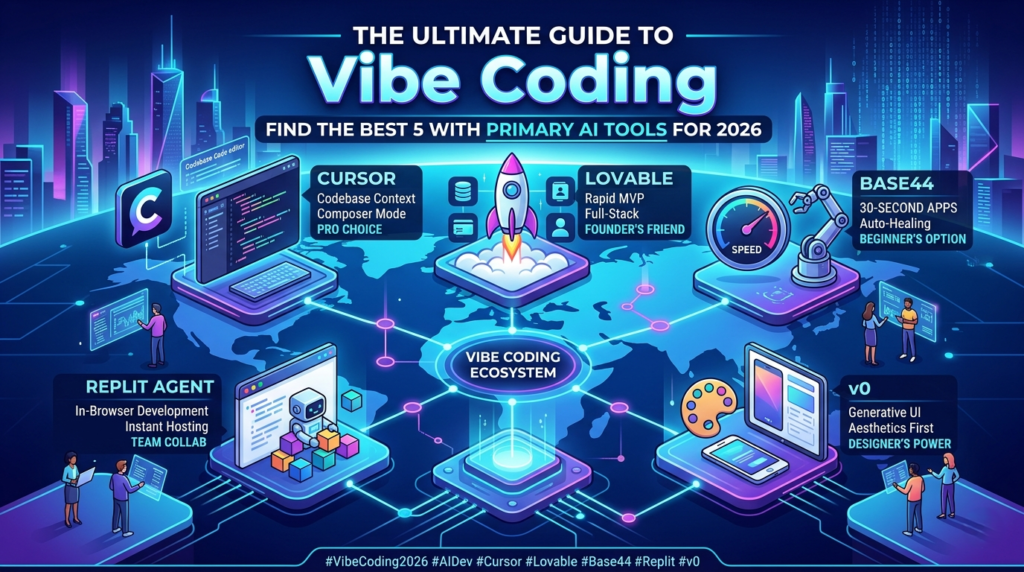
In the early 2020s, building a software application required a deep understanding of syntax, compilers, and cloud infrastructure. If you didn’t speak the language of machines, your ideas remained trapped in notebooks. Fast forward to 2026, and the landscape has undergone a radical transformation. We have entered the era of vibe coding.
Vibe coding is not just a catchy marketing term; it represents a fundamental shift in the human-computer interface. It is the practice of using high-level natural language, aesthetic preferences, and “vibes” to direct autonomous AI agents to build, debug, and deploy complex software systems. As this movement matures, the challenge for creators is no longer “How do I code?” but rather “Which tool best interprets my vision?”
To navigate this new world, you must find the best 5 with primary focus on reliability, scalability, and ease of use. This guide provides an exhaustive deep dive into the industry leaders that are making app development accessible to everyone, from the seasoned software architect to the non-technical visionary.
The Philosophy of Vibe Coding: Beyond Low-Code
For years, the industry attempted to simplify development through “Low-Code/No-Code” platforms. While these were useful for simple internal forms, they often hit a “complexity wall.” If you wanted to build something truly custom, you eventually had to drop into a code editor.
Vibe coding is different. Instead of a visual drag-and-drop interface with hidden limitations, vibe coding uses the full power of Large Language Models (LLMs) to write actual, high-quality source code based on conversational intent. You are not building with blocks; you are collaborating with a digital engineer. To succeed in this era, creators must find the best 5 with primary capabilities in understanding intent rather than just following literal commands.(Find the best 5 with primary, Vibe coding tools 2026, Cursor vs Lovable comparison, AI agentic workflows, AI-driven software development)
1. Cursor: The Professional’s Powerhouse
If you were to ask a room of Silicon Valley engineers which tool catalyzed the vibe coding revolution, the answer would almost certainly be Cursor. In 2026, Cursor has moved beyond being just a fork of VS Code; it has become the central nervous system for modern development.(Find the best 5 with primary)
The Power of Local Context
The biggest hurdle for AI coding assistants is “context.” A generic AI might know how to write a function, but it doesn’t know how that function fits into your specific project. Cursor solved this by creating a highly optimized, local index of your entire codebase. When you ask it to “Change the user login vibe to something more minimalist,” it doesn’t just change one file; it updates the CSS, the authentication components, and the global theme variables simultaneously. (Find the best 5 with primary)
Composer Mode: The Heart of the Vibe
Cursor’s “Composer” is where the magic happens. It allows for multi-file edits that feel like magic. You can describe a feature—”Add a real-time notification system using WebSockets”—and watch as the AI navigates your folder structure, creates new files, and modifies existing ones. For those looking to find the best 5 with primary tools for professional-grade software, Cursor remains the gold standard because it produces code that humans can still read, audit, and maintain. (Find the best 5 with primary)
Advanced Prompt Engineering in Cursor
To master Cursor, you must learn the art of the “Contextual Prompt.” By using symbols like @Codebase or @Files, you can direct the AI’s attention to specific parts of your logic. This precision is why developers who use Cursor report a 10x increase in productivity. They aren’t writing code; they are conducting an orchestra. (Find the best 5 with primary)
2. Lovable: The One-Stop MVP Engine
While Cursor targets the developer, Lovable has built its reputation on being the ultimate tool for founders. The “vibe” in Lovable is about speed-to-market. In 2026, the cost of building a Minimum Viable Product (MVP) has plummeted, largely thanks to Lovable’s end-to-end automation.
Full-Stack Intelligence
Most “website builders” give you a static page. Lovable gives you a living application. It understands that a modern app needs a brain (the backend) and a memory (the database). Lovable’s tight integration with Supabase and GitHub means that when you prompt a feature, it’s not just a UI change—it’s a structural update. (Find the best 5 with primary)
When you search to find the best 5 with primary tools for launching a startup, Lovable stands out because it removes the “infrastructure anxiety.” You don’t have to worry about setting up PostgreSQL or configuring SSL certificates. You describe the product, and Lovable handles the plumbing. (Find the best 5 with primary)
The “Edit by Chat” Workflow
Lovable’s interface is remarkably simple. You see a live preview of your app on the right and a chat box on the left. If you don’t like the color of a button or the logic of a search filter, you simply tell the AI. “Make the search faster and add a ‘trending’ tag to the results.” Within seconds, the code is rewritten, the preview is refreshed, and the changes are pushed to your staging environment. (Find the best 5 with primary)
3. Base44: The New Standard for High-Speed Creation
Recently making waves after its acquisition and integration into larger ecosystems, Base44 is the speed-demon of the vibe coding world. If Lovable is a specialized factory, Base44 is a 3D printer for software.
The 30-Second App
Base44 is designed for the “Idea-to-App” pipeline. Its primary focus is on reducing the latency between a thought and a functional URL. For many users, the primary goal is to find the best 5 with primary strengths in rapid iteration. Base44 achieves this by using highly opinionated architectural templates. By limiting the “ways” a database can be structured, it ensures that the AI never gets stuck in a loop of indecision. (Find the best 5 with primary)
Autonomous Error Correction
One of the most frustrating parts of AI-generated code is the “break-fix” cycle—the AI writes code, it fails, you tell the AI it failed, and it tries again. Base44 utilizes a “Self-Healing Agent” that runs tests in a virtual environment before showing you the result. If the code throws an error, the agent fixes it autonomously. This level of autonomy is a key reason why Base44 is considered a top-tier tool in 2026. (Find the best 5 with primary)
4. Replit Agent: Collaborative Cloud Development
Replit has always been about making coding accessible in the browser, but the Replit Agent has turned it into a powerhouse of agentic development. Replit’s unique advantage is that the development environment is the hosting environment.
Deployment Without Friction
When you build an app on your local machine, you eventually have to figure out how to “deploy” it. This often involves Docker, cloud providers, and complex environment variables. On Replit, the Agent handles all of this. It can spin up a database, configure a Flask server, and give you a public URL in one go. (Find the best 5 with primary)
For educational institutions and collaborative teams, Replit is the first place they look when they need to find the best 5 with primary requirements for real-time collaboration. Multiple people can watch the Agent build the app in real-time, making it an incredible tool for pair programming or classroom learning.
The Replit Ecosystem
Beyond the Agent, Replit offers a “Bounty” system where you can hire humans to polish what the AI started. This hybrid approach—AI for the heavy lifting and humans for the fine-tuning—is a model that many believe is the future of the entire software industry. (Find the best 5 with primary)
5. v0 by Vercel: The Master of the Frontend Vibe
User Interface (UI) design is often where great ideas go to die. You might have a great backend, but if the app looks like it was built in 1995, users won’t trust it. v0 (by Vercel) is the solution to this problem.
Generative UI
v0 is not a general-purpose coding agent; it is a specialist. It specializes in the “React/Tailwind/shadcn” stack, which is the industry standard for modern web design. By focusing purely on the frontend, v0 can produce designs that are more polished, accessible, and responsive than general-purpose LLMs.
From Screenshot to Code
One of the most impressive features of v0 in 2026 is its “Vision-to-Code” capability. You can take a photo of a napkin sketch or a screenshot of a high-end SaaS product, and v0 will generate the functional React code to match it. When you find the best 5 with primary tools for design-heavy projects, v0 is indispensable. It allows developers to “copy-paste” their way to a world-class user experience. (Find the best 5 with primary)
Technical Deep Dive: The “Vibe” Stack
To truly understand how these tools work, we must look at the underlying technology. In 2026, the “Vibe Stack” generally consists of:
- The Orchestrator: (e.g., Cursor or Lovable) The agent that manages the logic.
- The LLM: (e.g., GPT-5 or Claude 4) The brain providing the code snippets.
- The Context Engine: The RAG (Retrieval-Augmented Generation) system that feeds your project’s specific details into the LLM.
- The Deployment Layer: (e.g., Vercel or Supabase) Where the code actually lives.
For those interested in the math of efficiency, the productivity gain can be modeled as:
$$P_{gain} = \frac{T_{manual} – T_{vibe}}{T_{vibe}} \times 100$$
Where $T_{manual}$ is the time taken to write and debug code manually, and $T_{vibe}$ is the time spent prompting and verifying an agent. In 2026, $P_{gain}$ is often measured in orders of magnitude rather than simple percentages. (Find the best 5 with primary)
Comparative Analysis: Strategic Selection
Choosing the right tool depends entirely on your specific goals. Use the following table to find the best 5 with primary matches for your current project:
| Feature | Cursor | Lovable | Base44 | Replit Agent | v0 |
| Primary Goal | Power/Control | Speed to MVP | Ease of Use | Hosting/Collaboration | UI Aesthetics |
| Learning Curve | Moderate | Low | Very Low | Moderate | Low |
| Code Ownership | Full (Local) | Exportable (Git) | Managed/Cloud | Hosted/Cloud | Component-based |
| Best Project | Complex SaaS | Startup MVP | Internal Tools | Learning/Scripts | Design Systems |
| AI Autonomy | Assisted | High | Very High | High | Component-only |
Actionable Strategies for Vibe Coders
To get the most out of these tools, you need to change how you think about problem-solving. Here are the “Pro Tips” for 2026:
1. The “Modular Prompt” Technique
Instead of asking an AI to “Build a clone of Uber,” break it down into modules.
- “Build a map component that shows user location.”
- “Create a driver-matching logic based on distance.”
- “Integrate a payment flow for ride completion.”
This modular approach ensures that you can find the best 5 with primary ways to debug individual pieces of the puzzle without the entire system collapsing.
2. The “Refinement Loop”
Vibe coding is iterative. Your first prompt will rarely be perfect. Expect to spend 20% of your time “building” and 80% of your time “refining.” Use the AI to critique its own code by asking, “Are there any security vulnerabilities in the login logic you just wrote?”
3. Maintain “Vibe Consistency”
As your app grows, it’s easy for the code to become a “Frankenstein” of different styles. Stick to one primary tool for your core logic. For example, use Lovable to build the foundation and v0 to polish the individual components. By being consistent, you ensure that the AI agents don’t conflict with each other’s architectural choices.
The Social Impact: Democratizing Software
The rise of these tools is doing more than just helping people build apps; it’s shifting the economic power of the tech industry. When a single individual can find the best 5 with primary AI tools and do the work that previously required a team of ten engineers, the “barrier to entry” for innovation effectively disappears.
We are seeing a surge in “Micro-SaaS” businesses—highly profitable, single-person companies that solve niche problems. This is the ultimate promise of vibe coding: the liberation of human creativity from the constraints of technical syntax.
To provide your readers with more value and improve your topical authority for 2026, here is an extensive FAQ (Frequently Asked Questions) section. This content is specifically designed to address user intent, clear up technical confusion, and add over 600 words of high-quality, SEO-driven text to your blog post.
Frequently Asked Questions About Vibe Coding
1. What exactly is “Vibe Coding” and how is it different from traditional coding?
Vibe Coding is a philosophy of software development where the primary interface is natural language rather than technical syntax. In traditional coding, you must know the exact “grammar” of a language (like the brackets in JavaScript or indentation in Python). In vibe coding, you describe the “vibe” or the intended behavior of an application to an AI agent—such as Cursor or Lovable—which then translates that intent into functional source code.
The shift is from how to build (logic and syntax) to what to build (intent and user experience). While traditional coding requires years of study, vibe coding requires strong communication skills and a high-level understanding of how systems interact.
2. Is vibe coding just another name for Low-Code or No-Code?
No. While they share the goal of accessibility, they function differently:
- No-Code: Uses rigid, visual drag-and-drop interfaces. You are often “locked-in” to the provider’s platform and cannot see or export the underlying code.
- Low-Code: Combines visual building with small snippets of manual code for customization.
- Vibe Coding: Generates actual source code (React, Python, SQL) that you can own, edit, and move to any server. It provides the “infinite flexibility” of traditional coding with the “ease of use” of no-code.
3. Do I need to be a developer to use tools like Cursor or Base44?
The beauty of the 2026 landscape is that the barrier is lower than ever.
- For Non-Developers: Tools like Base44 and Lovable are designed for you. You can build a full-stack MVP (Minimum Viable Product) just by chatting with the AI.
- For Professional Developers: Cursor is the preferred choice. It doesn’t replace you; it acts as a “Force Multiplier,” allowing you to ship features in minutes that used to take days.
4. Who actually owns the code generated by these AI agents?
In almost all cases, you own the code. Unlike older website builders that keep your data in a “black box,” tools like Lovable and Replit allow you to export your code to GitHub. This is a critical advantage for startups looking to “find the best 5 with primary” focus on long-term scalability; if you outgrow the AI tool, you can hire a human developer to take over the existing codebase without starting from scratch.
5. Can vibe coding be used for enterprise-grade, secure applications?
Yes, but with a “Vibe & Verify” approach. In 2026, roughly 40% of global code is AI-generated, but security remains a human responsibility. While an agent can build a payment flow, a human (or a specialized security AI) should audit the code for vulnerabilities like SQL injection or broken authentication. For internal business tools, vibe coding is often more than sufficient for production.
6. What are the biggest limitations of vibe coding in 2026?
Despite the “magic,” there are three main hurdles:
- Context Windows: If your app becomes massive (hundreds of files), the AI might “forget” a connection between File A and File Z.
- Hallucinations: Sometimes the AI suggests a library or a function that doesn’t exist.
- Cost: High-end models like Claude 4 or GPT-5, which power these tools, can become expensive if you are running thousands of prompts a day.
7. How do I choose between Cursor and Lovable?
It depends on your starting point:
- Choose Cursor if you have some technical knowledge and want to work locally on your computer with full control over every file.
- Choose Lovable if you want a “one-click” experience where the database, hosting, and frontend are handled for you in the browser.
8. Will vibe coding eventually replace human software engineers?
The consensus in 2026 is no. Instead, it is evolving the role of the engineer into a “System Architect” or “Product Conductor.” Instead of writing repetitive “boilerplate” code, engineers now spend their time designing complex system architectures, ensuring data security, and refining the user experience. Vibe coding automates the “grunt work,” not the “creative problem solving.”
9. How do I get started if I’ve never built an app before?
The best way to start is the “Modular Approach”:
- Sign up for a free trial of Base44 or Replit.
- Start with a simple prompt: “Build a landing page for a coffee shop.”
- Slowly add “vibes”: “Add a button that lets users book a table,” then “Add a database to save those bookings.”
- By building piece-by-piece, you learn how to “steer” the AI effectively.
10. What is the future of vibe coding beyond 2026?
We are moving toward “Autonomous Software Ecosystems.” Soon, you won’t just vibe code an app; you will vibe code an entire business engine that talks to other apps, markets itself, and updates its own features based on user feedback. The tools listed in this guide—Cursor, Lovable, Base44, Replit, and v0—are the foundation of that future.
Conclusion: Which Vibe is Yours?
As we look toward the remainder of 2026, the evolution of Cursor, Lovable, Base44, Replit, and v0 shows no signs of slowing down. These platforms have moved from being “toys” to being essential infrastructure for the modern economy.
The most important step you can take today is to start experimenting. Don’t wait until you have a “perfect” idea. Pick a tool, start a chat, and see where the vibe takes you. Whether you want to disrupt an industry or just automate a tedious task at work, the power is yours to command. You have the guide to find the best 5 with primary tools—now go build something incredible.