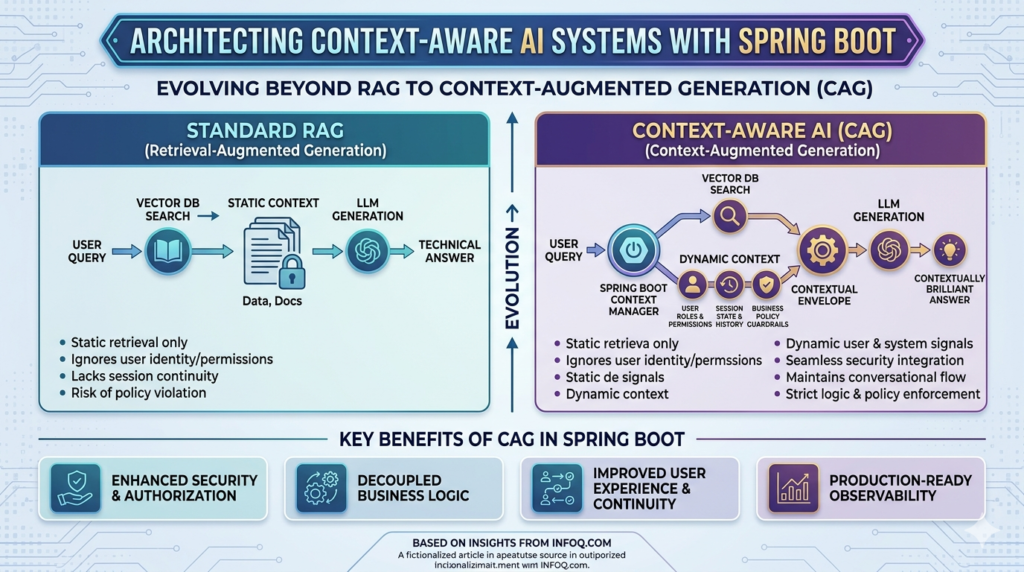
The landscape of Artificial Intelligence is shifting from simple prompt engineering to sophisticated system architecture. While Retrieval-Augmented Generation (RAG) has become the industry standard for grounding Large Language Models (LLMs) in private data, enterprise-grade applications are hitting a “context wall.” Standard RAG often fails to account for runtime variables—user roles, session history, and fluctuating business policies—leading to responses that are technically accurate but contextually deaf.
Enter Context-Augmented Generation (CAG). This architectural evolution, recently detailed by engineering leaders on InfoQ, moves beyond static retrieval to create truly context-aware AI systems. By leveraging the Spring Boot ecosystem, developers can now build AI agents that don’t just “know” the data, but “understand” the circumstances of the query.
In this guide, we will dive deep into why your enterprise needs to move beyond RAG, how to implement a Context Manager in Spring Boot, and the strategies for building production-ready, context-aware AI.
The Limitations of Traditional RAG in the Enterprise
Standard RAG operates on a simple “retrieve and generate” loop. When a user asks a question, the system searches a vector database for relevant snippets and passes them to the LLM.
However, in a corporate environment, the “correct” answer often depends on who is asking. Consider an internal HR bot:
- User A (Manager): “What is the budget for the upcoming team offsite?”
- User B (Intern): “What is the budget for the upcoming team offsite?”
A traditional RAG system might retrieve the same budget document for both. A context-aware AI system must recognize that User A has authorization to see the full spreadsheet, while User B should only receive general policy information. Standard RAG struggles with these dynamic runtime signals because they aren’t typically stored in the vector embeddings.
Introducing Context-Augmented Generation (CAG)
Context-Augmented Generation (CAG) is an architectural refinement that introduces a dedicated “Context Manager” layer above the standard RAG pipeline. Instead of modifying the retrieval mechanism or retraining the model, CAG focuses on assembling a “contextual envelope” before the LLM is even invoked.
Key Components of a Context-Aware Architecture:
- The Context Manager: A centralized Spring Boot component responsible for gathering runtime signals.
- User Identity & Permissions: Integration with OAuth2/OIDC to fetch roles and departments.
- Session State: Maintaining a window of previous interactions to ensure conversational continuity.
- Policy Guardrails: Real-time business rules that govern what information can be disclosed.
By decoupling contextual reasoning from the retrieval logic, you ensure that your context-aware AI systems are easier to audit, test, and scale.
Why Spring Boot is the Ideal Choice for Context-Aware AI Systems
Spring Boot has long been the backbone of enterprise Java development. Its mature ecosystem provides several “out-of-the-box” advantages for building context-aware AI systems:
- Spring AI: Provides a unified interface for interacting with different LLM providers (OpenAI, Anthropic, Ollama) and vector stores (Pinecone, PGVector).
- Security Integration: Seamlessly connects with Spring Security to inject user identity directly into the AI workflow.
- Dependency Injection: Allows for a clean implementation of the Context Manager pattern, making the system modular.
- Production Readiness: Features like Micrometer and Spring Boot Actuator provide the observability needed to monitor LLM latencies and token usage.
Step-by-Step: Implementing a Context Manager in Spring Boot
To move beyond RAG, you must centralize your contextual logic. In a Spring Boot application, this involves creating a ContextManager service that prepares the “prompt augmentation” data.
1. Defining the Context Object
First, create a POJO that represents the state of the world at the time of the request.
Java
public record AIContext(
    String userId,
    List<String> roles,
    String department,
    List<Message> sessionHistory,
    String activePolicy
) {}
2. The Context Manager Implementation
The Context Manager interacts with your existing microservices or security context to populate this data.
Java
@Service
public class ContextManager {
    public AIContext assembleContext(String userId) {
        var auth = SecurityContextHolder.getContext().getAuthentication();
        // Fetch additional data from User Service or Cache
        return new AIContext(
            userId,
            getRoles(auth),
            getDepartment(userId),
            getSessionHistory(userId),
            "Policy_v2.1"
        );
    }
}
3. Augmenting the RAG Pipeline
When the request hits your AI service, the context is used to “flavor” both the retrieval and the final generation.
| Feature | Standard RAG | Context-Aware AI (CAG) |
| Data Source | Vector Database only | Vector DB + Runtime User Data |
| Query Refinement | Static user query | Query + User Role + Session State |
| Safety | Prompt-based instructions | Hardcoded Policy Guardrails |
| Consistency | Low (Varies by retrieval) | High (Grounded in Identity) |
Actionable Insights for Moving Beyond RAG
Building context-aware AI systems is not just about writing code; it’s about rethinking the data flow. Here are four strategies to ensure your implementation succeeds:
Metadata Filtering is Your Best Friend
Don’t just rely on semantic similarity. Use the metadata in your vector store (like department_id or security_clearance) to filter results before they reach the LLM. If the Context Manager identifies the user as “Marketing,” your retrieval query should explicitly exclude “Finance” documents.
Manage the “Context Window” Wisely
Context is powerful, but it’s also expensive. Every piece of session history or user profile data consumes tokens. Implement a “sliding window” for session history and prioritize context that is directly relevant to the current intent.
Decouple Logic from Prompts
Avoid putting complex business logic inside the LLM prompt. Instead of saying, “If the user is a manager, show them the budget,” use your Spring Boot application logic to decide whether to even retrieve the budget data. This reduces “prompt injection” risks and makes your context-aware AI systems more predictable.
Observability and Traceability
In a context-aware system, a “bad” answer might not be the LLM’s fault—it could be a failure in the Context Manager. Log the AIContext object alongside the LLM response to trace exactly why a specific answer was generated.
The Future: From RAG to Agentic Workflows
As we move beyond RAG, the next frontier is Agentic workflows. In this model, the Context Manager doesn’t just provide data; it provides “tools.” A context-aware agent might decide to call a SQL database, check a real-time API, or browse a website based on the user’s current needs.
By building a robust foundation with Spring Boot and CAG today, you are preparing your organization for the transition to fully autonomous, context-intelligent agents.
Conclusion
The transition from basic retrieval to context-aware AI systems represents the maturation of Generative AI in the enterprise. By moving beyond RAG and implementing a structured Context-Augmented Generation architecture with Spring Boot, developers can solve the “identity and intent” gap that plagues most current LLM implementations.
Start small: centralize your user roles and session history into a Context Manager. As your system grows, you can add more complex policy layers, ensuring that your AI remains a helpful, secure, and contextually brilliant assistant.
Frequently Asked Questions: Basundhara Utsav 2026
General Information
What is Basundhara Utsav? Basundhara Utsav is a premium heritage meetup curated to celebrate the Odia New Year, also known as Maha Bishuba Sankranti or Pana Sankranti. Unlike standard corporate events, this is a cultural assembly designed for thought leaders, art enthusiasts, and heritage advocates to reconnect with the roots of Odisha. It serves as a platform for meaningful conversation, traditional culinary experiences, and the promotion of Odia handloom and art.
When and where is the event taking place? The event is scheduled for April 14, 2026, coinciding with the auspicious occasion of the Odia New Year. The venue is located in the heart of Bhubaneswar, Odisha. Specific location details and timing are provided upon registration to maintain the exclusivity and intimate nature of the gathering.
What is the core objective of this meetup? The primary goal is “Cultural Preservation through Connection.” We aim to create a space where modern professionals and traditional artisans can interact. By celebrating our shared identity—from the intricate weaves of our sarees to the historical significance of our festivals—we ensure that the essence of Odisha remains vibrant in a rapidly globalizing world.
Attendance & Registration
Who should attend Basundhara Utsav? This event is ideal for individuals who hold a deep appreciation for Odia culture. This includes entrepreneurs, educators, artists, handloom enthusiasts, and members of the diaspora who wish to experience an authentic celebration of their heritage. It is a “sophisticated meetup,” meaning the focus is on quality interaction rather than high-volume attendance.
Is there an entry fee or registration process? Yes, to ensure a curated experience, attendance is by registration. This helps us manage the logistics for the traditional Pana service and the cultural showcase. Interested participants can register through our official portal. Early registration is encouraged as the guest list is limited to maintain a premium atmosphere.
Can I bring guests or family members? We welcome the spirit of community; however, every attendee must be registered individually. Given the focus on cultural dialogue and heritage appreciation, we recommend the event for adults and young adults who share an interest in Odisha’s history and arts.
Event Highlights & Experience
What kind of culinary experience can I expect? In honor of Maha Bishuba Sankranti, the highlight of our refreshments will be the Bela Pana, a traditional summer drink crafted with wood apple, chenna, and aromatic spices. We will also feature a curated selection of Odia “Pitha” and regional delicacies that are synonymous with the New Year celebrations, offering a true taste of home.
Will there be a showcase of Odia Handloom? Absolutely. A significant segment of Basundhara Utsav is dedicated to the “Geographies of Weaves.” We will have a display featuring exquisite handloom sarees, highlighting the craftsmanship of various weaving clusters across Odisha. This is an opportunity to learn about the stories behind the patterns and the importance of supporting local weavers in the global market.
Is this a business networking event? While many professionals and entrepreneurs will be in attendance, Basundhara Utsav is primarily a Heritage Meetup. We encourage organic connections and the building of community ties, but the environment is designed to be free from “business pressure.” The focus is on shared culture, not sales pitches.
Logistics & Support
What is the dress code for the event? To honor the theme of the Utsav, we strongly encourage guests to wear Traditional Odia Attire. For men, this could be Sambalpuri or Maniabandi kurtas, and for women, we recommend handloom sarees such as Khandua, Kotpad, or Bomkai. Wearing our heritage is the first step in preserving it.
How can I contribute to the Utsav? If you are an artisan, a storyteller, or a researcher with a passion for Odisha’s history, we would love to hear from you. We have limited slots for cultural contributors who wish to share insights during the meetup. Please reach out to our organizing team via the contact form on our website.
Is there parking available at the venue? Yes, the selected venue in Bhubaneswar offers dedicated parking for guests. We will provide a digital map and parking instructions to all registered attendees 48 hours before the event to ensure a smooth arrival.
What measures are being taken for guest comfort? Given that April marks the beginning of the summer season in Odisha, the venue is climate-controlled. Furthermore, the traditional Pana served is specifically chosen for its cooling properties, ensuring that our guests remain comfortable while celebrating the New Year.