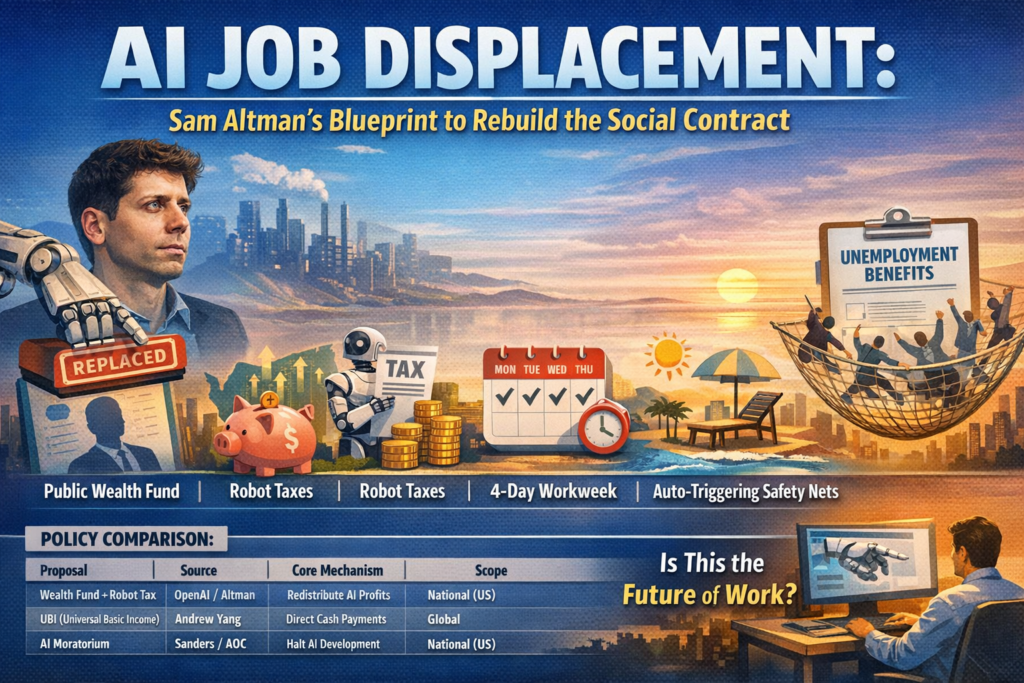
Sam Altman, the CEO of the world’s most powerful AI company, has issued a stark warning: AI job displacement is coming fast — and the current economic system is not built to handle it. His proposed fix involves robot taxes, a national wealth fund, and a four-day workweek — and it’s one of the most consequential policy documents Silicon Valley has ever produced.
If you want to understand what AI is about to do to the global workforce and what tech leaders, economists, and policymakers are planning to do about it, this article is your complete guide.
What Is AI Job Displacement — and Why Is It Different This Time?
Definition: AI Job Displacement vs. Past Automation
AI job displacement refers to the reduction or elimination of human roles caused by artificial intelligence systems capable of performing cognitive, creative, and administrative tasks previously done by people.
This is categorically different from past automation. Industrial robots in the 20th century replaced physical labor on factory floors. AI, by contrast, is displacing knowledge workers — the lawyers, analysts, writers, coders, and customer service professionals who were supposed to be automation-proof. The disruption is no longer arriving at the factory gate; it’s landing in the corner office.
The White-Collar Shock No One Predicted
The economic signals are already visible. White-collar payrolls have contracted for 29 consecutive months, a stretch economists describe as unprecedented outside a recession, and researchers have documented a decline in demand even for elite business school graduates. Quartz
This is not a future risk. It is a present reality. And according to Sam Altman, this is only the beginning.
Sam Altman’s Warning: “Capitalism as We Know It Won’t Be Enough”
The 13-Page Blueprint Explained
On April 6, 2026, OpenAI released a policy document titled “Industrial Policy for the Intelligence Age: Ideas to Keep People First.” The blueprint calls for sweeping economic reforms to prepare for what it describes as approaching superintelligence, including taxes on automated labour, a national public wealth fund seeded partly by AI companies, and pilots of a 32-hour working week. The Next Web
Altman told Axios that AI superintelligence is so close and so disruptive that America needs a new social contract — on the scale of the Progressive Era in the early 1900s, and the New Deal during the Great Depression. Axios
The comparison to the New Deal is not rhetorical flourish. The core issue is simple: modern economies are built on the assumption that human labor is central to value creation. People work, earn wages, and pay taxes. Medium If AI removes humans from that equation at scale, the entire fiscal and social architecture of modern states begins to fracture.
Altman is not merely philosophizing. Without intervention, he warned, the consequences could be severe — ranging from widespread job displacement to destabilizing cyberattacks, biological threats, and the concentration of power and wealth among a small number of companies. Inc
The two most immediate dangers he cited? Cyberattacks and AI-enabled biological weapons. Altman told Axios that a major cyberattack enabled by near-future AI models is “totally possible” within the next year, and that AI models being used to create novel pathogens is “no longer theoretical.” The Next Web
The Four Pillars of OpenAI’s Policy Proposal
OpenAI’s blueprint frames AI job displacement not as an inevitable catastrophe but as a manageable transition — if governments act deliberately and early. The document rests on four core proposals.(AI job displacement, robot tax, Sam Altman AI policy, public wealth fund AI, future of work AI)
Pillar 1 — The Public Wealth Fund
OpenAI proposes giving every American citizen a direct stake in AI-driven economic growth through a nationally managed fund, seeded in part by AI companies themselves, that “could invest in diversified, long-term assets that capture growth in both AI companies and the broader set of firms adopting and deploying AI.” Axios
The proposal is modeled on Alaska’s Permanent Fund WinBuzzer, which distributes annual dividends to state residents from oil revenues. In this case, the “resource” being shared would be the economic value generated by AI systems — essentially treating artificial intelligence as a public good, not just a corporate asset.
Any returns would be distributed directly to citizens — a prospect that may appeal to Americans who have watched AI inflate the market without seeing any of those gains themselves. TechCrunch
Pillar 2 — Robot Taxes and Tax Base Modernization
One of the most provocative ideas in the document is the so-called robot tax. OpenAI’s paper proposes “higher taxes on capital gains at the top, corporate income, or targeted measures on sustained AI-driven returns,” along with new approaches such as “taxes related to automated labor.” Fortune
The underlying logic is fiscally pragmatic. As AI automates more work, corporate profits and capital gains will expand while payroll tax revenue shrinks, threatening funding for Social Security, Medicaid, SNAP, and housing assistance. WinBuzzer If robots perform the work but pay no payroll taxes, the programs those taxes fund begin to collapse. The robot tax is designed to close that gap.
Altman described these tax changes as “in the Overton window, but near the edges” — politically difficult but not unthinkable. Newsweek
Pillar 3 — Auto-Triggering Safety Nets
Perhaps the most technically sophisticated idea in the blueprint is the concept of automatic, data-driven safety net expansion. The blueprint envisions a data-driven mechanism that would expand government assistance without requiring new legislation each time — once measurements of AI-related job displacement cross defined limits, programs covering income support, wage insurance, and direct cash payments would activate automatically. As labor market indicators recovered, the expanded benefits would wind down on their own. Quartz
This addresses a genuine governance problem: AI job displacement could accelerate faster than the legislative process can respond. Traditional policy requires years of debate; an auto-triggering system would respond to economic conditions in near real time.
Pillar 4 — The Four-Day Workweek
OpenAI suggested some way to “convert efficiency gains from AI into durable improvements in workers’ benefits when routine workload declines and operating costs fall.” Success in the latter, it said, could mean incentivizing companies to trial four-day workweeks with a view to making this change permanent. Newsweek
The idea isn’t new — Bill Gates has floated it, as has JPMorgan CEO Jamie Dimon. Dimon has said he thinks AI will shave the work week down to three and a half days, and improve life, even curing some cancers — though he’s equally wary about the technology’s impact on the labor market. Fortune What is new is that the company most responsible for accelerating AI is now formally proposing it as a policy goal.
How Does OpenAI’s Plan Compare to Other Proposals?
AI job displacement has attracted responses across the political spectrum. Here’s how OpenAI’s blueprint stacks up against alternatives:
| Proposal | Source | Core Mechanism | Scope |
|---|---|---|---|
| Public Wealth Fund + Robot Tax | OpenAI / Sam Altman (2026) | Redistribute AI profits; tax automated labor | National (US) |
| Alaska Permanent Fund Model | Various economists | State-owned resource dividends | State / Regional |
| AI Moratorium on Data Centers | Sen. Sanders / Rep. AOC | Halt new AI infrastructure until safety laws pass | National (US) |
| Universal Basic Income (UBI) | Andrew Yang, others | Direct cash to all citizens regardless of employment status | National |
| Government-Business Cushion Program | Jamie Dimon / JPMorgan | Subsidized retraining and cushion for AI-displaced workers | Corporate + Government |
| Anthropic Policy Blueprint (2025) | Anthropic | Range of regulatory responses to AI-driven disruption | National + International |
OpenAI’s approach is notably market-friendly compared to the Sanders/AOC moratorium, while being far more structurally ambitious than simple retraining programs. It occupies a centrist lane — accepting AI’s acceleration as inevitable, but arguing for aggressive redistribution of its gains.
Critics and Skeptics: Is This Genuine or Strategic?
The blueprint has not been received without skepticism. Altman was candid with Axios about the dual nature of the document: OpenAI is the company racing to build the very technology it is warning about, and positioning itself as the responsible actor proposing solutions is plainly also a strategy to shape regulation before regulation shapes it. The Next Web
The timing sharpens the critique. OpenAI prepared the blueprint as it approaches an IPO at an estimated $852 billion valuation, raising questions about whether the company building superintelligence should also be designing the safety net for its disruption. WinBuzzer
The blueprint offers few implementation details, with no specific tax rates, timelines for the wealth fund, or enforcement mechanisms. WinBuzzer Critics on the left, including Sanders and Ocasio-Cortez, favor harder structural constraints rather than voluntary frameworks crafted by the firms driving the disruption.
OpenAI was founded as a nonprofit premised on AI benefiting all of humanity. It became a for-profit company last year, a shift that has led critics to question whether its stated mission is compatible with its need to grow and fulfill its fiduciary duty to shareholders. TechCrunch
Still, Altman himself addressed this tension directly. He acknowledged there are many companies developing this technology, and that the urgency driving the document is genuine: “We do feel a sense of urgency. And we want to see the debate of these issues really start to happen with seriousness.” Axios
What AI Job Displacement Means for Workers Right Now
Jobs Most at Risk
AI job displacement is not hitting all sectors equally. Based on current research and economic data, the roles most vulnerable to near-term automation include:
- Data entry and document processing — already largely automated via large language models
- Junior software development — AI coding assistants are handling increasing shares of routine code
- Customer service and call centers — conversational AI is replacing first-line support at scale
- Legal research and paralegal work — AI can now summarize case law and draft contracts rapidly
- Financial analysis and reporting — AI tools are producing earnings summaries and risk models
- Content writing and copywriting — AI-generated drafts are reducing demand for entry-level writers
- Radiological and diagnostic imaging review — AI models now match or exceed human accuracy in several domains
- Back-office accounting — reconciliation, invoicing, and routine bookkeeping are heavily automated
Notably, AI job displacement is hitting roles that require education and credentialing — not just manual labor. This is a structural shift, not a sectoral one.
How to Future-Proof Your Career
The skills that AI struggles to replicate remain the most durable career assets. Workers navigating AI job displacement should consider:
Build human-AI collaboration skills. The workers who will thrive are those who can direct, audit, and improve AI outputs — not those who compete with them. Prompt engineering, AI tool literacy, and output verification are now foundational competencies.
Move toward judgment-intensive roles. AI is effective at pattern recognition and execution but weak at contextual judgment, ethical reasoning, and creative problem-framing. Roles requiring those capacities — strategy, negotiation, complex client relationships — are significantly more resilient.
Develop technical fluency even in non-technical careers. Understanding how AI tools work, their limitations, and their failure modes makes you more valuable in virtually every professional context.
Advocate for workforce transition support. Altman’s blueprint, whatever its political motivations, puts portable benefit accounts, retraining subsidies, and wage insurance on the policy agenda. Workers and their representatives have an opening to push for those protections before the displacement curve steepens.
The Bottom Line: A Starting Point, Not a Solution
AI job displacement is not a hypothetical risk in a 10-year forecast. It is an active, measurable phenomenon reshaping white-collar labor markets right now. Sam Altman’s 13-page blueprint is the first time a major AI CEO has formally acknowledged that his own technology may require a restructuring of capitalism itself — and proposed specific mechanisms to manage the fallout.
The proposals — a public wealth fund, robot taxes, auto-triggering safety nets, and subsidized four-day workweeks — are ambitious, imprecise, and politically contested. They are also a far more honest accounting of the problem than anything Silicon Valley has offered before.
OpenAI framed the blueprint explicitly: “We offer these ideas not as fixed answers but as a starting point for a broader conversation about how to ensure that AI benefits everyone.” Newsweek
That conversation is now unavoidable. The question is no longer whether AI will disrupt the labor market — it’s whether the institutions designed to protect workers will adapt fast enough to matter.
Frequently Asked Questions (FAQ)
1. What is AI job displacement?
AI job displacement refers to the replacement or reduction of human jobs due to artificial intelligence systems performing tasks that were previously done by people. Unlike traditional automation, which mainly affected manual labor, AI is now impacting white-collar roles such as writing, coding, legal research, and customer service.
2. Why is AI job displacement different from past automation?
Past automation primarily replaced physical labor in industries like manufacturing. Today’s AI systems, especially those developed by companies like OpenAI, can perform cognitive and creative tasks. This means professionals such as analysts, designers, and developers are also at risk—making this shift broader and more disruptive.
3. What did Sam Altman say about AI job displacement?
Sam Altman warned that AI could disrupt the labor market at an unprecedented scale. He emphasized that current economic systems may not be equipped to handle the speed and magnitude of this transition, calling for a “new social contract” to protect workers and redistribute wealth.
4. What is the “robot tax” and how would it work?
A robot tax is a proposed policy where companies pay taxes for using AI or automation systems that replace human workers. The idea is to compensate for lost payroll taxes and fund social welfare programs like unemployment benefits and retraining initiatives.
5. What is a public wealth fund in the context of AI?
A public wealth fund is a government-managed investment fund that distributes profits to citizens. In this case, it would be funded partly by AI-driven economic gains. The goal is to ensure that the benefits of AI are shared across society, not concentrated among a few tech companies.
6. How would a four-day workweek help address AI job displacement?
A four-day workweek redistributes productivity gains from AI. Instead of eliminating jobs entirely, companies could reduce working hours while maintaining pay. This allows workers to benefit from increased efficiency without losing employment.
7. What are auto-triggering safety nets?
Auto-triggering safety nets are systems that automatically expand government support—like unemployment benefits or direct payments—when AI job displacement crosses certain thresholds. This removes delays caused by political or legislative processes.
8. Which jobs are most at risk from AI?
Jobs most vulnerable to AI job displacement include:
- Data entry and administrative roles
- Customer support and call center jobs
- Junior software development
- Content writing and copywriting
- Legal research and paralegal work
- Financial analysis and reporting
These roles involve repetitive or pattern-based tasks that AI can efficiently handle.
9. Will AI create new jobs as well?
Yes, AI is expected to create new roles, especially in areas like AI training, prompt engineering, data governance, and human-AI collaboration. However, the challenge lies in whether job creation will keep pace with job displacement.
10. How can workers protect themselves from AI job displacement?
To stay relevant in the evolving job market:
- Learn to work alongside AI tools
- Develop critical thinking and decision-making skills
- Focus on roles requiring human judgment and creativity
- Continuously upskill in digital and AI-related technologies
11. Is Universal Basic Income (UBI) part of the solution?
UBI is often discussed as a potential solution, providing a fixed income to all citizens regardless of employment. While Sam Altman has supported UBI experiments in the past, his latest proposal focuses more on wealth redistribution through public funds and targeted policies.
12. Are governments ready for AI job displacement?
Most governments are still in early stages of preparing for AI-driven disruption. Policies like robot taxes, workforce retraining programs, and social safety nets are being debated, but large-scale implementation remains limited.
13. Is AI job displacement already happening?
Yes, AI job displacement is already underway. Many companies are adopting AI tools to automate tasks, reduce costs, and improve efficiency. This is particularly visible in industries like customer service, content creation, and software development.
14. What is the future of work with AI?
The future of work with AI will likely involve:
- Fewer routine jobs
- More hybrid human-AI roles
- Increased focus on creativity and strategy
- Shorter workweeks and flexible employment models
The transition will depend heavily on how policies and institutions adapt.
15. Should we be worried about AI taking all jobs?
Not all jobs will disappear, but many will change significantly. The real concern is not total job loss, but the speed of disruption and whether society can adapt quickly enough. That’s why proposals like those from Sam Altman are gaining attention.