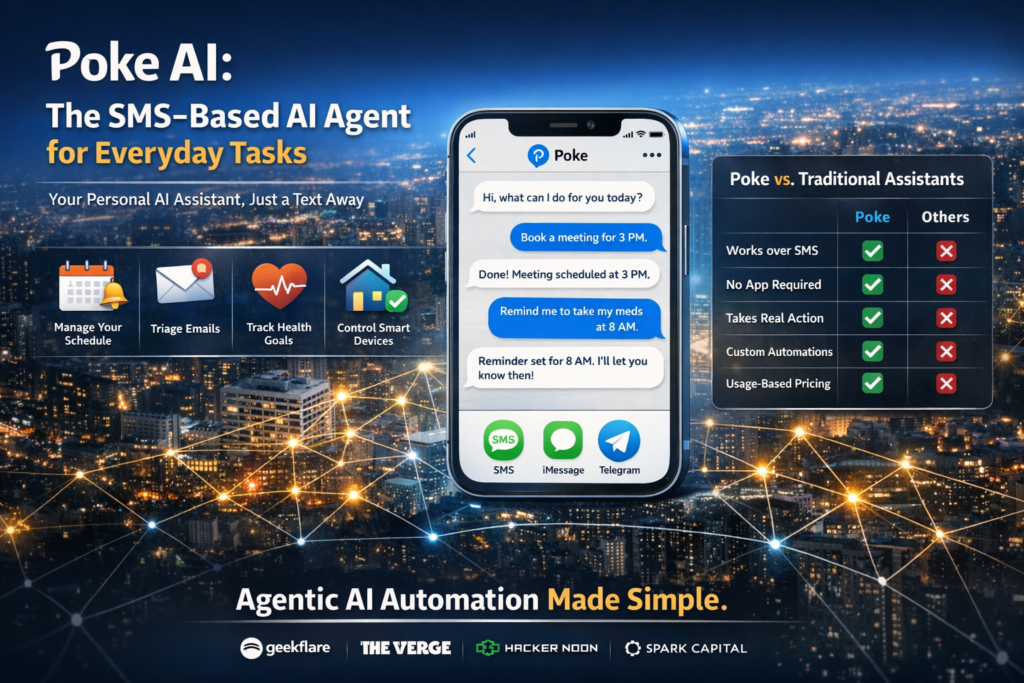
Poke is an AI agent for everyday tasks that works entirely over text message — no app download, no coding, no complexity. If you can send a WhatsApp message, you can now have a personal AI assistant that manages your calendar, monitors your email, tracks your health goals, and automates your daily routines.
The promise of agentic AI — software that doesn’t just answer questions but actually does things on your behalf — has been tantalizing. But until recently, acting on that promise meant navigating terminal commands, API keys, and security trade-offs that intimidated most people. Poke, launched publicly in March 2026 by The Interaction Company of California, changes that equation entirely.
What Is Poke?
Definition: Poke is a conversational AI assistant that operates through iMessage, SMS, and Telegram, allowing users to automate personal and professional tasks by simply sending a text message.
Unlike standalone apps or desktop tools, Poke lives inside the messaging platforms you already use every day. It’s described by its founders as a personal AI assistant with a personality — one that learns your preferences, runs automations proactively, and adapts to your life rather than demanding you adapt to it.
The key distinction: Poke isn’t a chatbot you query for information. It’s an AI agent for everyday tasks — software that takes action, executes workflows, and monitors your world on your behalf, with no technical setup required from the user.
How Poke Works as an AI Agent for Everyday Tasks
No App Required: Text to Get Things Done
Getting started with Poke takes about 30 seconds. You visit Poke.com, click “Get Started,” and enter your phone number. That’s it. The assistant then communicates with you through your native messaging app — iMessage on iPhone, SMS on any mobile device, or Telegram for users who prefer it.
This frictionless setup is deliberate. For years, the bar to access agentic AI has been too high for the average person. Systems like OpenClaw — a powerful agent framework popular among developers — require terminal installation, dependency management, and an understanding of system permissions. Poke strips all of that away.
The result is an AI agent for everyday tasks that is genuinely accessible: no technical skills required, no new app to learn, no onboarding tutorial to complete.
Under the Hood: Model-Agnostic Intelligence
One of Poke’s most strategically interesting features is that it doesn’t rely on a single AI model. Under the hood, it selects the model best suited to each task — drawing from leading commercial AI providers as well as open-source models.
This model-agnostic architecture gives Poke a competitive advantage that larger tech companies can’t easily replicate. As co-founder Marvin von Hagen explained, competitors like Meta AI are locked into Meta’s models and ChatGPT is bound to OpenAI’s. Poke can route each request to whatever AI performs it best at that moment.
To handle messaging integrations across platforms, Poke uses Linq — a solution that enables AI assistants to operate natively within messaging apps. WhatsApp support, while currently limited due to Meta’s platform policies, is expanding as regulators in the EU, Italy, and Brazil push back on those restrictions.
What Can You Actually Do With Poke?
Poke’s capabilities are designed around real daily friction points. Here’s a breakdown of what the assistant currently handles:
Productivity & Scheduling
- Manage your calendar and set reminders
- Triage incoming emails and alert you to priority messages
- Summarize the day’s news each morning
- Provide daily weather and outfit recommendations (“Do I need a jacket today?”)
Health & Wellness
- Send medication reminders on a custom schedule
- Track fitness goals via integration with Strava, Oura, Fitbit, and Withings
- Monitor nutrition or wellness streaks
Smart Home & Lifestyle
- Control smart home devices from Philips Hue, Sonos, and other platforms
- Track sports scores and notify you of results for your favourite teams
- Manage travel check-ins and real-time flight monitoring
Work & Developer Tools
- Integrate with Notion, Linear, GitHub, Vercel, Supabase, Cursor Cloud Agents, and Sentry
- Automate PostHog event monitoring or Webflow content updates
- Sync with Granola meeting notes and push updates to project tools
All of these are powered by what Poke calls “Recipes” — pre-built automation modules that you activate with a single click and a standard authorization step.
Poke vs. Traditional AI Assistants: How Does It Compare?
Understanding where Poke fits requires seeing it against the broader landscape of AI tools people use today.
| Feature | Poke | ChatGPT / Claude | OpenClaw | Siri / Google Assistant |
|---|---|---|---|---|
| Interface | SMS / iMessage / Telegram | Web app / Mobile app | Terminal / API | Voice / Native app |
| Technical setup | None | Minimal | Advanced | None |
| Takes real action | Yes | Limited | Yes | Limited |
| Custom automations | Yes (Recipes) | No | Yes (complex) | No |
| Model flexibility | Multi-model | Single provider | Depends on config | Proprietary |
| Works in background | Yes (proactive) | No | Yes | Partially |
| Shareable automations | Yes | No | No | No |
| Pricing | Free → usage-based | Free → $20+/mo | Free (self-hosted) | Free |
The table makes the distinction clear: Poke is an AI agent for everyday tasks that combines the ease of Siri with the power of OpenClaw and the intelligence of frontier AI models — inside a text thread.
Poke Recipes: Custom Automations in Plain English
What Is a Recipe?
A Poke Recipe is a shareable, pre-built automation that connects an AI agent to one or more apps or services. Recipes are the mechanism through which Poke becomes genuinely useful across dozens of domains — from health tracking to developer workflows.
Examples of real Recipes users have built:
- A food recommendation bot that crowdsources dining opinions from other Poke users (built on MCP, shared publicly)
- A daily morning briefing combining your calendar, weather, top news, and pending emails
- A fitness accountability check-in that reads from Oura Ring data and sends an alert if your sleep dips below a threshold
Crucially, Recipes can be written in plain text — no code required. If you can describe what you want, Poke can usually build the automation. This makes Poke not just a consumer of pre-made workflows, but a platform where anyone can be a creator.
Earn from Your Recipes
Poke has added an incentive layer: creators earn between $0.10 and $1 (adjusted for geography) for every user who signs up for Poke via their Recipe. This positions Poke as an AI agent platform with a creator economy built in — a meaningful differentiator from every other AI assistant on the market today.
Why Poke Makes Agentic AI Accessible to Everyone
The Problem With Current Agentic AI
Agentic AI is having a moment. OpenAI acquired the creator of OpenClaw. Nvidia’s CEO has stated that every company needs an OpenClaw strategy. Demand for AI that acts rather than just answers is surging across enterprises.
But the consumer side of this story has been largely ignored.
For most people, “agentic AI” still conjures images of a developer hunched over a terminal, running npx commands and troubleshooting dependency errors. The security model of systems like OpenClaw — which requires deep system access — raises concerns that even technically literate users find uncomfortable.
Poke’s Approach: Meet People Where They Already Are
Poke’s insight is deceptively simple: the most powerful interface for an AI agent for everyday tasks isn’t a new app. It’s the messaging thread that people already check dozens of times a day.
By operating over SMS and iMessage, Poke eliminates the activation energy that prevents most people from using agentic AI. There’s no context switch. There’s no new mental model to learn. You just… text it.
This positions Poke at a unique intersection: consumer-grade simplicity with enterprise-grade capability — the same combination that made smartphones dominant over PCs for daily computing.
Security Without Sacrifice
One concern with agentic AI is trust: if an AI agent can take actions on your behalf, what prevents it from taking the wrong action — or exposing your data?
Poke’s security model includes regular penetration testing, layered permission controls, and a policy that prevents even Poke’s own team from viewing user data without explicit opt-in. Users can flip a switch to share log data for analytics — but it’s off by default. For an AI agent for everyday tasks to gain mainstream adoption, this kind of trust architecture is non-negotiable.
Pricing: What Does Poke Actually Cost?
Poke’s pricing model is one of its most innovative features — and perhaps the clearest sign that its founders are thinking about mass adoption seriously.
Free tier: Tasks that don’t require real-time data — answering questions, static reminders, basic scheduling — are free.
Usage-based pricing: What costs Poke money (and therefore costs users money) is real-time inference: automations that run on every incoming email, live flight tracking, continuous health monitoring. The AI agent itself determines personalized pricing based on what’s actually being used.
During beta, users negotiated their price with the AI — a range of $10–$30/month emerged organically. Now, pricing is set algorithmically based on usage intensity.
For a fully capable AI agent for everyday tasks that replaces several productivity tools, even $20/month is arguably underpriced — especially compared to the $15–20/month cost of standalone apps like Notion, Calendly, or fitness trackers that cover only one function each.
Who Is Behind Poke?
The Interaction Company of California is a Palo Alto-based, 10-person startup co-founded by Marvin von Hagen and Felix Schlegel. The company’s first product was an AI assistant for email; when beta testers began asking it for medication reminders, sports scores, and weather updates, the founders recognized demand for something far more general.
Poke has raised $25 million to date: a $15 million seed round followed by an additional $10 million, at a post-money valuation of $300 million. Investors include Spark Capital and General Catalyst. Notable angels include Patrick and John Collison (Stripe founders), Joanne Jang of OpenAI, Scott Wu of Cognition, Guillermo Rauch of Vercel, Ken Howery of PayPal, Thomas Wolf of Hugging Face, and Arash Ferdowsi of Dropbox.
The fact that Poke sits at the top of Vercel’s AI Gateway leaderboard — even without publicising user numbers — suggests that its infrastructure usage is already substantial.
Why This Matters for the Future of AI Agents
The Shift From Querying to Acting
We’re transitioning from a world where AI is something you consult to a world where AI is something that runs on your behalf. The question is: who gets access to that future?
If agentic AI remains the preserve of developers and enterprise teams, it will amplify existing capability gaps — between people who can leverage AI and those who can’t. Poke’s bet is that the right delivery mechanism for a true AI agent for everyday tasks is zero friction: available on any device, over any messaging platform, to anyone.
What Poke Gets Right
Three things stand out:
1. Distribution via trust. Text messaging is the highest-frequency interface in most people’s lives. Poke enters through a trusted channel, not a new one.
2. Model agnosticism as durability. As AI models improve and multiply, being locked to one provider is a liability. Poke’s architecture lets it improve as the ecosystem improves.
3. Recipes as community flywheel. Every useful Recipe that a user creates and shares makes Poke more valuable for everyone. It’s the same community-content flywheel that made platforms like Reddit and GitHub sticky — now applied to personal AI automation.
The Road Ahead
Von Hagen has stated that Poke’s goal for the coming months is to become part of everyday life for a billion people. That’s an ambitious target — but the infrastructure is in place: broad messaging platform support, a growing Recipe library, model-agnostic intelligence, and a monetisation model designed for accessibility rather than extraction.(AI agent for everyday tasks, conversational AI assistant, SMS AI agent, , agentic AI automation, personal AI assistant app)
If the next wave of agentic AI belongs to the people, Poke is one of the clearest early candidates to lead it.
Frequently Asked Questions About Poke and AI Agents for Everyday Tasks
What exactly is an AI agent for everyday tasks?
An AI agent for everyday tasks is software that goes beyond answering questions — it actively takes actions on your behalf. Unlike a search engine or a chatbot, which waits for you to ask and then responds, an AI agent monitors your world, runs automations in the background, connects to your apps, and executes tasks without requiring you to initiate every step. Poke is a prime example: it reads your emails, updates your calendar, tracks your fitness data, and proactively sends you alerts based on rules you’ve set — all without you opening an app or typing a command each time.
How is Poke different from ChatGPT or Google Gemini?
ChatGPT and Gemini are conversational AI assistants — they are optimised for answering questions, writing content, and reasoning through problems. They respond when you ask. Poke is an AI agent for everyday tasks — it acts on an ongoing basis, connects to your third-party apps, and automates workflows that run persistently in the background. Think of the difference this way: you’d ask ChatGPT to explain a concept or draft an email; you’d set up Poke to automatically flag every email from your boss, remind you to take your evening medication, and update you on your running goals each morning without any manual input.
Do I need to be technically skilled to use Poke?
No. This is one of Poke’s core advantages. Setting up an AI agent for everyday tasks has historically required technical knowledge — configuring APIs, managing dependencies, or writing code. Poke eliminates that barrier entirely. You visit Poke.com, enter your phone number, and start texting. Automations called “Recipes” can be activated with a single click, and custom automations can be written in plain English — no programming required.
Is Poke available on WhatsApp?
Currently, Poke has limited WhatsApp support due to Meta’s platform policies barring general-purpose chatbots. However, the situation is actively changing: regulators in the EU, Italy, and Brazil have opened antitrust investigations into Meta’s policy, which has already brought Poke back to Brazil. Full WhatsApp availability in more markets is expected as regulatory pressure continues. In the meantime, Poke works fully via iMessage, SMS, and Telegram.
What integrations does Poke support?
Poke integrates with a broad range of services across categories including productivity (Gmail, Outlook, Google Calendar, Notion, Linear), health and fitness (Strava, Oura Ring, Fitbit, Withings), smart home (Philips Hue, Sonos), developer tools (GitHub, Vercel, Supabase, Sentry, PostHog, Cursor Cloud Agents), and meeting and project tools (Granola, Webflow). The integration library continues to grow as the Recipes marketplace expands.
Can I build and share my own automations?
Yes — and Poke will pay you for it. Any user can write a custom Recipe in plain text and share it publicly. Poke offers creators between $0.10 and $1 (adjusted for geography) for every new user who signs up through their Recipe. This makes Poke not just a tool but a platform — one where community-built automations extend the value of the AI agent for everyday tasks model for everyone.
Is my data safe with Poke?
Poke uses a multi-layered security model that includes regular penetration testing and strict permission controls for both agents and employees. By default, Poke’s team cannot access your data without your explicit opt-in. Users control what information is shared, and the permission model is designed to provide the capabilities of a powerful AI agent for everyday tasks without compromising user trust or privacy.
How does Poke decide which AI model to use?
Poke is model-agnostic — it routes each request to whichever AI model performs it best, drawing from leading commercial providers and open-source alternatives. This is a structural advantage over tools tied to a single provider. As the AI model ecosystem evolves, Poke’s performance improves automatically because it is not bound to any one lab or architecture.
Who is Poke best suited for?
Poke is designed for anyone who wants the benefits of a capable AI agent for everyday tasks without any technical complexity. Early adopters include professionals who want to automate email triage and calendar management, fitness-focused users who want proactive health tracking, smart home enthusiasts, and developers who want to automate parts of their workflow. Given its free entry point and conversational interface, Poke has the potential to be useful to virtually anyone with a smartphone.
What does Poke cost?
Poke is free for tasks that don’t require real-time processing — basic reminders, static scheduling, and general queries. Usage-based fees apply for automations that involve real-time data, such as continuous email monitoring, live flight tracking, or ongoing health data analysis. Pricing is determined by the AI agent itself based on your actual usage patterns, keeping costs proportional to the value being delivered. During Poke’s beta, monthly fees ranged from $10–$30 depending on usage intensity.(AI agent for everyday tasks, conversational AI assistant, SMS AI agent, , agentic AI automation, personal AI assistant app)