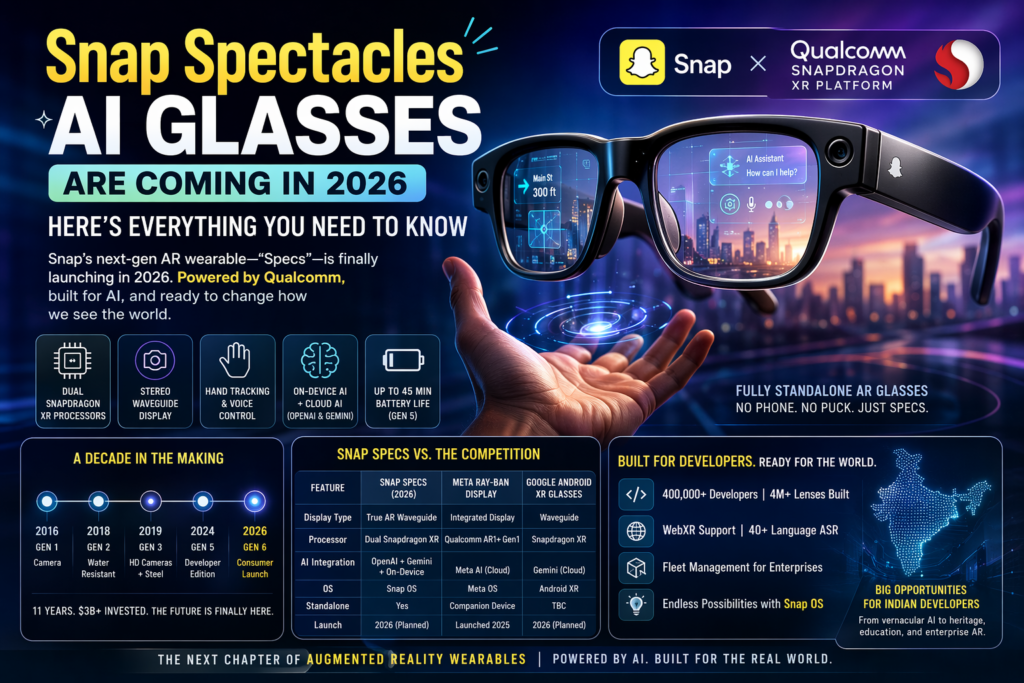
Snap Spectacles AI glasses are finally moving from developer prototype to consumer product. After years of delays, executive reshuffles, and a pivot to a developer-only model, Snap has announced a strategic multi-year partnership with Qualcomm — the strongest signal yet that its Specs wearable will reach store shelves in 2026.
If you are a developer, tech enthusiast, or early adopter tracking the augmented reality space, this is the moment the Snap Spectacles story gets genuinely interesting.
What Are Snap Spectacles AI Glasses?
Definition: Snap Spectacles AI glasses — now commercially rebranded as “Specs” — are standalone augmented reality wearables developed by Snap Inc. Unlike smartphone-tethered AR devices, they run Snap OS, a purpose-built operating system that uses hand tracking, voice input, and on-device AI to overlay digital information on the physical world.
The glasses are designed to be fully standalone: no phone required, no external compute puck. They combine a dual-processor architecture with a stereo waveguide display, built-in cameras and sensors, voice input, and full hand tracking. Knoxlabs
This positions them as a direct competitor to Meta’s Ray-Ban smart glasses line — but with a far more immersive, true AR display rather than a camera-and-speaker accessory.
A Decade in the Making — The Spectacles Timeline
The story of Snap Spectacles AI glasses is one of the longest product development arcs in consumer tech. Understanding the journey helps explain why the 2026 launch feels both overdue and significant.
The first generation Spectacles launched in 2016 and featured a built-in camera to capture first-person video. The second generation followed in 2018 with improved form factor and water resistance, and the third generation in 2019 added two HD cameras and stainless steel construction. Wikipedia
After 2019, the product quietly retreated from consumers. The last consumer-facing version of the glasses was released in 2019. Since 2024, the glasses have been a developer-only product — giving Snap the opportunity to seed new programs that the company hopes will draw users upon launch. TechCrunch
The fifth and current generation Spectacles, released to developers in 2024, included major updates to display quality and spatial tracking, running standalone on Snap OS. Snap then announced it will release a sixth, consumer-focused generation in 2026. Wikipedia
In January 2026, Snap took the unusual step of spinning the Specs division into a standalone company called Specs, signaling serious organizational commitment. Then came a setback: in February 2026, the company abruptly parted ways with Scott Myers, its SVP of Specs, over a reported conflict with CEO Evan Spiegel. TechCrunch The Qualcomm partnership announced in April 2026 is the clearest sign that the project has survived those internal turbulences.
The Qualcomm Partnership: What It Means for Snap Specs 2026
Snapdragon XR Platform Explained
Snap Specs will be powered by Qualcomm’s Snapdragon XR platforms — systems-on-a-chip designed specifically to power augmented and virtual reality devices. TechCrunch This is not a new relationship from scratch. The existing developer Spectacles already run on a dual Snapdragon processor architecture from Qualcomm, splitting the compute workload across two chips to enable more immersive experiences while reducing power consumption. Snap Newsroom
What the new multi-year strategic agreement does is formalize and expand this foundation. The two companies will jointly develop on-device AI capabilities, cutting-edge graphics, and advanced multiuser digital experiences. TechCrunch
For developers, this matters enormously. Qualcomm’s Snapdragon XR chipsets are already the backbone of most major XR devices on the market — from Meta’s headsets to various Android XR partners. By deepening this partnership, Snap is betting on proven silicon rather than custom hardware risk.
On-Device AI Capabilities
One of the most compelling aspects of the Qualcomm partnership is what it enables on the AI side. Qualcomm’s AR chipsets can support AI models with up to 1 billion parameters running locally on the device — meaning AI features can operate completely offline, without data leaving the glasses. SkarredGhost This is a significant privacy advantage over cloud-dependent approaches.
As Evan Spiegel put it in the April 2026 announcement: “Our work with Qualcomm provides a strong foundation for the future of Specs, bringing developers and consumers advanced technology and performance that pushes the boundaries of what’s possible.”
Snap Specs vs. Competitors — How Do They Stack Up?
The AR glasses market in 2026 is more competitive than at any point in history. Here is how Snap Spectacles AI glasses compare to the leading alternatives:
| Feature | Snap Specs (2026) | Meta Ray-Ban Display | Google Android XR Glasses |
|---|---|---|---|
| Display Type | True AR stereo waveguide | Integrated display | Waveguide (partner-dependent) |
| Processor | Dual Qualcomm Snapdragon XR | Qualcomm AR1+ Gen1 | Qualcomm Snapdragon XR |
| AI Integration | OpenAI + Google Gemini + on-device | Meta AI (cloud) | Google Gemini (cloud) |
| OS | Snap OS (built for AR) | Meta OS | Android XR |
| Target Audience | Consumer + Developer | Consumer | Consumer + Enterprise |
| Launch Status | 2026 (planned) | Launched 2025 | 2026 (planned) |
| Standalone | Yes (no phone/puck needed) | Companion device | TBC |
| Battery Life | ~45 min (Gen 5); improving | ~4–6 hours | TBC |
The key differentiator for Snap Spectacles AI glasses is the combination of a true standalone AR display with dual-AI integration (both OpenAI and Gemini). Meta has found early success with Ray-Ban Meta, but Snap’s Specs are expected to be significantly more expensive — requiring Snap to turn AR glasses from something novel into a genuinely practical device. TechCrunch
Key Features of the Upcoming Snap Specs
Based on everything Snap has revealed so far, here is what the consumer Snap Spectacles AI glasses are expected to offer:
- Smaller, lighter form factor compared to the developer generation — Evan Spiegel described them as “smaller, considerably lighter, and with a ton more capability.” TechRadar
- Dual Qualcomm Snapdragon XR processors for split-workload compute
- 46-degree diagonal stereo display with 37 pixels per degree resolution (based on Gen 5 specs)
- Four cameras for spatial understanding, hand tracking, and machine learning
- Six-microphone array and stereo speakers for voice interaction
- Snap OS 2.0 as the operating system
- WebXR support for browser-based AR experiences without app downloads
- Fleet Management for enterprise and developer deployments
- Automated Speech Recognition supporting over 40 languages in real time
- Depth Module API that translates 2D information from large language models to anchor AR content accurately in 3D space Snap Newsroom
The battery limitation remains a real concern. The current developer Spectacles provide up to 45 minutes of use on a single charge — a figure that will need significant improvement for daily consumer use. Tom’s Guide Snap has acknowledged this and indicated plans to address it for the consumer launch.
AI Integration Deep Dive — OpenAI, Gemini, and Snap OS
The AI story behind Snap Spectacles AI glasses is arguably more interesting than the hardware.
Snap has enabled deep integrations with both OpenAI and Google Gemini on Google Cloud, allowing developers to build multimodal AI-powered Lenses. Real-world examples already built on the platform include Super Travel (real-time translation and currency conversion), Cookmate (recipe suggestions based on what you see), and Wisp World (context-aware interactive experiences). Snap Newsroom
Snap has also partnered with OpenAI to bring cloud-hosted multimodal AI models to Spectacles through a new integration that will help developers provide more context about what users see, say, or hear. Snap Newsroom
This dual-AI architecture — OpenAI for generative reasoning, Gemini for Google Cloud multimodal capabilities, and Qualcomm’s Snapdragon for on-device inference — creates a layered intelligence stack that is genuinely unprecedented in a wearable form factor.
How Snap OS Powers the Experience
Snap OS delivers an intuitive interface through hand and voice navigation, with a main menu accessible from the palm of the user’s hand. The Snap Spatial Engine understands the surrounding environment and renders Lenses in three dimensions with 13-millisecond motion-to-photon latency. Snap Newsroom
Snap’s forthcoming Specs are positioned as the culmination of a strategy merging AR with AI to understand and interact with the user’s environment — with CTO Bobby Murphy describing it as building “the most developer-friendly platform in the world.” Developer Tech News
The developer ecosystem backing this platform is substantial: Snap has a community of 400,000 developers who have collectively built over 4 million Lenses. Developer Tech News That is a content library no competitor can replicate overnight.
Snap OS 2.0 — The Software Engine Behind the Hardware
Hardware grabs headlines, but software wins long-term platform wars. This is exactly why Snap OS 2.0 deserves its own spotlight in any discussion of Snap Spectacles AI glasses.
Snap OS 2.0 packs in an overhauled web browser with a minimalist design for faster performance, a more intuitive UI for viewing content in AR, and even ports of popular XR games like the rhythm title Synth Riders. Road to VR These are not developer-facing tweaks — they are consumer-readiness signals.
Snap OS 2.0 overlays computing directly on the world around you, letting users interact with digital objects the same way they interact with physical ones — using voice, gesture, and touch. Spectacles That interaction paradigm is fundamentally different from anything on a phone screen, and it is what separates Snap Spectacles AI glasses from a glorified heads-up display.
What makes OS 2.0 practically compelling is its Translation Lens. The Translation Lens not only rapidly translates and provides subtitles for whoever is speaking, but pins those subtitles to the specific person talking — meaning in a multi-person conversation, each speaker’s words are individually tracked and displayed. Tom’s Guide For multilingual markets like India, where conversations routinely switch between English, Hindi, and regional languages, this capability alone could be transformative.
The browser upgrade is also worth noting. Page loading speeds have been improved considerably, and users can pin the browser anywhere in their field of view Tom’s Guide — creating a persistent, spatial workspace that follows you rather than being fixed to a screen.
The Specs Inc. Spin-Off — Why It Changes Everything
One of the most underreported developments in the Snap Spectacles AI glasses story is the January 2026 decision to spin the project into a dedicated subsidiary.
Snap established Specs Inc. on January 28, 2026, as a distinct subsidiary within Snap Inc., built to focus solely on consumer augmented reality glasses and accelerate a public release later in 2026. Glass Almanac
This matters for several reasons. Spin-offs in tech typically signal one of two things: either a company is preparing to divest a struggling division, or it believes a product line is big enough to deserve dedicated resources and independent operational focus. In this case, all evidence points to the latter.
A standalone brand could make Specs easier to market to non-Snap users and justify higher hardware pricing — but launch quality, battery life, and app support will ultimately decide whether Specs becomes mainstream or remains a developer curiosity. Glass Almanac
For investors and developers tracking the Indian tech ecosystem, the Specs Inc. structure also creates a cleaner path to potential future partnerships, licensing deals, or even regional distribution agreements — the kind of business development that is harder to execute when a hardware product is buried inside a social media company’s org chart.
The AR Market in 2026 — Why Timing Has Never Mattered More
Snap is not launching Snap Spectacles AI glasses into a vacuum. The 2026 AR glasses market is the most contested it has ever been, and the competitive dynamics will directly shape how Specs performs commercially. (Snap Spectacles AI glasses, Snap Specs 2026 launch, Qualcomm Snapdragon XR AR glasses, augmented reality smart glasses, Snap OS developer platform)
IDC forecasted 39.2% growth in AR and VR shipments in 2025, signalling rising supply and interest heading into 2026. Glass Almanac That growth curve means consumers are becoming more receptive to wearable computing — but it also means the window for first-mover advantage is closing quickly.
The competitive landscape breaks down into three tiers:
Tier 1 — Established Smart Glasses: Meta Ray-Ban Display glasses launched in 2025 and have already built consumer familiarity. They lack a true AR display but have strong brand recognition and a massive distribution network. (Snap Spectacles AI glasses, Snap Specs 2026 launch, Qualcomm Snapdragon XR AR glasses, augmented reality smart glasses, Snap OS developer platform)
Tier 2 — Full AR Entrants (2026): This is where Snap Specs sits alongside Google’s Android XR glasses. Some of Snap’s largest competitors are moving at a more iterative pace — first releasing smart glasses, then planning full AR glasses — while Snap is attempting to launch full AR glasses directly to consumers as its first entry. Road to VR This is an aggressive bet.
Tier 3 — Future Entrants: Both Samsung and Apple are rumoured to be exploring smart glasses alongside their existing AR roadmaps, but neither is expected to ship a consumer AR glasses product in 2026.
Snap’s public 2026 timeline turns a long-running hardware rumour into a commercial deadline for competitors and platform partners alike Glass Almanac — compressing rivals’ roadmaps and creating urgency across the entire ecosystem.
Real-World Use Cases — What You Will Actually Do With Snap Specs
Specifications and partnerships tell one story. What matters for adoption is whether Snap Spectacles AI glasses solve real problems in everyday life. Based on the developer experiences already built on Snap OS, here is what practical daily use looks like:
Navigation and wayfinding: Snap’s Guided Navigation feature makes it easy to build AR-guided tours that direct people through a series of landmarks at events or museums Snap Newsroom — a capability that scales naturally to airport navigation, campus wayfinding, and urban tourism.
Real-time language translation: The Translation Lens, powered by multimodal AI, overlays translated text directly onto menus, signs, and documents in your field of view — far more intuitive than pointing a phone camera at a sign.
Cooking assistance: Cookmate finds recipes based on available ingredients and provides step-by-step cooking guidance in the kitchen Snap Newsroom — hands-free, spatially anchored in your actual kitchen environment.
Music and skill learning: Drum Kit teaches new drummers how to play by overlaying cues directly on a real drum set and listening to the notes played. Snap Newsroom
Collaborative gaming: Snap OS supports multi-user Lenses, meaning shared AR experiences between multiple Specs wearers — a capability with obvious implications for gaming, education, and remote collaboration.
Each of these use cases represents a category where Snap Spectacles AI glasses offer a meaningfully better experience than a smartphone — which is ultimately the bar every AR wearable must clear to achieve mainstream adoption. (Snap Spectacles AI glasses, Snap Specs 2026 launch, Qualcomm Snapdragon XR AR glasses, augmented reality smart glasses, Snap OS developer platform)
What Indian Developers Should Know About Snap Specs
For the Indian developer and tech ecosystem, the Snap Spectacles AI glasses launch carries specific implications worth unpacking.
Why the Indian AR market is primed for this:
India has the second-largest developer community on GitHub globally, and Snap’s AR Lenses already see massive engagement through Snapchat’s Indian user base. The Snap OS developer program — previously $99/month for hardware access — is likely to expand as the consumer launch approaches, making it more accessible for indie developers and studios based in India.
Key opportunities for Indian developers:
- Vernacular language experiences: Snap OS’s Automated Speech Recognition supports 40+ languages, creating immediate opportunity for Odia, Hindi, Tamil, Telugu, and regional language AR experiences
- Tourism and heritage: Snap’s existing partnerships (like Niantic Spatial’s AI-powered world mapping) open doors for immersive experiences at historical sites
- Education and skill training: The 3D overlay capability of Snap Spectacles AI glasses is well-suited for vocational training in manufacturing and healthcare — two sectors seeing rapid AI adoption in India
- Enterprise Fleet Management: The Fleet Management tool Snap announced allows businesses to remotely manage multiple Specs — applicable to retail, logistics, and field service deployments
Snap has invested more than $3 billion and 11 years into developing this category of wearable computing Snap Newsroom — a long runway that suggests this is a platform bet, not a product launch. Developers who build on Snap OS now will have first-mover advantage when consumer adoption accelerates.
Frequently Asked Questions
When will Snap Specs be available to consumers?
Snap confirmed it will release a sixth, consumer-focused generation of Spectacles in 2026. Wikipedia No specific month or price has been announced as of April 2026, but the Qualcomm partnership announcement signals the launch is on track.
What is the difference between Spectacles and Specs?
Spectacles is the product family name Snap has used since 2016. “Specs” is the new consumer brand for the sixth-generation glasses launching in 2026 — lighter, more powerful, and intended for everyday use rather than developer experimentation.
Do Snap Specs require a phone to work?
No. Snap describes them as “fully standalone, lightweight, immersive AR glasses, powered by Snapdragon, with an operating system built from the ground up for augmented reality.” Tom’s Guide No phone or external compute device is required.
What AI models power Snap Spectacles?
Snap Spectacles AI glasses support on-device AI via Qualcomm Snapdragon XR, plus cloud-based integrations with both OpenAI and Google Gemini. Developers can build multimodal AI Lenses using any of these layers.
How does Snap Specs compare to Meta Ray-Ban glasses?
Meta Ray-Ban Display glasses are primarily a camera-and-display accessory reliant on Meta AI cloud services. Snap Spectacles AI glasses offer a true stereo AR waveguide display and run fully standalone with both on-device and cloud AI, making them closer to a spatial computer than a smart accessory.
What happened to the Specs SVP Scott Myers?
Scott Myers, Snap’s SVP of Specs, departed in February 2026 following a reported conflict with CEO Evan Spiegel. TechCrunch The Qualcomm partnership announced in April suggests the project has continued without major disruption.
Can Indian developers join the Snap OS developer program?
Yes. Snap’s developer program has been globally accessible, with Lens Studio available to developers worldwide. With the consumer launch approaching, Snap is expected to expand developer access and support.
The Bottom Line
The Snap Spectacles AI glasses story has been long, turbulent, and expensive — over $3 billion and a decade in the making. But the Qualcomm partnership announced in April 2026 is the clearest sign yet that the consumer launch is real and imminent.
What makes Snap’s position genuinely interesting is not just the hardware. It is the combination of a 400,000-strong developer ecosystem, dual AI integration with OpenAI and Gemini, a purpose-built operating system for AR, and now formalized chip-level partnership with Qualcomm — the same silicon partner powering almost every major XR device on the market today.
For developers in India and globally, Snap Spectacles AI glasses represent a rare chance to build on a new computing platform before it reaches mass scale. The window for first-mover advantage is open right now.