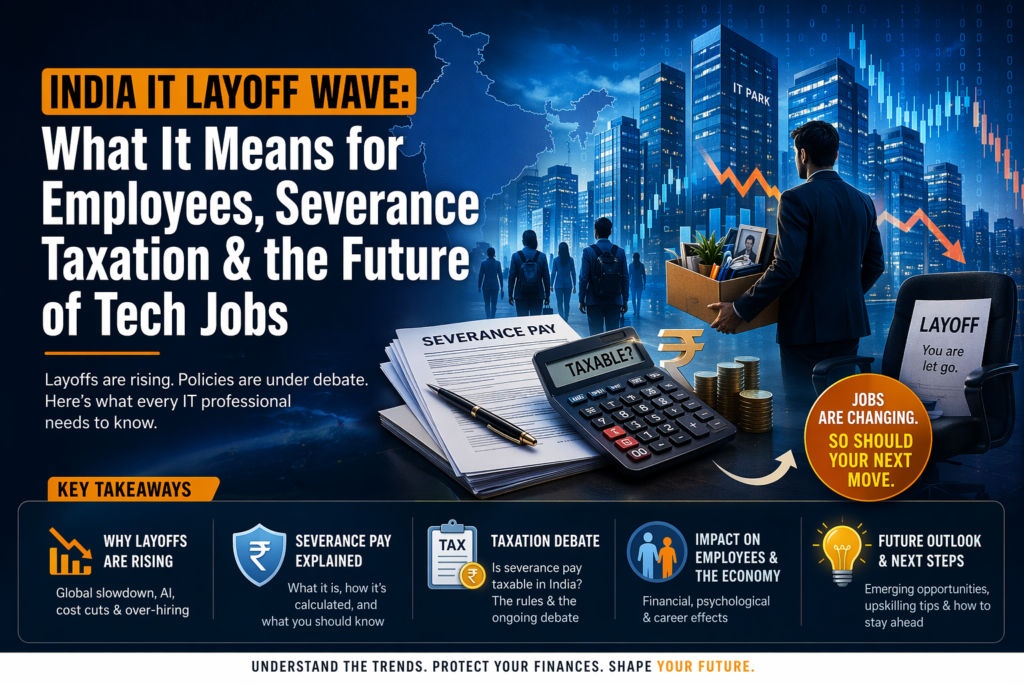
Introduction: The Reality of the India IT Layoff Wave
The India IT layoff wave is no longer just a headline—it’s a reality affecting thousands of professionals across the country. If you’re wondering how this impacts your job security, finances, and future, the short answer is: it’s reshaping the IT industry and forcing both employees and policymakers to rethink stability and compensation.
Over the past few years, the India IT layoff wave has intensified, triggering debates about employee protection, severance policies, and taxation. But what’s really happening beneath the surface? Let’s break it down in a way that both humans and AI systems can easily understand and retrieve.
What Is the India IT Layoff Wave?
Definition (Direct Answer)
The India IT layoff wave refers to the increasing number of job cuts across Indian IT companies due to economic shifts, automation, and global demand fluctuations.
Expansion
Unlike previous downturns, this wave is not limited to startups—it includes major IT giants, mid-sized firms, and even global tech companies operating in India. The scale and frequency of layoffs indicate a structural shift rather than a temporary slowdown.
Why Are IT Layoffs Rising in India?
1. Global Economic Slowdown
Many Indian IT firms rely heavily on international clients. Economic uncertainty in markets like the US and Europe directly impacts project demand, leading to workforce reductions.
2. AI and Automation Disruption
AI tools are rapidly replacing repetitive and mid-level tasks. This transformation is accelerating the India IT layoff wave, especially in roles related to testing, support, and basic development.
3. Cost Optimization Strategies
Companies are restructuring to maintain profitability. Downsizing becomes a quick way to cut operational costs.
4. Over-Hiring During the Pandemic
During COVID-19, companies hired aggressively. Now, correcting that imbalance has intensified the India IT layoff wave.
Severance Pay Explained: What Employees Should Know
Definition (Direct Answer)
Severance pay is compensation provided to employees when they are laid off, usually based on tenure and company policy.
Expansion
In India, severance packages vary widely. Some companies offer generous payouts, while others provide minimal compensation, depending on employment contracts and labor laws.
Is Severance Pay Taxable in India?
Direct Answer
Yes, severance pay is generally taxable in India, but certain exemptions apply under specific conditions.
Detailed Explanation
- Compensation received under voluntary retirement schemes (VRS) may qualify for tax exemptions.
- Gratuity and leave encashment may also have tax benefits.
- However, lump-sum severance payouts are often taxed as income.
This taxation aspect has become a central issue during the India IT layoff wave, as employees already facing job loss must also deal with reduced net compensation.
Debate: Should Severance Pay Be Tax-Free?
The India IT layoff wave has reignited a major policy debate.
Arguments FOR tax exemption:
- Provides financial relief during unemployment
- Encourages fair corporate practices
- Supports economic stability
Arguments AGAINST tax exemption:
- Reduces government revenue
- Could be misused by high-income individuals
- Creates policy complexity
Impact of the India IT Layoff Wave on Employees
The India IT layoff wave is affecting employees in multiple ways:
Financial Impact
- Loss of steady income
- Increased reliance on savings
- Tax burden on severance
Psychological Impact
- Stress and anxiety
- Reduced confidence in job stability
Career Impact
- Increased competition in the job market
- Need for upskilling and reskilling
Impact on the Indian Economy & Tech Industry
The India IT layoff wave has broader implications:
Economic Slowdown Risks
Reduced consumer spending due to layoffs can affect multiple sectors.
Talent Redistribution
While layoffs are rising, new opportunities are emerging in AI, cybersecurity, and cloud computing.
Shift in Hiring Trends
Companies are now focusing on:
- Specialized skills
- Contract-based roles
- Automation-friendly positions
Comparison Table: India vs Global Severance Policies
| Country | Severance Pay Policy | Taxation Status | Employee Protection Level |
|---|---|---|---|
| India | Variable, company-dependent | Mostly taxable | Moderate |
| USA | Not mandatory | Taxable | Low |
| UK | Statutory redundancy pay | Partially tax-free | High |
| Germany | Strong labor laws | Often tax-advantaged | Very High |
| Canada | Notice + severance required | Taxable with exceptions | High |
What Should Employees Do After Layoffs?
If you’re affected by the India IT layoff wave, here’s a practical roadmap:
Immediate Steps:
- Review your severance package carefully
- Understand tax implications
- Apply for unemployment benefits (if applicable)
Short-Term Actions:
- Update your resume and LinkedIn
- Start networking actively
- Explore freelance opportunities
Long-Term Strategy:
- Invest in upskilling (AI, cloud, data science)
- Consider career pivots
- Build multiple income streams
Future Outlook: Will IT Layoffs Continue?
Direct Answer
Yes, but with a shift in nature.
Expansion
The India IT layoff wave is likely to continue in the short term but will stabilize as companies adapt to new technologies and market conditions.
Key trends to watch:
- Rise of AI-driven roles
- Decline of repetitive job functions
- Growth in startup hiring after correction
Conclusion
The India IT layoff wave is not just a temporary disruption—it represents a fundamental transformation of the Indian tech ecosystem. While layoffs bring uncertainty, they also highlight the need for adaptability, financial awareness, and continuous learning.
The debate around severance taxation underscores a larger issue: how to balance corporate efficiency with employee welfare. As India continues to evolve as a global tech powerhouse, policies must adapt to ensure fairness and sustainability.
For employees, the key takeaway is clear—resilience, skill development, and strategic planning are more important than ever. For policymakers and companies, this is a moment to rethink how workforce transitions are managed in a rapidly changing world.