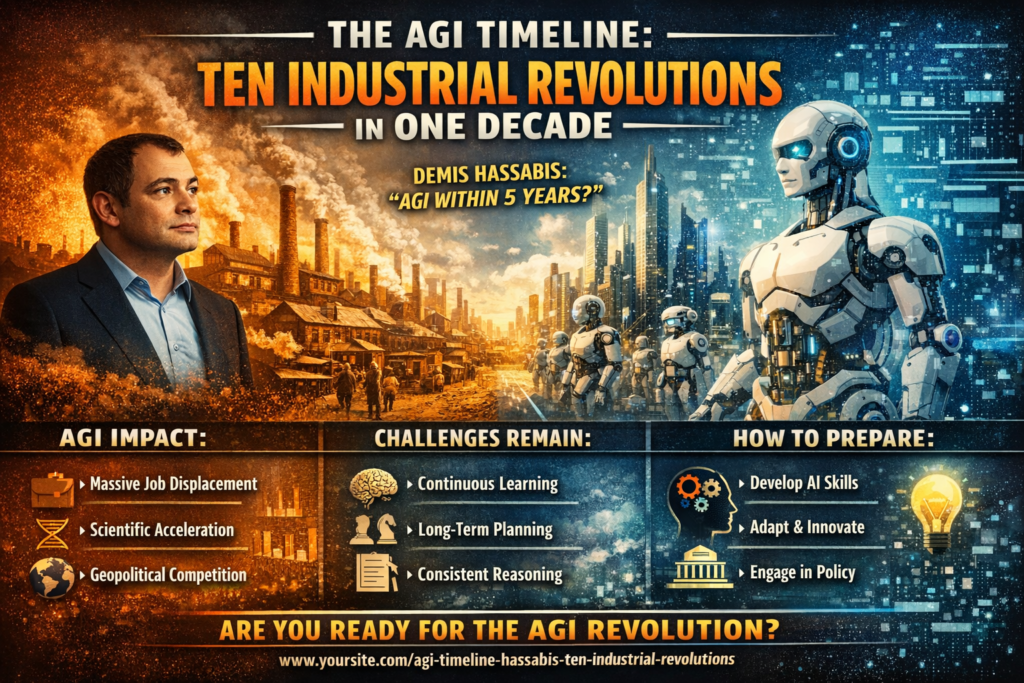
The AGI timeline is no longer a distant thought experiment — according to DeepMind CEO Demis Hassabis, artificial general intelligence could arrive within five years and reshape civilization faster than any technological shift in human history. If he’s right, the next decade will be the most consequential in recorded history.
What Is the AGI Timeline Demis Hassabis Is Predicting?
AGI timeline refers to the projected period during which artificial general intelligence — AI systems capable of matching or surpassing human-level performance across virtually any cognitive task — is expected to emerge.
In a April 2026 interview on the 20VC podcast, Hassabis quantified his view with striking precision: AGI will arrive with the force of “10 times the industrial revolution at 10 times the speed — unfolding over a decade instead of a century.” He added that he sees “a very good chance of it being within the next 5 years,” a prediction that, notably, aligns with a forecast made by DeepMind co-founder Shane Legg back in 2010, who estimated it would take about 20 years. By that count, we’re essentially on schedule.
This is not hype for hype’s sake. Hassabis is one of the most credentialed voices in AI — the architect of AlphaGo, AlphaFold, and Gemini. When he sets an AGI timeline this specific, the world listens.
Why Hassabis Compares AGI to Ten Industrial Revolutions
What Was the Industrial Revolution — and Why It’s the Right Benchmark?
The Industrial Revolution (roughly 1760–1840) transformed every dimension of human life: how we work, where we live, how long we survive, and how societies are organized. It mechanized labor, created the factory system, birthed modern capitalism, and sparked urbanization on a mass scale. It took roughly 80 years for its full effects to ripple through society.
That transformation is the gold standard for technological disruption. It’s the closest historical parallel to what Hassabis believes AGI will produce — except compressed from eight decades into one.
Ten Times the Impact, Ten Times the Speed
The comparison isn’t rhetorical flourish. It’s a structural argument about compounding. Where the Industrial Revolution automated physical labor, AGI would automate cognitive labor — the kind that drives science, medicine, law, engineering, art, and governance.
Hassabis’s framing — ten industrial revolutions in ten years — implies not just faster change, but change that arrives before most institutions, legal systems, or economies can adapt. The AGI timeline he describes is one where the window for preparation is shorter than the average corporate strategic cycle.
The “Jagged Intelligence” Problem: What AGI Still Needs to Solve
Despite his confidence in the AGI timeline, Hassabis is candid about the gaps that remain. He describes current AI systems — even the most advanced large language models — as “jagged intelligences.”
What does “jagged intelligence” mean?
A jagged intelligence is a system that performs brilliantly on some tasks when approached in certain ways, but fails at surprisingly elementary problems when the framing changes slightly. It’s capable of writing a legal brief but stumbling on basic spatial reasoning. It can explain quantum mechanics but miscount objects in a simple image.
This unevenness is a fundamental barrier to the AGI timeline. Hassabis identifies four core technical capabilities that still need significant advances before AGI is achievable:
- Continuous learning — the ability to update knowledge from new experiences without forgetting prior ones (overcoming “catastrophic forgetting”)
- Long-term planning — sustained, coherent reasoning across extended time horizons and multi-step goals
- Better memory architectures — richer, more structured, more retrievable internal representations of knowledge
- Greater consistency — stable, reliable performance regardless of how a question is framed or what context surrounds it
Each of these is an active research frontier. Solving them doesn’t guarantee AGI by any fixed date — but Hassabis believes scaling plus targeted architectural breakthroughs will close these gaps within this decade.
Importantly, he also notes that while scaling continues to deliver improvements, the gains are “a bit less than they were at the start.” This signals that raw compute scaling alone won’t complete the AGI timeline; architectural innovation matters just as much.
The Perception Gap: Overhyped Now, Underappreciated Long-Term
One of the most nuanced points Hassabis makes concerns the double mismatch in how people currently perceive AI.
His argument:
- Short-term (now to ~2027): AI is overhyped. Expectations exceed near-term capabilities, leading to disappointment and backlash.
- Long-term (~2030–2035): AI — and AGI in particular — is still “very underappreciated” in terms of how revolutionary it will actually be.
This creates a policy and preparation paradox. The noise of near-term overhype drowns out serious preparation for the long-term transformation. Businesses, governments, and individuals are calibrating their expectations on a curve that’s wrong in both directions simultaneously.
The AGI timeline problem isn’t just technical — it’s cognitive. We are collectively bad at preparing for slow-then-sudden shifts, especially when early hype has already eroded trust.
AGI Timeline Predictions vs. Historical AI Forecasts
How does the current AGI timeline compare to prior expert forecasts? Here’s a structured comparison of major predictions across the last two decades:
| Year | Source / Forecaster | AGI Timeline Estimate | Key Reasoning |
|---|---|---|---|
| 2009 | Shane Legg (DeepMind co-founder) | ~2029 (20 years out) | Extrapolation from early deep learning progress |
| 2014 | Nick Bostrom (Superintelligence) | Mid-21st century | Emphasized alignment difficulty as a constraint |
| 2017 | Various ML researchers (survey) | ~2040–2060 median | Broad consensus; high variance in estimates |
| 2023 | Sam Altman (OpenAI) | “Could be this decade” | GPT-4 capabilities accelerated expectations |
| 2024 | Ilya Sutskever (ex-OpenAI) | “AGI may already be near” | Hinted at internal progress beyond public models |
| 2026 | Demis Hassabis (DeepMind CEO) | Within 5 years (high confidence) | Scaling + architectural breakthroughs on track |
What the table tells us: AGI timeline estimates have systematically shifted earlier as capability gains have outpaced expectations. The 2017 median estimate of 2040–2060 now looks conservative. The current AGI timeline debate has essentially narrowed from “this century” to “this decade” — and, for Hassabis, to “this half of this decade.”
What the AGI Timeline Means for Society, Business, and You
For Society
The AGI timeline Hassabis describes would compress transformations that normally unfold across generations into a single decade. The closest historical parallels — the printing press, industrialization, electrification, the internet — each reshaped labor markets, governance, culture, and power structures. AGI would do all of that simultaneously.
Key societal implications include:
- Labor displacement at scale: Not just routine jobs, but knowledge work, professional services, and creative industries face restructuring.
- Scientific acceleration: Hassabis has consistently argued that AGI will compress decades of progress in medicine, climate science, and materials research into years. AlphaFold’s impact on protein science is a preview of this dynamic.
- Geopolitical competition: Nations racing to lead on the AGI timeline will treat AI development as a strategic priority equivalent to nuclear capability — with all the attendant security implications.
- Governance lag: Legal systems, regulatory frameworks, and democratic institutions are not designed to respond to change at the pace the AGI timeline implies.
For Businesses
Companies that plan on five-to-ten year strategic cycles are operating on a timeline that may be disrupted from below. The AGI timeline creates pressure to:
- Audit which workflows are vulnerable to automation within a 5-year horizon
- Invest in human-AI collaboration rather than binary replacement thinking
- Build institutional literacy around AI capabilities across every function — not just engineering
For Individuals
The AGI timeline is personally consequential in ways that most career and education planning hasn’t yet absorbed. Skills with a long shelf life in an AGI-adjacent world share one characteristic: they leverage judgment, creativity, relationship-building, and ethical reasoning — capacities that remain “jagged” for AI systems even as technical capabilities surge.
How to Prepare for the AGI Timeline — Practical Steps
What can individuals and organizations do now, given the AGI timeline Hassabis describes?
Preparation isn’t about panic — it’s about building resilience and positioning ahead of the shift. Here are concrete steps:
- Stay epistemically humble: The AGI timeline is uncertain even for experts. Hold strong views loosely and update them as capabilities evolve.
- Develop AI fluency: Understanding what current AI systems can and cannot do — and why — is a foundational literacy for navigating the transition period.
- Invest in adaptable skills: Reasoning under uncertainty, cross-domain synthesis, creative problem-solving, and interpersonal judgment are durable regardless of how the AGI timeline unfolds.
- Follow primary sources: Read papers, watch interviews (like the 20VC conversation with Hassabis), and engage with researchers directly rather than relying on second-hand AI coverage.
- Engage with governance: The AGI timeline is too important to leave entirely to technologists. Policy, ethics, and societal input matter and are under-resourced.
- Plan in scenarios, not certainties: Whether AGI arrives in 3 years or 15, scenario planning for different timelines is more useful than betting on a single date.
Frequently Asked Questions About the AGI Timeline
What exactly is AGI?
AGI — artificial general intelligence — is an AI system that can perform any intellectual task that a human can, across domains and contexts, without being specifically trained for each task. It is distinct from current AI, which excels at narrow, specific tasks.
Is the 5-year AGI timeline realistic?
Demis Hassabis believes so, and his track record of calling major milestones in AI (AlphaGo, AlphaFold) gives his predictions more weight than most. However, the AGI timeline is genuinely uncertain; major technical barriers — continuous learning, consistency, long-term planning — remain unsolved. Most researchers view “within this decade” as more probable than “within 5 years,” but the gap is narrowing.
How is AGI different from today’s AI like ChatGPT or Gemini?
Today’s frontier AI systems are extraordinarily powerful but “jagged” — they can outperform humans on many benchmark tasks while failing on simple variations of those same tasks. AGI implies robustness, consistency, and general capability across virtually all cognitive domains. The current AGI timeline discussion is precisely about when these remaining gaps get closed.
What will AGI do to jobs?
The AGI timeline Hassabis describes implies that cognitive automation will eventually touch most white-collar work. The more immediate question is what happens in the transition period — which jobs get augmented (humans + AI), which get displaced, and which new categories of work emerge. Historical evidence from prior technological revolutions suggests net job creation over the long run, but significant disruption in the short term.
Should I be alarmed about the AGI timeline?
Concern is reasonable; panic is not productive. The AGI timeline creates an imperative for preparation — personally, institutionally, and societally. Hassabis himself sees transformative upside (accelerated science, disease cures, climate solutions) alongside serious risks that require careful governance. The answer to the AGI timeline isn’t fear; it’s informed, adaptive action.
The Bottom Line: What the AGI Timeline Really Tells Us
The AGI timeline Demis Hassabis describes — ten industrial revolutions compressed into ten years — is either the most important statement made about technology in our lifetimes, or an overestimate that will nonetheless define how this decade’s AI development is understood.
Either way, the direction is clear. AI capabilities are advancing faster than most institutions and individuals are adapting. The AGI timeline debate has already shifted from “will it happen?” to “when?” and now, for the most credentialed people in the field, to “probably this decade.”
That shift demands a different kind of attention — not the breathless hype cycle that Hassabis himself acknowledges as a short-term problem, but the deliberate, eyes-open preparation that a genuine civilizational transition requires.
The window is open. The decade has already started.