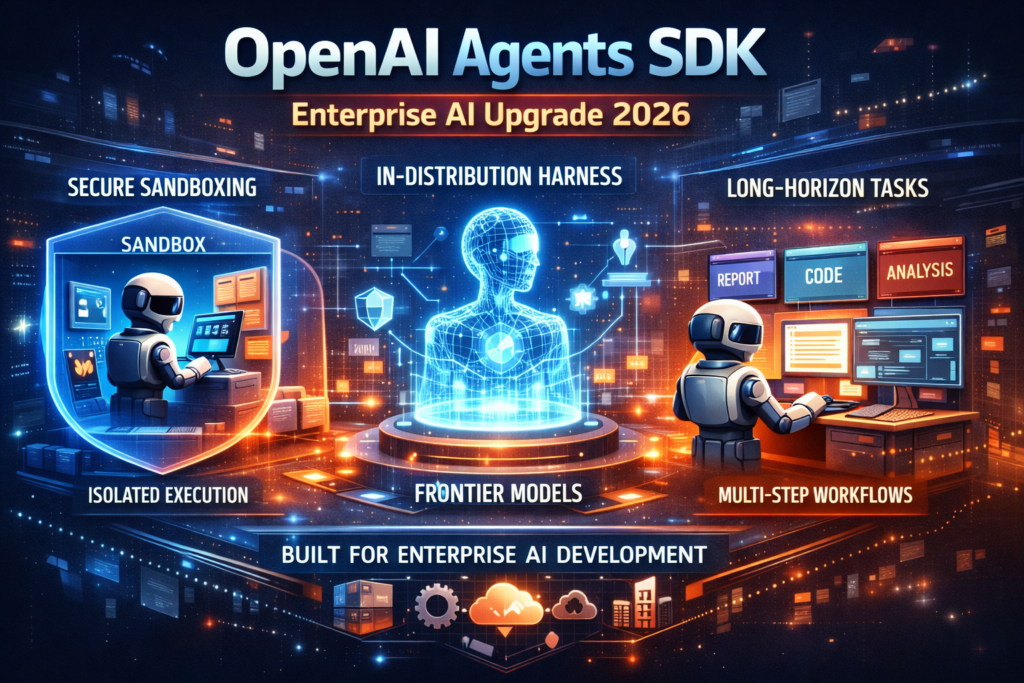
OpenAI has updated its Agents SDK with enterprise-critical capabilities — including AI agent sandboxing and in-distribution harness support — that make it significantly safer and more powerful to build and deploy autonomous AI agents at scale. If your organization is evaluating agentic AI for enterprises, this update changes the calculus in meaningful ways.
Released on April 15, 2026, the new version of the OpenAI Agents SDK introduces a set of features explicitly designed to address the two biggest enterprise blockers: safety and complexity. Here’s everything you need to know.
What Is the OpenAI Agents SDK?
Definition: The OpenAI Agents SDK is a software development toolkit that enables developers to build, configure, and deploy AI agents powered by OpenAI’s language models. It provides the core scaffolding — tools, memory, orchestration, and execution logic — needed to create agents that can reason through and complete multi-step tasks autonomously.
Unlike using the raw OpenAI API, the Agents SDK is purpose-built for agentic workflows: tasks that require an AI to plan across steps, use tools, access files, call external APIs, and adapt its behavior based on intermediate results.
For enterprises, the OpenAI Agents SDK serves as the foundation layer for building AI-powered workflows that go far beyond simple chatbot interactions. Think automated code review pipelines, internal knowledge retrieval agents, customer support escalation systems, and document analysis workflows — all operating with minimal human intervention.
What’s New in the Latest OpenAI Agents SDK Update?
The April 2026 update to the OpenAI Agents SDK introduces three headline capabilities: a sandboxing integration, an in-distribution harness for frontier models, and expanded support for long-horizon tasks.
AI Agent Sandboxing: Controlled Execution Environments
What is sandboxing in the context of AI agents? Sandboxing allows an AI agent to operate within a controlled, isolated computer environment — limiting what files, tools, and system resources the agent can access during any given operation.
This is a major safety advancement. Running AI agents in a fully unsupervised, unrestricted environment introduces real risks: an agent with too much access could inadvertently modify files, consume unintended resources, or trigger irreversible actions across a system. The sandbox integration addresses this directly.
With the new OpenAI Agents SDK, agents work within a siloed workspace, accessing only the files and code that are explicitly relevant to the task at hand. The rest of the system’s integrity is preserved. For enterprise IT and security teams, this is the feature that opens the door to broader internal deployment — because it makes agents far easier to contain, audit, and govern.
The SDK is being built to be compatible with multiple sandbox providers, giving enterprise developers flexibility in choosing the execution environment that fits their existing infrastructure.
In-Distribution Harness for Frontier Models
What is a harness in agent development? In agentic AI development, the “harness” refers to all the components surrounding the core language model: the tools the agent can use, the files it can access, the APIs it can call, and the logic controlling how it behaves.
The new in-distribution harness in the updated OpenAI Agents SDK is specifically designed for frontier models — the most advanced, general-purpose AI models currently available. An in-distribution harness ensures the agent operates consistently within the expected behavioral range of the model, reducing the likelihood of unpredictable or out-of-scope actions.
Practically, this means enterprises can both deploy and test their agents against frontier models within a standardized framework. It reduces the engineering overhead of building custom wrapper logic and gives teams a reliable, auditable baseline for agent behavior.
As Karan Sharma from OpenAI’s product team explained to TechCrunch, the goal is for this, paired with the sandbox capabilities, to allow users to “go build these long-horizon agents using our harness and with whatever infrastructure they have.”
Long-Horizon Task Support
What are long-horizon AI agents? Long-horizon agents are AI systems capable of completing complex, multi-step tasks that unfold over extended periods — rather than single-turn interactions. Examples include: drafting a full research report by searching, synthesizing, and formatting information over multiple steps; autonomously managing a codebase refactor across dozens of files; or running an end-to-end data pipeline from ingestion to reporting.
The updated OpenAI Agents SDK is explicitly engineered to support these long-horizon workflows. The combination of sandboxing (safe execution), the frontier model harness (reliable behavior), and improved tool access creates an environment where agents can work through complex, extended tasks without requiring constant human checkpoints.
Why This Update Matters for Enterprise AI Development
The release of these features signals a maturation of the agentic AI market — one that’s moving past proof-of-concept demos into production-grade infrastructure.
The Safety Gap Is Being Closed
One of the primary reasons enterprises have hesitated to deploy AI agents broadly is the unpredictability problem. Without proper guardrails, an agent given broad system access is a liability. The sandboxing feature directly addresses this concern by introducing execution boundaries that mirror established enterprise security practices — least-privilege access, isolated workspaces, and auditable scopes.
The Complexity Gap Is Being Reduced
Building reliable agentic AI for enterprises has historically required significant custom engineering. Teams needed to design their own harnesses, manage model behavior at the edges, and build infrastructure to support long-running tasks. The OpenAI Agents SDK update consolidates much of this into the toolkit itself, reducing time-to-deployment and lowering the barrier for teams without deep ML infrastructure expertise.
The Competitive Signal
OpenAI is not the only player in this space. Anthropic, LangChain, and others have been developing their own agent frameworks with varying degrees of enterprise readiness. The speed and specificity of this update — targeting sandbox compatibility, frontier model harnesses, and long-horizon support simultaneously — suggests OpenAI is deliberately positioning its Agents SDK as the enterprise default for agentic AI development.
OpenAI Agents SDK vs. Competing Agent Frameworks
How does the updated OpenAI Agents SDK compare to other major options for enterprise agent development?
| Feature | OpenAI Agents SDK (2026) | LangChain / LangGraph | Anthropic Claude Agents |
|---|---|---|---|
| Sandboxing Support | ✅ Native, multi-provider | ⚠️ Requires custom setup | ⚠️ Partial, via tool use |
| Frontier Model Harness | ✅ In-distribution, built-in | ❌ Model-agnostic, no harness | ✅ Via Claude model tooling |
| Long-Horizon Task Support | ✅ Explicitly designed for it | ✅ Via graph-based agents | ✅ Extended context + tools |
| Enterprise Access | ✅ Via API, standard pricing | ✅ Open source + hosted | ✅ API + Workbench |
| Python Support | ✅ Available now | ✅ Available now | ✅ Available now |
| TypeScript Support | 🔜 Planned | ✅ Available now | ✅ Available now |
| Multi-model Compatibility | ❌ OpenAI models only | ✅ Multi-model | ❌ Anthropic models only |
| Audit & Governance Tools | ✅ Sandbox-level isolation | ⚠️ Depends on deployment | ⚠️ Limited native tooling |
Key takeaway: The OpenAI Agents SDK leads on integrated safety infrastructure (sandboxing + harness), while LangChain/LangGraph retains an edge on flexibility and multi-model support. Enterprises standardized on OpenAI’s model stack will find the SDK the most cohesive option; teams seeking model-agnostic workflows may still prefer LangChain.
Who Can Access the New OpenAI Agents SDK Features?
Q: Do you need a special plan or enterprise contract to access the new capabilities?
No. OpenAI confirmed that the new harness and sandbox features in the updated Agents SDK are available to all customers via the standard API, using standard pricing. There is no premium tier or enterprise-only gate for the core features.
Q: What programming languages are supported right now?
As of the April 2026 release, the new sandbox and harness capabilities are available in Python. TypeScript support is in development and planned for a future release. OpenAI has also indicated that additional agent capabilities — including code mode and subagents — are being brought to both Python and TypeScript.
Q: Is this the same as the existing Assistants API?
No. The OpenAI Agents SDK is distinct from the Assistants API, though they share underlying model infrastructure. The Agents SDK is focused on building autonomous, tool-using, multi-step agents with production-grade safety features, whereas the Assistants API is designed for more structured assistant interactions.
How to Start Building Safer Enterprise Agents with the OpenAI Agents SDK
If your team is ready to evaluate or begin building with the updated OpenAI Agents SDK, here’s a practical starting framework:
- Audit your task inventory. Identify which internal workflows involve repetitive, multi-step reasoning — document processing, data extraction, code review, customer ticket routing — as these are the best candidates for agentic AI for enterprises.
- Start with sandboxed environments. Use the new sandbox integration from day one, even in development. Building within execution boundaries from the start makes governance and production deployment significantly easier.
- Define your harness scope explicitly. Specify exactly which tools, files, and APIs the agent should have access to. The in-distribution harness works best when you’ve clearly mapped the operational boundaries before deployment.
- Design for long-horizon reliability. Break complex tasks into auditable sub-steps. Even with long-horizon AI agent support built into the SDK, designing tasks with clear intermediate checkpoints improves reliability and debuggability.
- Test with frontier models in-distribution. Use the harness as intended — evaluate your agent’s behavior against the frontier model within the SDK’s framework rather than building custom evaluation logic outside it.
- Monitor execution traces. With sandbox isolation, you gain the ability to audit what an agent accessed during a task. Build logging into your workflow from the start to create a complete execution record.
- Plan for TypeScript. If your team works primarily in TypeScript, build your Python prototype now and document the architecture — TypeScript support is coming, and a well-structured implementation will migrate cleanly.
What OpenAI Plans Next for the Agents SDK
OpenAI has signaled that the April 2026 update is the beginning of an ongoing expansion of the OpenAI Agents SDK, not a finished product. Several developments are publicly confirmed or implied:
Code mode and subagents: OpenAI is actively working to bring code mode (enabling agents to write and execute code as part of their reasoning) and subagent support (allowing agents to spawn and coordinate with other agents) to both Python and TypeScript.
Broader sandbox provider compatibility: The current update focuses on making the SDK compatible with a range of sandbox providers, suggesting that future releases will expand the number of supported execution environments — potentially including cloud-native sandboxing options from AWS, Google Cloud, and Azure.
Extended long-horizon capabilities: As frontier model context windows continue to expand, the long-horizon capabilities of the OpenAI Agents SDK are expected to scale accordingly, enabling even more complex, multi-day autonomous workflows.
TypeScript parity: Full feature parity between Python and TypeScript is a stated goal, which will significantly broaden the enterprise developer audience — particularly for teams building full-stack applications where TypeScript is the primary language.
❓ Frequently Asked Questions (FAQ)
1. What is the OpenAI Agents SDK and how does it work?
The OpenAI Agents SDK is a powerful development framework designed to help developers build, deploy, and manage AI agents that can perform complex, multi-step tasks autonomously. Unlike traditional API-based integrations, the SDK provides built-in support for memory, tool usage, workflow orchestration, and execution logic.
In simple terms, it allows AI to go beyond answering questions and actually complete tasks—such as analyzing documents, writing code, or automating workflows. The OpenAI Agents SDK works by combining advanced language models with a structured environment where agents can interact with tools, data, and external systems in a controlled way.
2. What are the key features of the OpenAI Agents SDK in 2026?
The 2026 update of the OpenAI Agents SDK introduces several groundbreaking features that significantly enhance enterprise readiness. These include AI agent sandboxing, which ensures secure execution environments; an in-distribution harness for predictable behavior with advanced models; and support for long-horizon AI agents capable of handling complex, multi-step workflows.
Additionally, the SDK simplifies enterprise AI development by reducing the need for custom infrastructure. Developers can now build scalable and secure agentic AI systems more efficiently, making it easier to move from prototype to production.
3. What is AI agent sandboxing and why is it important?
AI agent sandboxing refers to running AI agents in isolated, controlled environments where their access to files, systems, and resources is restricted. This is one of the most critical features introduced in the OpenAI Agents SDK.
For enterprises, sandboxing is essential because it minimizes risks associated with autonomous AI behavior. It prevents agents from accessing sensitive data, modifying critical systems, or performing unintended actions. By enforcing strict boundaries, sandboxing ensures that AI agents operate safely while still being effective in completing tasks.
4. What are long-horizon AI agents?
Long-horizon AI agents are systems designed to handle tasks that require multiple steps over an extended period of time. Instead of responding to a single prompt, these agents can plan, execute, and adapt their actions across a sequence of operations.
For example, a long-horizon agent can research a topic, compile information, generate a report, and refine it—all without human intervention. The OpenAI Agents SDK is specifically optimized to support these types of workflows, making it ideal for enterprise use cases like automation, analytics, and process optimization.
5. How does the OpenAI Agents SDK improve enterprise AI development?
The OpenAI Agents SDK significantly improves enterprise AI development by addressing two major challenges: safety and complexity. With built-in sandboxing and structured execution environments, enterprises can deploy AI agents with greater confidence and control.
At the same time, the SDK reduces development complexity by providing pre-built components for orchestration, memory, and tool integration. This eliminates the need for extensive custom engineering and accelerates the development lifecycle. As a result, organizations can implement agentic AI solutions faster and more efficiently.
6. How does the OpenAI Agents SDK compare to other frameworks like LangChain?
Compared to frameworks like LangChain, the OpenAI Agents SDK offers a more integrated and enterprise-focused approach. While LangChain provides flexibility and supports multiple models, it often requires additional setup for features like sandboxing and governance.
In contrast, the OpenAI Agents SDK includes native support for sandboxing, an in-distribution harness, and long-horizon task management. This makes it a more streamlined choice for organizations already using OpenAI models. However, teams looking for multi-model compatibility may still prefer alternatives like LangChain.
7. Who can use the OpenAI Agents SDK?
The OpenAI Agents SDK is available to all developers and organizations using OpenAI’s API. There are no special enterprise-only restrictions for accessing the core features introduced in the 2026 update.
Currently, the SDK supports Python, with TypeScript support expected in future releases. This accessibility makes it suitable for startups, mid-sized companies, and large enterprises alike, enabling a wide range of users to build advanced AI agent solutions.
8. What are the best use cases for the OpenAI Agents SDK?
The OpenAI Agents SDK is ideal for use cases that involve complex workflows and require automation across multiple steps. Common applications include document processing, customer support automation, data analysis, code generation, and internal knowledge management.
It is especially useful for enterprises looking to implement agentic AI for repetitive and time-consuming tasks. By leveraging long-horizon AI agents, organizations can improve efficiency, reduce operational costs, and enhance decision-making processes.
9. Is the OpenAI Agents SDK safe for enterprise deployment?
Yes, the OpenAI Agents SDK is designed with enterprise safety in mind. The introduction of sandboxing ensures that agents operate within controlled environments, reducing the risk of unintended actions. Additionally, the in-distribution harness helps maintain predictable behavior, even when using advanced AI models.
These features make the SDK one of the most secure options available for deploying AI agents in production environments. Enterprises can implement governance, monitoring, and auditing mechanisms to further enhance safety and compliance.
10. How can beginners get started with the OpenAI Agents SDK?
Beginners can start by installing the OpenAI Agents SDK in a Python environment and exploring basic agent workflows. It’s recommended to begin with simple tasks, such as creating an agent that retrieves and summarizes information.
From there, developers can gradually introduce tools, APIs, and sandboxed environments to build more advanced workflows. Following best practices—such as defining clear task boundaries and monitoring agent behavior—will help ensure successful implementation.
Key Takeaways
The April 2026 update to the OpenAI Agents SDK is one of the most significant enterprise-focused releases in the agentic AI space so far this year. Here’s the short version:
- The OpenAI Agents SDK now includes native sandboxing, enabling agents to operate in isolated, secure execution environments — a critical feature for enterprise deployment.
- A new in-distribution harness allows teams to build and test agents running on frontier models within a standardized, predictable framework.
- Long-horizon AI agent support is now explicitly built into the SDK, enabling complex, multi-step autonomous workflows at scale.
- All new features are available to all API customers at standard pricing, with Python support now and TypeScript coming.
- For enterprises evaluating agentic AI, this update materially addresses the two biggest adoption blockers: safety and infrastructure complexity.
The race to define the enterprise standard for agentic AI is accelerating. The OpenAI Agents SDK is now a serious, production-ready contender — and for teams already building on OpenAI’s model stack, this update removes most of the remaining reasons to look elsewhere.