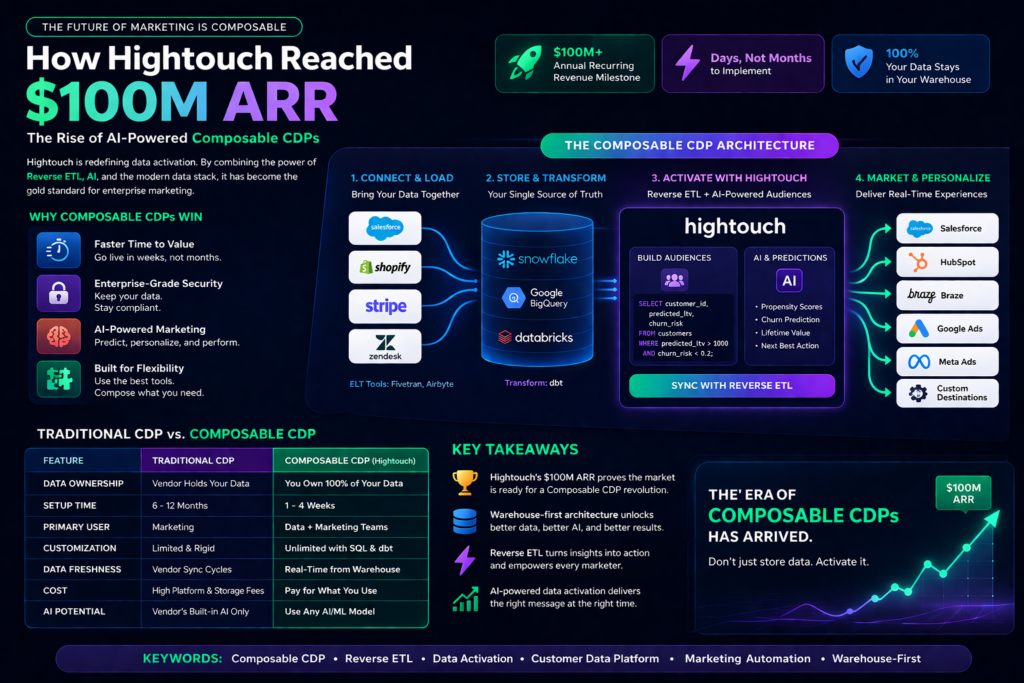
The modern marketing stack is undergoing a seismic shift, and the recent announcement that Hightouch has surpassed $100 million in Annual Recurring Revenue (ARR) is the definitive proof. This milestone marks the official transition of the Composable CDP from a “developer’s secret” to the gold standard for enterprise marketing. By leveraging AI-driven data activation and the power of Reverse ETL, Hightouch has fundamentally changed how brands interact with their customers.
In its simplest form, a Composable CDP is an architecture that allows a company to build a full-scale Customer Data Platform using its existing cloud data warehouse as the foundation. Instead of shipping data to a “black box” vendor, companies keep their data in Snowflake, BigQuery, or Databricks and “compose” the features they need—like audience segmentation and multi-channel syncing—directly on top of it.
1. What is a Composable CDP? (Definition + Expansion)
To understand the rise of Hightouch, one must first define the Composable CDP. Traditionally, a Customer Data Platform (CDP) was a monolithic software package. You bought it, sent your data to the vendor’s cloud, and hoped their “identity resolution” algorithms worked. If they didn’t, your data was essentially trapped in a silo that your data scientists couldn’t access.
The Composable CDP flips this script. It is an unbundled approach to data management. Instead of one giant piece of software, it is a modular stack consisting of:
- The Loading Layer: Tools like Fivetran or Airbyte that move data from SaaS apps into your warehouse.
- The Storage Layer: Your cloud data warehouse (the “Single Source of Truth”).
- The Transformation Layer: Tools like dbt (data build tool) that clean and model your data.
- The Activation Layer: This is where Hightouch lives. It takes the modeled data and syncs it to marketing tools.
By choosing a Composable CDP, organizations ensure that their marketing teams are using the exact same data as their finance and analytics teams. There is no “data gap.” If a customer cancels a subscription, that information is updated in the warehouse and instantly synced to the email marketing tool via Reverse ETL, preventing an embarrassing “please renew” email from being sent to a frustrated former customer.
2. The $100M Milestone: Why Hightouch is Winning
The journey to $100M ARR is a rare feat in the SaaS world, especially in a category as crowded as the Customer Data Platform space. Hightouch’s success is built on three pillars: Speed, Security, and Simplicity.
Speed to Value
Traditional CDPs often take six to twelve months to implement because they require a complete overhaul of how a company collects data. A Composable CDP, however, can be “turned on” in days. Since the data already lives in the company’s warehouse, Hightouch simply connects to it and starts syncing. This “Time-to-Value” is a massive competitive advantage when CMOs are under pressure to show results quarterly.
Enterprise-Grade Security
In an era of GDPR, CCPA, and strict data privacy laws, sending PII (Personally Identifiable Information) to yet another third-party vendor is a massive legal risk. With a Composable CDP, the data never leaves your infrastructure. Hightouch acts as a “pass-through” layer. It reads the data, encrypts it, sends it to the destination (like Facebook or Salesforce), and then “forgets” it. This architecture is a dream for Chief Information Security Officers (CISOs).
3. The Role of Reverse ETL in Modern Data Stacks
You cannot talk about the growth of Hightouch without mentioning Reverse ETL. If ETL (Extract, Transform, Load) is the process of getting data into a warehouse, Reverse ETL is the process of getting it out and into the hands of business users.
Question: Why is Reverse ETL the engine of the Composable CDP?
Answer: Because it democratizes data. For decades, the best data in a company was “locked” in the warehouse, accessible only to people who knew SQL. Reverse ETL tools like Hightouch create a UI that allows a non-technical marketer to say, “Take this list of high-value customers from our Snowflake table and sync it to our Google Ads account every hour.”
This creates a “Data Activation” loop. Instead of just looking at dashboards (passive data), companies are now using that data to trigger real-world actions (active data). This shift from “reporting” to “activation” is exactly why Hightouch has seen such explosive growth.
4. How AI-Powered Marketing Tools are Fueling Growth
As we move further into 2026, the integration of Artificial Intelligence has become the primary growth lever for the Composable CDP. AHomeI requires a massive amount of high-quality data to be effective. Because the composable model uses the warehouse, it provides the most comprehensive data set possible for AI models.
Predictive Modeling at Scale
Hightouch has introduced AI features that allow marketers to predict customer behavior before it happens. By analyzing historical patterns in the warehouse, the AI can assign a “Propensity Score” to every customer.
- Who is 80% likely to churn?
- Who is 90% likely to buy a second pair of shoes?
- Which customers have the highest Lifetime Value (LTV)?
These scores are then synced via the Composable CDP to ad platforms, allowing for hyper-targeted bidding. Instead of spending $5 to show an ad to everyone, a company might spend $50 to show an ad only to the “High LTV” segment, knowing the ROI will be significantly higher.
5. Comparison: Traditional CDP vs. Composable CDP
To help decision-makers understand the landscape, here is a detailed breakdown of the two competing philosophies:
| Feature | Traditional Packaged CDP | Composable CDP (Hightouch Model) |
| Data Ownership | Vendor owns a copy of your data | You own 100% of your data |
| Primary User | Marketing | Data Engineering + Marketing |
| Setup Time | 6 – 12 Months | 1 – 4 Weeks |
| Data Freshness | Dependent on Vendor’s sync cycle | Dependent on your Warehouse speed |
| Customization | Limited to vendor’s “Standard” fields | Unlimited (Anything in SQL/dbt) |
| Cost | High (Storage + Platform + Seats) | Low (Pay per “Sync” or “Destination”) |
| AI Integration | Limited to vendor’s “built-in” AI | Connects to any AI/ML model in your cloud |
6. Case Study: Personalization at Scale with Generative AI
Imagine a global retail brand with 10 million customers. In the old world, they would send the same “10% Off” email to everyone. With a Composable CDP and Generative AI, the process looks like this:
- Data Aggregation: The warehouse collects data on every shirt, pant, and accessory a customer has looked at.
- AI Analysis: A Generative AI model (like Gemini or GPT-4) analyzes the customer’s “vibe” based on their browsing history.
- Content Generation: The AI writes a personalized email subject line: “Hey Sarah, we noticed you loved those linen trousers—here are 3 tops to match your style.”
- Activation: Hightouch syncs this personalized content to the email service provider (ESP) instantly.
This level of 1-to-1 personalization was impossible five years ago. Today, it is the reason why companies using Hightouch are seeing massive increases in conversion rates.
7. The Architecture of a Composable CDP: A Deep Dive
To build a Composable CDP, an organization typically follows a specific technical blueprint. This modularity is what makes the system so resilient.
The Identity Resolution Layer
One of the hardest problems in marketing is “Identity Resolution”—knowing that “john.doe@gmail.com” on a phone is the same “John D.” who bought a jacket on a laptop. Traditional CDPs tried to solve this with proprietary identity graphs. In a Composable CDP, identity resolution happens in the warehouse using SQL or specialized tools like Zilch or Spark. This ensures the logic is transparent and “inspectable” by the data team.
The Audience Builder
A key component of Hightouch’s success is its “Visual Audience Builder.” It allows marketers to create segments using a “no-code” interface that looks like a flowchart. Behind the scenes, Hightouch translates these visual blocks into complex SQL queries that run directly against the warehouse. This bridges the gap between the technical capabilities of the data warehouse and the creative needs of the marketing team.
8. Why “Warehouse-First” is the Future of AI
AI is only as good as the context it is given. If you ask an AI to write a marketing email but only give it the last three clicks from a website, the email will be generic. However, if you give that AI access to the Composable CDP—which includes five years of purchase history, customer support tickets, and loyalty program status—the AI can generate something truly “magical.”
The warehouse is the only place where this level of “Omnichannel” data exists. Therefore, the warehouse-first approach is the only way to truly leverage the next generation of LLMs (Large Language Models) in a business context.
9. Overcoming Implementation Hurdles
While the benefits of a Composable CDP are clear, the transition isn’t without challenges. Organizations must ensure:
- Data Quality: If the data in your warehouse is “trash,” your activation will be “trash.” Garbage in, garbage out.
- Warehouse Performance: Syncing 100 million rows every hour requires a well-optimized Snowflake or BigQuery environment.
- Team Collaboration: Data engineers and marketers must learn to speak the same language. The data engineer provides the “tables,” and the marketer provides the “intent.”
10. FAQ: Everything You Need to Know About Composable CDPs
Q: Is a Composable CDP more expensive than a traditional one?
A: Generally, no. While you have to pay for your warehouse storage, you avoid the massive “platform tax” charged by legacy CDPs. Most companies find that the Composable CDP model reduces their total cost of ownership (TCO) by 30-50%.
Q: Can I use Hightouch with my existing marketing tools?
A: Yes. Hightouch supports over 200+ destinations, including Salesforce, Hubspot, Braze, Iterable, Facebook Ads, and even custom API endpoints.
Q: Do I need to be a coder to use a Composable CDP?
A: No. While a data engineer usually sets up the initial connection, the day-to-day use of the audience builder and sync management is designed for non-technical marketers.
Q: How does the Hightouch $100M ARR milestone affect the market?
A: It signals to investors and enterprises that the “unbundled” data stack is a permanent fixture of the industry. Expect to see more legacy vendors trying to “add” composable features to their existing platforms to keep up.
11. Conclusion: The New Standard for Data Activation
The story of Hightouch reaching $100M ARR is a story of technology catching up to marketing’s biggest promises. For years, “the right message at the right time” was a myth. Today, thanks to the Composable CDP, it is a reality.
By centering the customer experience around the data warehouse, brands are becoming more agile, more secure, and more personal. As AI continues to evolve, the gap between those who “activate” their data and those who simply “store” it will only widen. The $100M milestone is just the beginning; the era of the Composable CDP has truly arrived.
❓ Frequently Asked Questions
What is this new approach to managing customer data?
This modern approach focuses on building a flexible system using your existing data infrastructure rather than relying on a single all-in-one platform. Instead of sending customer information to an external system, everything is managed within your own cloud environment.
It allows businesses to combine different tools for collecting, transforming, and using data. This creates a more adaptable system where teams can choose the best solutions for their needs instead of being locked into one vendor.
The biggest advantage is transparency. Teams can see exactly how data is structured and used, which improves trust and decision-making across departments.
How does data move from storage to marketing tools?
Data is first collected and stored in a central system, usually a cloud-based warehouse. After being cleaned and organized, it is then pushed into various tools used by marketing, sales, and support teams.
This process ensures that insights are not just stored but actively used. For example, a list of high-value customers can be automatically sent to an advertising platform or email tool without manual effort.
The result is faster execution, better targeting, and more consistent communication across all customer touchpoints.
Why is keeping data in your own system important?
Keeping data within your own environment gives you full ownership and control. You don’t have to depend on external vendors to store or process sensitive customer information.
This approach also improves security and compliance. Since the data doesn’t need to be duplicated across multiple systems, the risk of breaches or inconsistencies is reduced.
Additionally, it ensures that all teams are working with the same information, eliminating confusion caused by mismatched data across platforms.
What are the main advantages of this data strategy?
One of the biggest advantages is speed. Since the data is already available in your system, you can quickly launch campaigns and experiments without waiting for long setup processes.
Another benefit is flexibility. You can easily switch tools or add new ones without disrupting your entire setup. This makes it easier to adapt to changing business needs.
It also improves accuracy. With a single source of truth, there is less chance of errors or conflicting reports between teams.
Finally, it supports advanced use cases like predictive analytics and automation, helping businesses stay competitive in a data-driven world.
Is this approach suitable for smaller businesses?
Yes, but it depends on the company’s readiness. Smaller businesses can benefit from this approach, especially as cloud tools become more affordable and user-friendly.
However, it works best when there is a clear structure for collecting and managing data. If a company is still in the early stages of building its data systems, it may need to start with simpler solutions before adopting a more advanced setup.
As the business grows, this approach can scale with it, making it a future-proof investment.
How does artificial intelligence fit into this system?
Artificial intelligence plays a major role by turning raw data into meaningful insights. Since all information is stored in one place, AI models can analyze patterns more effectively.
This enables use cases like predicting customer behavior, identifying potential churn, and recommending personalized offers. These insights can then be automatically applied across different platforms.
The combination of centralized data and intelligent algorithms allows businesses to move from reactive decisions to proactive strategies.
What challenges should companies be aware of?
One common challenge is maintaining high-quality data. If the data being collected is incomplete or inaccurate, it can lead to poor decisions and ineffective campaigns.
Another challenge is coordination between teams. Technical and non-technical teams need to work closely together to ensure everything runs smoothly.
There may also be an initial learning curve when setting up the system. However, once established, it becomes much easier to manage and scale over time.
How does this improve marketing automation?
This approach enables real-time updates and dynamic audience creation. Instead of relying on static lists, marketers can use live data to trigger actions instantly.
For example, if a customer shows interest in a product, they can immediately receive a relevant message or offer. This increases engagement and improves the overall customer experience.
Automation becomes smarter and more responsive, leading to better results with less manual effort.
Which industries can benefit the most?
Many industries can take advantage of this strategy. Retail businesses use it to personalize shopping experiences and improve customer retention.
Software companies use it to track user behavior and optimize onboarding processes. Financial institutions rely on it for better insights and compliance.
Even sectors like healthcare and education are starting to use data-driven systems to improve outcomes and decision-making.
In general, any organization that relies on customer data can benefit from a more flexible and scalable approach.
Is this the future of data-driven marketing?
All signs point in that direction. Businesses are increasingly prioritizing control, flexibility, and real-time insights. Traditional systems often struggle to keep up with these demands.
This newer approach addresses those limitations by offering a more open and adaptable framework. It aligns well with modern technologies like cloud computing and artificial intelligence.
As these technologies continue to evolve, more organizations are expected to adopt this model, making it a standard practice in the coming years.