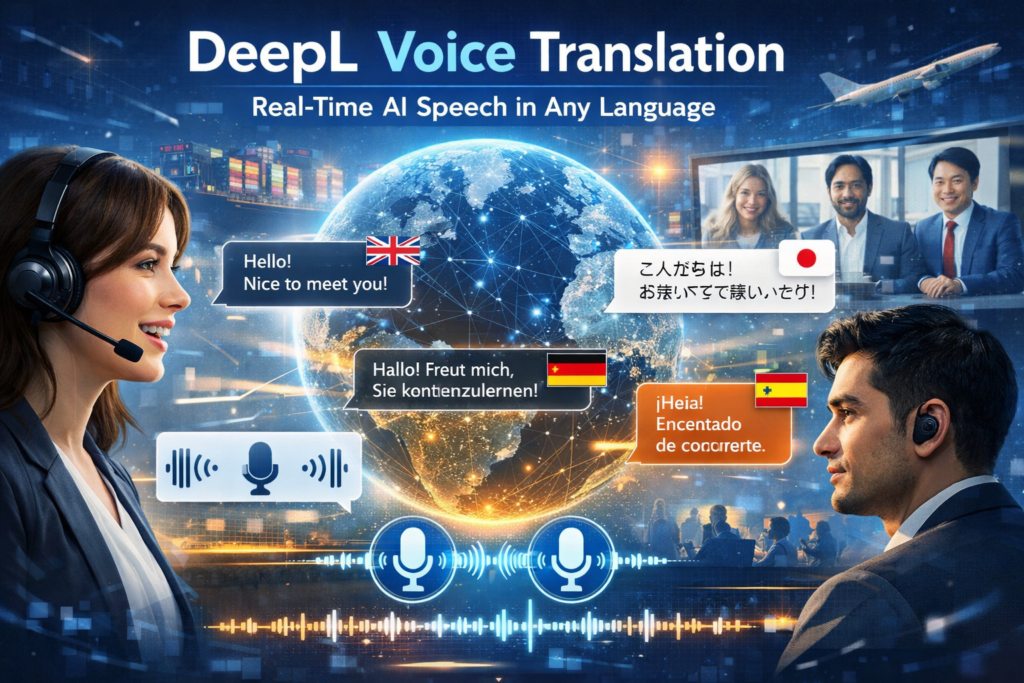
DeepL Voice translation is the newest breakthrough from the industry-leading language AI company, designed to provide instantaneous, high-fidelity speech-to-speech and speech-to-text interpretation. By leveraging its world-renowned neural networks, DeepL is bridging the gap between static text translation and fluid, real-time verbal dialogue for global enterprises.
For years, DeepL has been the “gold standard” for professionals who found other tools too literal or clunky. Now, with the launch of its voice capabilities, the company is targeting the multi-billion dollar interpretation market. This post explores the mechanics, advantages, and future implications of DeepL Voice translation in a world that is more connected yet linguistically diverse than ever.
What is DeepL Voice?
DeepL Voice translation is a suite of AI-driven tools that allows users to speak in one language and have their words translated into another instantly. Unlike traditional “translate then speak” apps that suffer from significant lag, this technology focuses on “live” streams of data. It is built to handle the nuances of spoken language—including fillers, accents, and local dialects—which are often lost in standard text-to-speech engines.
The expansion into voice is a natural evolution. As businesses move toward hybrid and remote work models, the demand for real-time AI speech translation has skyrocketed. DeepL is moving beyond the browser and the document uploader, embedding itself directly into video conferencing platforms and mobile devices to act as a digital interpreter.
Definition: Speech-to-Speech (S2S) vs. Speech-to-Text (S2T)
In the context of DeepL, “Voice” refers to two distinct but interlinked technologies. First, there is the visual component, where spoken words are converted into translated captions on a screen. Second, there is the auditory component, where the AI synthesizes a voice to “speak” the translation. DeepL Voice translation excels in both, ensuring that whether you are reading a live transcript or listening to a localized audio feed, the meaning remains intact.
The Technology Behind DeepL Voice Translation
To understand why DeepL Voice translation is different, one must look at its architectural foundation. Most voice tools use a three-step process: Automatic Speech Recognition (ASR), Machine Translation (MT), and Text-to-Speech (TTS). DeepL has optimized this pipeline to minimize “drift”—the phenomenon where errors in the first step cascade through the rest.
Neural Networks and Low Latency
The core of DeepL’s success has always been its proprietary neural network architecture. For voice, they have introduced “Streaming Transformer” models. These models don’t wait for a speaker to finish a whole sentence before they begin processing. Instead, they predict context based on the first few words, allowing for a latency that feels near-human.
Maintaining Context in Speech
Spoken language is messy. We say “um,” we correct ourselves mid-sentence, and we use slang. DeepL Voice translation utilizes a specialized cleaning layer that filters out non-lexical fillers while retaining the emotional intent of the speaker. This ensures that the final output sounds professional and coherent, rather than a word-for-word transcript of a disorganized thought.
DeepL Voice vs. Traditional Translation Tools
When choosing a communication stack, businesses often compare DeepL vs. Google Translate or Microsoft Translator. The following table highlights the key differences in the voice-specific domain.
| Feature | DeepL Voice Translation | Google Translate (Voice) | Microsoft / Skype Translator |
| Accuracy | Extremely High (Nuance-focused) | High (General purpose) | Moderate |
| Latency | Ultra-Low / Real-time | Low / Near-real-time | Variable |
| Enterprise Security | SOC2 / GDPR Compliant | Standard | Enterprise Ready |
| Primary Use Case | Business / Diplomacy | Travel / Casual | Meetings / Education |
| Contextual Awareness | High (Industry-specific) | Moderate | Moderate |
Key Features of DeepL Voice Translation for Businesses
For the modern Operations Manager or CTO, DeepL Voice translation offers a set of features designed to eliminate the friction of international trade. These aren’t just gadgets; they are enterprise-grade tools that integrate into existing workflows.
1. Virtual Meeting Integration
One of the most powerful applications of DeepL Voice translation is its ability to sit inside your meeting software. Whether you use Zoom, Microsoft Teams, or Google Meet, the AI provides live captions in multiple languages simultaneously. This means a single presenter can speak in Japanese, while participants see captions in English, German, and Odia at the same time.
2. Mobile Interpret Mode
For on-the-ground interactions—such as trade shows, factory floor visits, or international hospital visits—the Mobile Interpret Mode is a game changer. It allows two people to hold a phone between them and have a natural conversation in two different languages. The interface is split, showing the transcript to both users in their respective languages.
3. Custom Glossaries and “Vibe” Control
DeepL understands that a “bank” in a financial meeting is different from a “bank” in a geological survey. Users can upload specific company terminology or product names to ensure the AI doesn’t misinterpret technical jargon. Furthermore, you can adjust the “formality” of the voice to suit the cultural context of the conversation.
Technical Breakthroughs in AI Voice Technology 2026
The year 2026 marks a turning point in AI voice technology 2026. We are moving away from the “robotic” sounding voices of the early 2020s toward expressive, emotive AI. DeepL has been at the forefront of this, using Large Language Models (LLMs) to understand the vibe of a conversation.
Prosody and Emotional Mapping
If a speaker is excited, the DeepL Voice translation output reflects that energy. If the speaker is asking a question, the inflection rises naturally at the end. This is achieved through “Prosody Transfer” technology, which maps the acoustic features of the source voice onto the synthesized target voice. This makes the AI-generated voice sound less like a computer and more like a human interpreter.
Zero-Shot Cross-Lingual Voice Cloning
A particularly advanced feature appearing in 2026 is the ability for the AI to speak in the translated language using the original speaker’s vocal characteristics. If a CEO with a deep, gravelly voice speaks in English, the German translation will also be delivered in a deep, gravelly voice. This preserves the “personality” of the speaker, which is vital for building trust in international business.
DeepL Voice Translation for Global Logistics and Supply Chains
In the world of operations and logistics, clarity is the difference between a successful shipment and a million-dollar loss. DeepL Voice translation is being rapidly adopted by supply chain managers who oversee teams across multiple continents.
- Real-time Warehouse Coordination: Managers can give instructions in their native tongue, which are broadcast via headsets to a multilingual workforce.
- Emergency Response: In the event of a technical failure on an oil rig or a manufacturing plant, specialists can communicate with local teams instantly, regardless of language barriers.
- Audit and Compliance: Legal teams can conduct interviews and site inspections in foreign jurisdictions with real-time language interpretation ensuring that no regulatory detail is lost in translation.
The Strategic Importance of Real-Time AI Speech Translation
Why is everyone talking about real-time AI speech translation now? The answer lies in the “Speed of Trust.” In business, trust is built through clear communication. When you rely on a slow, third-party human interpreter, the flow of the conversation is broken. There is a “gatekeeper” between the two parties.
With DeepL Voice translation, that gatekeeper is replaced by a transparent window. The interaction becomes direct. You can see the other person’s facial expressions and hear their tone as the translation happens. This immediacy is what allows for “vibe-based” negotiations, where the subtle cues of a conversation are just as important as the words themselves.
Implementation Strategies for Enterprise Rollouts
To get the most out of DeepL Voice translation, organizations should follow a structured rollout. It is not enough to simply buy the licenses; you must integrate the tool into the company culture.
Phase 1: Infrastructure and Hardware
The quality of real-time AI speech translation is heavily dependent on audio input. Companies should invest in:
- Noise-Canceling Microphones: Essential for open-office environments.
- High-Bandwidth Connectivity: Voice streaming requires stable, low-latency internet to prevent the “stutter” effect.
- Dedicated AI Workstations: For high-end local processing if cloud latency is an issue.
Phase 2: Glossary and Context Training
Before a major international seminar, input your technical terms into the DeepL dashboard to “prime” the engine. This is particularly important for industries like AI development, where terms like “RAG,” “Agentic Workflows,” and “Vector Databases” might be misinterpreted by a general-purpose model.
Phase 3: The Hybrid Workflow
For high-stakes diplomacy or legal depositions, use DeepL Voice translation as a primary tool with a human “editor” monitoring the text output. This “Human-in-the-loop” (HITL) approach provides a safety net for highly specific cultural nuances or legal definitions that require 100% precision.
Overcoming Cultural Nuance in AI Translation
One of the biggest critiques of AI has been its lack of “cultural common sense.” For instance, a direct “No” in one culture might be considered rude, while in another, it is expected. DeepL Voice translation is addressing this by incorporating “Cultural Localization” layers.
These layers don’t just translate words; they translate intent. If a Japanese speaker uses a polite, indirect refusal, the AI can be set to translate this into a clear but professional “We are unable to proceed at this time” in English, rather than a confusing literal translation of the Japanese idiom. This level of multilingual business communication is what separates DeepL from its competitors.
The Impact on Global Education and Talent Acquisition
The introduction of DeepL Voice translation effectively ends the era where language proficiency was a barrier to high-level employment. In a globalized economy, a brilliant engineer in India can now present to a boardroom in Brazil without either party needing to master a secondary language.
Democratizing the Workforce
For recruitment partners and HR professionals, this opens up a global talent pool. You no longer have to filter for “English-speaking engineers.” You can filter for the best engineers and let DeepL Voice translation handle the interview process. This significantly increases the diversity and technical capability of remote-first companies.
Education and Training
In the technical training sector, specifically for MERN stack or AI/LLM engineering, real-time AI speech translation allows for global classrooms. A masterclass conducted in Bhubaneswar can be attended by students in Paris and Seoul, with each student hearing the lecture in their native language. This accelerates the global spread of technical knowledge.
Multilingual Business Communication: The New Standard
As we look toward the future, multilingual business communication will move from being a “specialized skill” to a “utility.” Just as we don’t think twice about the technology behind a Zoom call, we will soon stop thinking about the translation happening in our ears.
The Cost of Miscommunication
Historically, miscommunication in international business has cost billions. Whether it’s a misunderstood contract clause or a botched marketing slogan, the stakes are high. DeepL Voice translation provides a standardized, reliable layer of clarity that reduces the risk of these expensive errors.
The Role of SEO in a Multilingual World
For businesses, this also means their “voice” content—podcasts, webinars, and live streams—can now be indexed and searched globally. By using the transcript generation features of DeepL Voice translation, companies can automatically create SEO-friendly text in multiple languages for every video they produce, dramatically increasing their global reach.
The Future of Language Barriers in the Age of AI
Is the “Universal Translator” finally here? DeepL Voice translation suggests that we are 95% of the way there. As the technology matures, we may see a shift in how languages are taught in schools. Instead of focusing on rote memorization of grammar, education might shift toward “cultural intelligence”—understanding the etiquette, history, and norms of a country, while the AI handles the literal syntax.
Beyond the Smartphone: Wearables and Neural Links
The next step for AI voice technology 2026 is the move away from screens. We are already seeing the integration of DeepL into smart glasses and “hearables.” Imagine walking through a market in a foreign country and hearing the translated prices whispered directly into your ear by your earbuds, while your glasses show you the translated signs on the walls.
Ethical Considerations and Data Privacy
With great power comes the need for great security. DeepL Voice translation is built with enterprise security in mind, offering SOC2 and GDPR compliance. This is a critical differentiator from “free” tools that often use your voice data to train their models. For sensitive business negotiations, knowing that your voice is processed securely and then deleted is paramount.
Conclusion: Embracing the DeepL Revolution
The arrival of DeepL Voice translation is more than just a software update; it is a fundamental shift in human connectivity. By providing a tool that is fast, accurate, and contextually aware, DeepL is enabling a world where ideas are no longer trapped behind the walls of a specific vocabulary.
Whether you are a startup founder looking to hire global talent, an operations manager coordinating complex logistics, or a cultural event planner reaching out to international sponsors, the integration of real-time AI speech translation is no longer optional—it is a competitive necessity. As we look toward the rest of 2026, the organizations that communicate the fastest across borders will be the ones that lead their respective industries.
The “language barrier” is falling. It is time to decide what you are going to say once everyone can finally understand you.