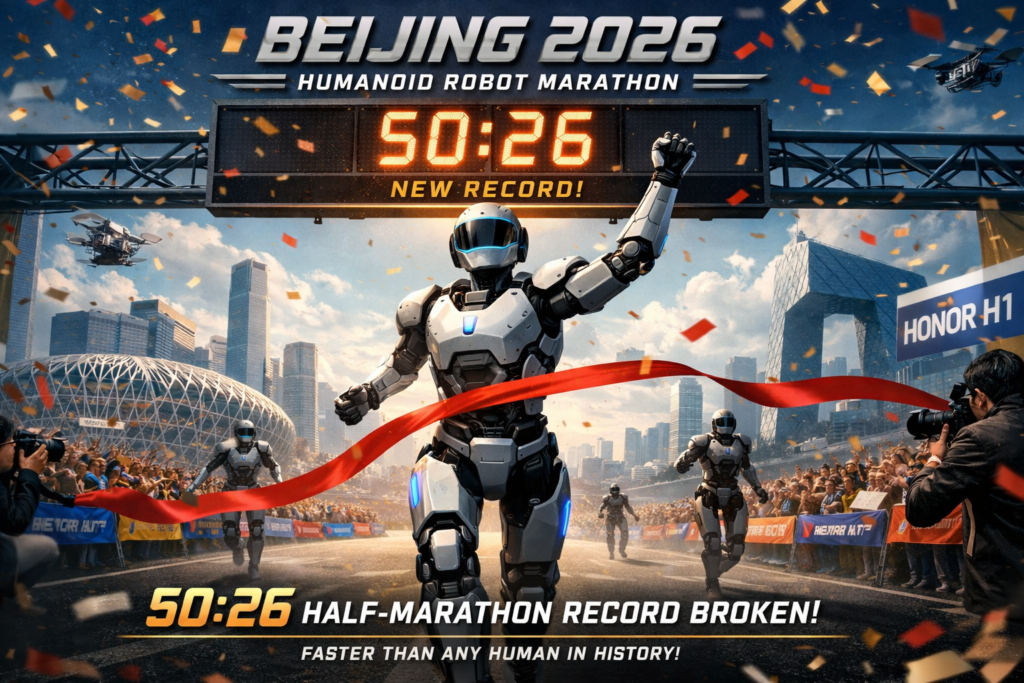
In April 2026, a humanoid robot marathon race in Beijing ended with a finish time that no human has ever achieved — 50 minutes and 26 seconds for a half-marathon distance. That result didn’t just make headlines; it marked a definitive turning point in the global robotics arms race, signaling that bipedal machines are no longer novelties on a track — they are legitimate athletic performers.
Whether you follow robotics, artificial intelligence, or simply love a good underdog-beats-the-record story, what happened at the 2026 Beijing Humanoid Half Marathon deserves your full attention.
What Happened at the 2026 Beijing Humanoid Robot Marathon
The Beijing Humanoid Half Marathon, organized by Beijing’s E-Town technology hub, brought together dozens of bipedal robots to compete over the classic 21.1-kilometer distance. The event is part of China’s broader strategy to position itself as the world leader in humanoid robotics development.
The Winning Time That Broke Records
The autonomous winner of the 2026 humanoid robot marathon crossed the finish line in 50 minutes and 26 seconds — a time that is not only impressive for a machine, but also faster than the current human world record of 57 minutes, recently set by Ugandan runner Jacob Kiplimo.
However, context matters here. A separate Honor-built robot actually completed the course in 48 minutes and 19 seconds, but that unit was remote controlled. Under the race’s weighted scoring system — which rewarded autonomous operation — the 50:26 robot was declared the winner. Roughly 40% of the field competed autonomously, while 60% relied on human remote control.
The winning robot was built by Honor, the Chinese smartphone and consumer electronics manufacturer, whose entry into humanoid robotics underscores how quickly non-traditional tech companies are staking their claim in this space.
Autonomous vs. Remote-Controlled: How the Race Was Scored
What is the difference between autonomous and remote-controlled robots in the Beijing race?
An autonomous robot operates entirely on its own — its onboard AI makes all real-time decisions about balance, gait, speed, and obstacle avoidance without any human input. A remote-controlled robot relies on a human operator to guide it, effectively functioning as an advanced mechanical puppet. (humanoid robot marathon, Beijing humanoid robot race 2026, robot vs human marathon record, autonomous robot running technology, humanoid robotics competition)
The Beijing race used a weighted scoring system that gave significant credit to autonomy. This reflects the real-world engineering goal: a robot that can run, navigate, and adapt to its environment without a human in the loop is dramatically more valuable for practical deployment.
| Category | Winner | Time | Control Mode |
|---|---|---|---|
| Overall Race Winner (weighted score) | Honor H1 Robot | 50:26 | Autonomous |
| Fastest Raw Finish | Honor Robot (variant) | 48:19 | Remote Controlled |
| Human World Record (half-marathon) | Jacob Kiplimo | 57:00 | N/A — Human |
| Previous Robot Record (2025) | Undisclosed robot | 2:40:00 | Mixed |
How Far Humanoid Robots Have Come in One Year
2025 vs. 2026 — A Year of Radical Progress
The most stunning number from the 2026 humanoid robot marathon is not the winning time itself — it is the comparison to 2025.
At the inaugural Beijing Humanoid Half Marathon in April 2025, the fastest robot finished in two hours and forty minutes. In a single year, the leading time dropped from 2:40:00 to 50:26 — a reduction of nearly two hours, or roughly a 68% improvement.
To put that in human athletic terms: imagine an elite runner improving their half-marathon time from 2 hours 40 minutes (a recreational pace) to 50 minutes (faster than any human has ever run) in twelve months. That kind of leap does not happen in biological systems. It only happens when hardware, software, and training data all converge at the right moment.
Key factors that drove the year-over-year improvement:
- Advances in real-time gait optimization algorithms, allowing robots to dynamically adapt their stride mid-race
- Improved battery energy density, reducing weight and extending operational range
- Better proprioceptive sensors that detect balance disruptions before they cause falls
- Larger and more diverse simulation training datasets that exposed robots to more edge-case scenarios before race day
- A competitive funding environment in China, with major tech companies treating humanoid robotics as a strategic priority
Why This Humanoid Robot Marathon Matters Beyond Sports
What Robot Running Tells Us About Locomotion AI
A humanoid robot marathon is not really about sport. It is a high-stakes, highly visible benchmark for solving one of the hardest problems in robotics: stable, efficient, dynamic bipedal locomotion in uncontrolled environments. (humanoid robot marathon, Beijing humanoid robot race 2026, robot vs human marathon record, autonomous robot running technology, humanoid robotics competition)
Running is not a controlled laboratory test. A half-marathon course involves variable terrain, changing air resistance, unpredictable footing, and the cumulative mechanical stress of thousands of footfalls. Every second a robot maintains speed without falling represents a successful real-time decision by its control system.
Why does this matter outside of racing?
The locomotion capabilities demonstrated in a humanoid robot marathon have direct applications in:
- Disaster response and search-and-rescue — robots that can traverse rubble, stairs, and uneven ground at speed
- Industrial logistics — bipedal robots that can operate in factories and warehouses built for humans, without requiring redesigned infrastructure
- Healthcare and elder care — assistive robots that can navigate home environments and respond quickly to emergencies
- Defense and exploration — autonomous systems capable of operating in environments hostile to wheeled or tracked platforms
When a robot runs a half-marathon faster than a human, it is not showing off. It is demonstrating that the underlying locomotion system is robust enough to handle 21 kilometers of continuous, variable, real-world stress.
Humanoid Robots vs. Human Athletes — A Fair Comparison?
Is it fair to compare a humanoid robot marathon time to a human world record?
This is the most debated question following the Beijing race. One social media commenter captured the skepticism well: “My car can outrun a cheetah too.” The point is that machines operating on different energy and control paradigms should not necessarily be held to biological standards.
But the comparison is still analytically useful — not to claim robots are “better” than humans, but to use the human world record as a well-understood, stable benchmark against which to measure engineering progress over time.
| Dimension | Humanoid Robot (2026 Winner) | Human World Record Holder |
|---|---|---|
| Finish Time (half-marathon) | 50:26 | 57:00 |
| Energy Source | Battery (electric) | Aerobic metabolism (food/oxygen) |
| Control System | Onboard AI / autonomous | Central nervous system |
| Maintenance Between Runs | Hardware recharge / software update | Rest, nutrition, recovery |
| Improvable via software update? | Yes | No |
| Capable of fatigue? | Battery depletion only | Yes — physical and cognitive |
| Year-over-year improvement rate | ~68% (2025→2026) | Fractions of seconds per year |
| Falls or mechanical failures | At least 2 robots fell/hit barriers | Rare at elite level |
The table above reveals the fundamental asymmetry: robots can improve by orders of magnitude year-over-year; humans cannot. But robots also still fail in ways humans simply do not — one robot fell at the starting line, another hit a barrier. Reliability at scale is where biological systems still have an enormous edge.
The Technology Behind the Speed: What Drives Bipedal Robot Running
Key Engineering Factors That Enabled the 2026 Breakthrough
What technology allows a humanoid robot to run a half-marathon faster than a human?
Several distinct engineering disciplines converge in a competitive humanoid robot marathon entry. Understanding them separately makes it easier to track where the field is advancing fastest.
1. Model Predictive Control (MPC) for Gait Planning MPC allows the robot’s onboard computer to simulate the next several steps of its gait in real time and select the optimal movement pattern. This prevents the robot from committing to a step that would cause instability on the next footfall.
2. Reinforcement Learning (RL) for Locomotion Policy Rather than being explicitly programmed with movement rules, modern competition robots learn to walk and run through millions of simulated training episodes. RL-trained locomotion policies are more adaptable and resilient than handcrafted control code.
3. Lightweight Actuator Design The joints of a humanoid robot are driven by actuators — motors, hydraulics, or in newer designs, custom electric linear actuators optimized for the force-to-weight ratios required in dynamic movement.
4. Proprioception and IMU Integration Inertial Measurement Units (IMUs) and joint-level torque sensors give the robot a continuous, high-frequency feed of its own body state. This is equivalent to a human’s proprioceptive sense — knowing where your limbs are without looking at them.
5. Thermal and Power Management Running generates heat in motors and electronics. Managing thermal load over 21 kilometers without degrading performance is a non-trivial engineering challenge that teams have been working to solve between the 2025 and 2026 events.
The Competitive Landscape: Which Companies Are Building Racing Robots?
The Beijing race is not just a sporting event — it is a competitive intelligence showcase. The companies entering robots are signaling their capabilities to investors, government bodies, and potential commercial partners.
Notable players in the 2026 humanoid robot marathon field:
- Honor — The race winner. A Chinese consumer electronics brand (spun off from Huawei) that has pivoted aggressively into humanoid robotics R&D.
- Unitree Robotics — One of China’s best-known bipedal robot manufacturers, known for the H1 and G1 platforms.
- Various university and research institute teams — Chinese academic institutions fielded entries as part of national robotics research programs.
The race also drew attention to the gap between Chinese and Western robotics development timelines. While companies like Boston Dynamics, Figure AI, and Agility Robotics are making strides in the US, the Beijing event demonstrated that Chinese teams are moving fast — and that state-backed competition venues are accelerating the pace of progress.
What Comes Next After the Humanoid Robot Marathon Record
The 2026 Beijing result is a milestone, but it is also a starting line for what comes next.
Near-term predictions for humanoid robot athletics (2026–2028):
- Sub-45-minute autonomous half-marathon — Given the pace of improvement, a fully autonomous robot finishing under 45 minutes within the next two race cycles is plausible.
- Full marathon distance — The natural progression from a half-marathon (21.1 km) to a full marathon (42.2 km) will test energy management and mechanical durability at a level the current generation hasn’t faced.
- Obstacle course and trail running formats — Flat road racing is a relatively controlled environment. The harder challenge — and more practically useful test — is off-road and obstacle-laden terrain.
- Multi-robot team events — Racing formats that require coordination between multiple autonomous robots could emerge as a new benchmark category.
The broader implication of a humanoid robot marathon breaking the human world record is not that robots will replace runners. It is that the engineering systems underlying that achievement — locomotion AI, real-time decision-making, energy management, mechanical resilience — are maturing fast enough to enter practical deployment timelines.
Every kilometer those robots ran in Beijing was a data point. And data points, in machine learning, are how systems get better.
Frequently Asked Questions
Q: Did a robot really beat the human world record at the Beijing half-marathon? Yes. The autonomous winning robot finished in 50 minutes and 26 seconds, compared to the current human world record of 57 minutes. A remote-controlled variant finished even faster at 48:19, but was not eligible for the overall win under weighted scoring rules.
Q: Who built the winning robot? The winning robot was built by Honor, a Chinese consumer technology company originally spun off from Huawei. Honor’s entry in the humanoid robot marathon signals the company’s serious commitment to robotics as a strategic business area.
Q: How much did performance improve from 2025 to 2026? The fastest time improved from 2 hours and 40 minutes (2025) to 50 minutes and 26 seconds (2026) — a reduction of approximately 110 minutes, or about a 68% improvement in finishing time.
Q: What percentage of robots ran autonomously? Approximately 40% of the competing robots operated autonomously. The remaining 60% were remote controlled. The weighted scoring system favored autonomous performance.
Q: Are humanoid robot marathon results comparable to human performance? They are comparable as benchmarks but not equivalent as athletic achievements. Robots run on electricity, don’t experience fatigue in the same way, and can be updated via software. The comparison is useful for tracking engineering progress over time, not for making claims about robot “superiority” over human runners.
Key Takeaways
- The 2026 Beijing Humanoid Half Marathon produced a winning time of 50:26 by an autonomous Honor-built robot — faster than the human world record of 57:00.
- The result represents a 68% improvement in finishing time from the 2025 race, where the fastest robot finished in 2:40:00.
- Roughly 40% of entrants ran autonomously; the race’s weighted scoring system rewarded autonomous operation over raw speed.
- The technologies driving this breakthrough include reinforcement learning locomotion policies, model predictive control, lightweight actuators, and advanced sensor integration.
- The real-world significance of a humanoid robot marathon is not sport — it is the maturation of locomotion AI with direct applications in disaster response, industrial logistics, healthcare, and exploration.