The SpaceX Cursor acquisition option is the biggest story in AI-powered software development right now — and it signals a seismic power shift in who controls the tools that write tomorrow’s code. Here’s everything you need to know, and why it matters.
What Is the SpaceX–Cursor Deal?
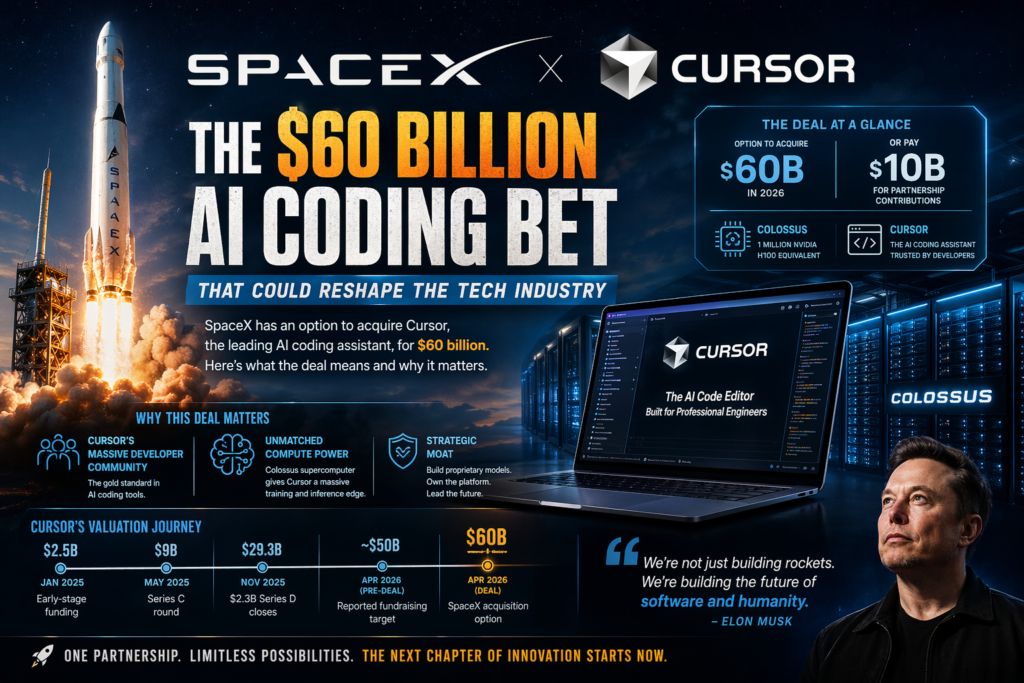
Definition: The SpaceX Cursor acquisition refers to a formal partnership announced on April 21, 2026, in which SpaceX and Cursor — the AI-powered coding assistant — agreed to build a next-generation “coding and knowledge work AI” together. The deal also grants SpaceX an option to purchase Cursor outright for $60 billion at some point later in 2026.
Expansion: This is not a standard vendor contract. SpaceX will contribute the raw muscle of its Colossus supercomputer — reportedly equivalent to the processing power of one million Nvidia H100 chips — while Cursor brings its product excellence and its massive base of expert software engineering users. The partnership is structured so that SpaceX will either pay Cursor $10 billion for its contributions to the joint project, or exercise its option to acquire the startup for $60 billion. The choice is SpaceX’s to make.
In short: Cursor gets guaranteed money, SpaceX gets a potential monopoly on the world’s most popular AI coding tool, and the entire developer tooling industry gets a shock to its foundation.
How Did We Get Here? The Road to a $60 Billion Valuation
Understanding the SpaceX Cursor acquisition requires a quick look at how fast Cursor’s value has compounded — and at the web of relationships that made this deal inevitable.
Cursor’s Valuation Rocket Ship
Cursor’s growth curve is one of the most dramatic in recent startup history:
| Date | Valuation | Event |
|---|---|---|
| January 2025 | $2.5 billion | Early-stage funding |
| May 2025 | $9 billion | Series C round |
| November 2025 | $29.3 billion | $2.3B Series D closes |
| April 2026 (pre-deal) | ~$50 billion | Reported fundraising target |
| April 2026 (deal) | $60 billion | SpaceX acquisition option |
In roughly 15 months, Cursor went from a well-funded startup to a company that one of the world’s most valuable private enterprises is willing to pay $60 billion to own. That trajectory reflects the extraordinary demand for AI coding tools among professional developers — demand that Cursor has consistently captured better than its rivals.
The xAI Connection: This Wasn’t a Cold Call
The SpaceX Cursor acquisition did not emerge from nowhere. The groundwork was laid through a series of moves in the weeks and months prior:
- Chip rental: Reports emerged that xAI, Elon Musk’s AI company, began renting computing capacity to Cursor, supplying tens of thousands of xAI chips for model training.
- Executive departures: Two of Cursor’s most senior engineering leaders — Andrew Milich and Jason Ginsberg — left the startup to join xAI, reporting directly to Musk.
- Existing model dependency: Cursor currently resells access to Anthropic’s Claude and OpenAI’s GPT models, a situation that both companies are actively working to escape as they build competing coding products.
The SpaceX Cursor deal is therefore less of a sudden courtship and more of a formal commitment after months of increasing entanglement.
What SpaceX Gets from Cursor — and What Cursor Gets from SpaceX
Why SpaceX Wants Cursor
Question: Why would a rocket company spend $60 billion on an AI coding tool?
Direct Answer: Because SpaceX is not just a rocket company. It is positioning itself as a full-spectrum technology conglomerate ahead of a highly anticipated IPO, and owning the dominant AI-powered software development platform would dramatically increase investor confidence in its software-side revenues.
More specifically, SpaceX gains:
- Cursor’s product quality and user base. Cursor is widely regarded as the gold standard in AI coding assistants, with deep penetration among professional (“expert”) software engineers — the highest-value segment of the developer market.
- A proprietary software moat. Neither Cursor nor xAI currently has AI models that match Anthropic’s Claude or OpenAI’s GPT-4 class offerings. Ownership of Cursor’s interface and distribution layer gives SpaceX leverage even without winning the model war.
- Colossus utilization. SpaceX’s Colossus supercomputer needs use cases that justify its enormous cost. Running the world’s most-used AI coding tool provides exactly that — a high-volume, commercially valuable workload.
Why Cursor Would Accept
- Guaranteed liquidity. Even if SpaceX declines its option, Cursor collects $10 billion for its partnership contributions — an enormous outcome.
- Compute at scale. Access to Colossus-level compute could allow Cursor to train its own proprietary models and escape its uncomfortable reliance on Anthropic and OpenAI.
- IPO or acquisition clarity. An acquisition path at $60 billion removes the uncertainty of an independent public offering in a volatile market.
SpaceX vs. Other Big Tech AI Coding Moves: A Competitive Comparison
The SpaceX Cursor acquisition doesn’t happen in a vacuum. Here’s how it stacks up against the other major bets being placed on AI-powered software development:
| Company | AI Coding Move | Model Strategy | Developer Focus |
|---|---|---|---|
| SpaceX / xAI | Option to acquire Cursor for $60B | Building proprietary models; renting xAI compute to Cursor | Expert/professional engineers |
| Microsoft | Deep GitHub Copilot integration with Azure OpenAI | Full GPT-4o access; own Azure compute | Enterprise and individual devs |
| Gemini Code Assist across Google Cloud and IDEs | Proprietary Gemini models | Enterprise developers | |
| Anthropic | Claude API + direct Claude coding interface | Proprietary Claude models (used by Cursor today) | API-first developers |
| OpenAI | Codex, GPT-4o coding, ChatGPT integrations | Proprietary GPT models (used by Cursor today) | Broad developer market |
Key Insight: Every major AI player is converging on the same battlefield — the coding assistant. What makes the SpaceX Cursor acquisition unique is that SpaceX comes from outside the traditional AI ecosystem, bringing a compute advantage (Colossus) that none of the pure-software players can match.
The $60 Billion Question: Buy or Pay $10 Billion?
Question: Will SpaceX actually exercise its option to acquire Cursor for $60 billion?
Direct Answer: It depends on whether the partnership produces results that justify the price — and whether SpaceX needs the optics of a landmark software acquisition for its IPO story.
Here are the key factors in each direction:
Reasons SpaceX exercises the acquisition option:
- The Colossus + Cursor joint product exceeds expectations, giving SpaceX a platform play that investors will pay a premium for at IPO.
- Cursor successfully trains its own proprietary model using xAI compute, making the company self-sufficient and more valuable.
- The competitive pressure from Microsoft, Google, and Anthropic intensifies, making it urgent for the Musk ecosystem to lock in a coding tool leader.
Reasons SpaceX pays $10 billion and walks away:
- The joint product underperforms, making $60 billion an indefensible valuation.
- SpaceX’s financial position — already strained by the xAI and X acquisitions — makes a $60 billion outlay untenable without stock consideration.
- Cursor raises capital at $50 billion independently, diluting SpaceX’s interest in pursuing a full buyout.
The deal structure itself is telling: by offering a $10 billion floor, SpaceX has ensured Cursor’s cooperation regardless of the outcome. Cursor’s founders win in either scenario. SpaceX holds the optionality.
Why This Deal Matters for the AI Coding Tool Market
The SpaceX Cursor acquisition — or even the partnership alone — reshapes competitive dynamics across AI-powered software development in three significant ways.
The Anthropic and OpenAI Threat Becomes More Urgent
Cursor currently sells access to Claude (Anthropic) and GPT (OpenAI) models to its users. Both Anthropic and OpenAI are now building their own competing coding tools. If Cursor trains a proprietary model on xAI compute and cuts its dependency on both, it eliminates a revenue stream for two of AI’s biggest companies while simultaneously strengthening a rival ecosystem.
This isn’t a slow transition — it’s a race. Whichever side (Cursor or the model providers) moves fastest will determine whether the coding tool market consolidates around model providers or around interface leaders.
Compute Becomes a Competitive Weapon
The deal makes explicit what has been implied for years: in AI-powered software development, raw compute is a strategic asset, not just a cost center. Colossus’s million-H100-equivalent capacity gives the SpaceX-Cursor partnership a training and inference advantage that most pure-software startups cannot replicate. This will push other AI coding tool providers to lock in their own compute partnerships — or be outpaced.
The Developer Tooling M&A Wave Is Just Beginning
If SpaceX is willing to put a $60 billion price tag on Cursor, expect other tech conglomerates to begin acquisitive moves on the remaining independent AI coding tool leaders. The SpaceX Cursor acquisition sets a new benchmark for how the market values distribution + developer trust in the AI era.
What Happens Next: Three Scenarios to Watch
Scenario 1: SpaceX Acquires Cursor and Builds a Developer Platform
SpaceX exercises its option, integrates Cursor deeply with Colossus and xAI’s model stack, and launches a vertically integrated AI development platform. This would be the most aggressive IPO narrative — positioning SpaceX not just as a space company, but as the infrastructure layer for the next generation of software engineering.
Scenario 2: SpaceX Pays $10 Billion, Cursor Stays Independent
The partnership produces valuable technology but not a blockbuster product. SpaceX pays Cursor the $10 billion milestone and moves on. Cursor, now flush with cash and potentially equipped with its own model, proceeds with a $50 billion+ public offering or independent raise.
Scenario 3: A Competing Bidder Emerges
The public announcement of a $60 billion acquisition option is, functionally, an invitation for competing bids. If Microsoft, Google, or a sovereign wealth fund decides that owning Cursor is strategically essential, the SpaceX Cursor acquisition option could ignite a bidding war that drives the final price even higher.
Key Takeaways: What You Need to Know About the SpaceX–Cursor Deal
- The SpaceX Cursor acquisition option values Cursor at $60 billion — more than 24x its January 2025 valuation of $2.5 billion.
- SpaceX will either pay Cursor $10 billion for joint development work or exercise a full $60 billion acquisition later in 2026.
- The partnership combines Cursor’s developer product and distribution with SpaceX’s Colossus supercomputer (equivalent to 1 million Nvidia H100 chips).
- The deal is structurally motivated by SpaceX’s anticipated IPO, where owning the leading AI coding tool would significantly expand its software-side valuation narrative.
- Cursor currently relies on Anthropic’s Claude and OpenAI’s GPT models — models whose parent companies are now competing directly against Cursor in the developer tools market. The SpaceX partnership offers an eventual escape from that dependency.
- The deal sets a new M&A benchmark for AI-powered software development, signaling that developer tooling is now a strategic priority for the largest players in tech.
Frequently Asked Questions (FAQ): SpaceX Cursor Acquisition
1. What is the SpaceX Cursor acquisition and why is it important?
The SpaceX Cursor acquisition refers to a strategic partnership in which SpaceX has secured the option to acquire Cursor for $60 billion. This deal is important because it represents one of the largest potential acquisitions in the AI software development space. The SpaceX Cursor acquisition is not just about ownership—it is about reshaping how software is built in the era of artificial intelligence.
What makes the SpaceX Cursor acquisition particularly significant is the combination of infrastructure and product. SpaceX brings unmatched computing power through its Colossus system, while Cursor contributes a highly refined AI coding interface used by professional developers. Together, this partnership could redefine the competitive landscape of AI coding tools.
2. Why is the SpaceX Cursor acquisition valued at $60 billion?
The $60 billion valuation in the SpaceX Cursor acquisition reflects Cursor’s rapid growth, strong developer adoption, and strategic importance. In just over a year, Cursor has grown from a $2.5 billion startup into a company commanding massive interest from top tech players.
The SpaceX Cursor acquisition valuation also considers future potential. AI coding tools are expected to dominate software development workflows, and owning a leading platform like Cursor could give SpaceX a long-term advantage. Additionally, the ability to integrate Cursor with proprietary compute infrastructure significantly increases its value proposition.
3. How does the SpaceX Cursor acquisition impact developers?
For developers, the SpaceX Cursor acquisition could bring both opportunities and changes. On one hand, developers may benefit from faster, more accurate AI coding tools powered by large-scale compute. On the other hand, consolidation in the market could reduce competition among AI tool providers.
The SpaceX Cursor acquisition is expected to enhance productivity by enabling more advanced code generation, debugging, and automation features. Developers working with complex systems could see significant efficiency gains as the platform evolves.
4. What role does xAI play in the SpaceX Cursor acquisition?
The SpaceX Cursor acquisition is closely tied to xAI, which provides AI research and compute resources. xAI has already been collaborating with Cursor by supplying training infrastructure and recruiting key engineering talent.
In the context of the SpaceX Cursor acquisition, xAI acts as the intelligence layer, helping Cursor transition from relying on external AI models to developing its own proprietary systems. This integration could significantly reduce dependence on competitors.
5. Will Cursor stop using OpenAI and Anthropic models?
Currently, Cursor relies on models from OpenAI and Anthropic. However, the SpaceX Cursor acquisition signals a potential shift toward independence.
If the partnership succeeds, the SpaceX Cursor acquisition could lead to Cursor building its own AI models using SpaceX’s compute resources. This would reduce reliance on external providers and strengthen its competitive position in the AI coding market.
6. How does the SpaceX Cursor acquisition compare to competitors?
The SpaceX Cursor acquisition stands out because it combines hardware-scale compute with a leading software interface. While companies like Microsoft and Google focus on integrating AI into existing ecosystems, the SpaceX Cursor acquisition aims to build a vertically integrated platform.
This approach gives the SpaceX Cursor acquisition a unique advantage. Instead of relying on third-party infrastructure, SpaceX can control both the backend compute and the frontend user experience, creating a more optimized and scalable solution.
7. What happens if SpaceX does not acquire Cursor?
Even if the full SpaceX Cursor acquisition does not happen, Cursor still benefits significantly. SpaceX is committed to paying $10 billion for joint development work if it chooses not to exercise the acquisition option.
In this scenario, the SpaceX Cursor acquisition still delivers value by accelerating Cursor’s growth and technological capabilities. Cursor could remain independent while leveraging the partnership to strengthen its position in the market.
8. How does the SpaceX Cursor acquisition affect the AI industry?
The SpaceX Cursor acquisition is a signal that AI coding tools are becoming a central battleground in the tech industry. It highlights the importance of developer tools as strategic assets rather than simple utilities.
By placing such a high valuation on Cursor, the SpaceX Cursor acquisition sets a benchmark for future deals. It is likely to trigger increased investment and competition among companies building AI-powered development platforms.
9. Could the SpaceX Cursor acquisition lead to a monopoly?
There are concerns that the SpaceX Cursor acquisition could concentrate too much power in one ecosystem. If SpaceX fully acquires Cursor and integrates it with its own AI stack, it could dominate the AI coding space.
However, the SpaceX Cursor acquisition also faces strong competition from major players. The presence of multiple well-funded companies ensures that innovation and competition will continue, even as consolidation increases.
10. What does the future look like after the SpaceX Cursor acquisition?
The future of the SpaceX Cursor acquisition depends on execution. If successful, it could lead to a new generation of AI-powered development tools that automate large portions of the software lifecycle.
The SpaceX Cursor acquisition may also redefine how developers interact with code. Instead of writing every line manually, developers could shift toward guiding AI systems, reviewing outputs, and focusing on higher-level problem solving.
🔚 Conclusion: Why the SpaceX Cursor Acquisition Matters
The SpaceX Cursor acquisition is more than just a high-value deal—it is a turning point in the evolution of software development. By combining advanced AI capabilities with massive compute infrastructure, this partnership has the potential to redefine how code is written, tested, and deployed.
At its core, the SpaceX Cursor acquisition represents a shift in power toward companies that control both intelligence and infrastructure. Whether SpaceX ultimately acquires Cursor or not, the impact of this deal will be felt across the entire technology ecosystem.
For developers, investors, and tech leaders, the SpaceX Cursor acquisition is a clear signal: the future of software belongs to AI-driven platforms. Understanding this shift is essential for staying competitive in a rapidly changing digital landscape.