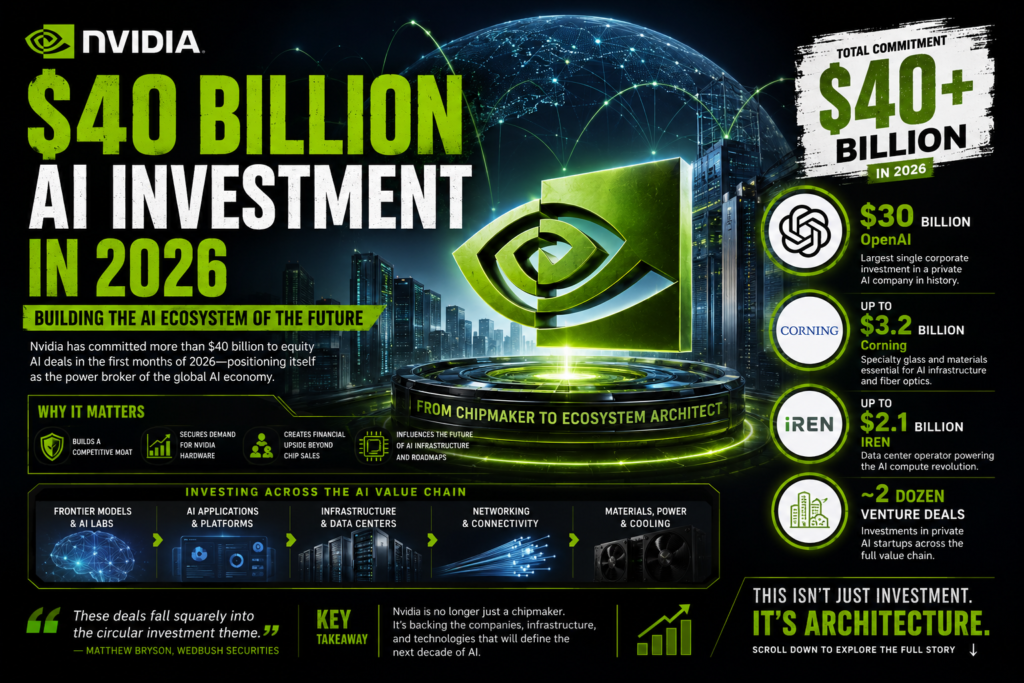
Nvidia has committed more than $40 billion to equity AI deals in just the first few months of 2026 — making it one of the most aggressive corporate investors in the history of the technology sector. If you want to understand who is shaping the AI landscape right now, you need to understand Nvidia’s investment strategy.
This post unpacks every dimension of that strategy: where the money is going, why it matters, what critics are saying, and what founders, investors, and strategists should do with this information.
What Is Nvidia’s AI Investment Strategy?
Definition: Nvidia’s AI investment strategy refers to the company’s deliberate deployment of capital — through equity stakes, venture rounds, and large strategic deals — into companies across the AI value chain, from frontier model labs to infrastructure providers.
Nvidia is no longer just a chipmaker. Through its Nvidia AI investment activity, the company is positioning itself as a full-stack power broker in the global AI economy. Rather than building everything internally, Nvidia is acquiring strategic influence over the companies that buy its products, depend on its infrastructure, and define the future of compute.
From Chipmaker to Power Broker
For most of its history, Nvidia’s revenue came from selling graphics processing units (GPUs). That changed dramatically as AI workloads exploded. Today, Nvidia’s data center segment dwarfs its gaming business, and the company’s strategic ambitions have grown to match.
The Nvidia AI investment push is, at its core, a vertical integration play — but done through financial instruments rather than acquisitions. By taking equity positions in AI companies, Nvidia gains:
- Preferential access to information about where AI demand is heading
- Stronger long-term sales relationships with its largest customers
- A financial upside that compounds as the AI ecosystem it helped build matures
- Influence over technical roadmaps that may shape future chip requirements
This makes the Nvidia AI investment program unlike typical corporate venture capital. It is simultaneously a revenue-protection strategy, a demand-creation strategy, and a returns-generation strategy.
Breaking Down the $40 Billion: Where Is the Money Going?
The $40 billion figure is real, reported, and staggering — but it is not evenly distributed. Understanding its composition reveals how deliberately Nvidia has structured its Nvidia AI investment portfolio.
The $30 Billion OpenAI Bet
The single largest component of Nvidia’s 2026 investment activity is a $30 billion equity investment in OpenAI. This alone accounts for 75% of the $40 billion total and marks one of the largest single corporate investments in a private company in history.
The strategic logic is straightforward: OpenAI is among the world’s largest consumers of Nvidia’s H100 and Blackwell GPU clusters. Owning equity in OpenAI means Nvidia benefits not only from selling chips to the company, but from the valuation appreciation of OpenAI itself — whose trajectory depends, in part, on continued access to Nvidia hardware.
Multi-Billion Dollar Deals in Public Companies
Beyond OpenAI, Nvidia has announced seven multi-billion dollar investments in publicly traded companies in 2026. Two of the most recent examples illustrate the breadth of the strategy:
- Corning — Up to $3.2 billion invested in the specialty glass and materials manufacturer, whose products are essential for fiber optic infrastructure used in AI data centers.
- IREN — Up to $2.1 billion invested in the data center operator, which provides the physical infrastructure where AI compute runs.
These are not passive financial bets. They are deliberate moves to ensure the ecosystem around Nvidia’s chips — the cables, the cooling, the buildings, the power — is well-capitalized and aligned.
Venture Rounds in Private AI Startups
At the startup end of the spectrum, Nvidia has participated in approximately two dozen investment rounds in private companies already in 2026, according to FactSet data. This follows 67 venture deals the company completed in 2025, cementing its reputation as one of the most active strategic investors in AI startup funding.
Nvidia AI Investment vs. Other Big Tech AI Investors in 2026
How does Nvidia’s investment posture compare to its peers? The table below summarizes what is publicly known about major corporate AI investment programs in 2026.
| Company | Primary Investment Vehicle | Estimated 2026 AI Commitments | Notable Deals |
|---|---|---|---|
| Nvidia | Equity stakes, venture rounds | $40B+ | OpenAI ($30B), Corning ($3.2B), IREN ($2.1B) |
| Microsoft | Strategic partnerships + equity | Multi-billion | OpenAI (ongoing), Inflection AI |
| Google / Alphabet | Ventures + internal deployment | Multi-billion | Anthropic (ongoing), AI-native startups |
| Amazon / AWS | Cloud credits + equity | Multi-billion | Anthropic ($4B+), AI infrastructure |
| SoftBank | Vision Fund 2 + direct deals | Multi-billion | OpenAI, AI robotics |
What distinguishes Nvidia’s approach is hardware leverage — every company Nvidia invests in is a potential or current customer for its chips. No other investor in this table has that structural advantage.
The “Circular Investment” Controversy Explained
The size and structure of Nvidia’s investment program has attracted significant criticism. The most pointed critique is the accusation of circular deals — the idea that money is moving in a loop rather than genuinely creating new value.
What Is a Circular Deal?
A circular deal occurs when Company A invests in Company B, Company B uses that investment to buy products from Company A, and Company A records those sales as revenue growth. The concern is that this creates an illusion of organic demand.
In Nvidia’s case: Nvidia invests in OpenAI → OpenAI uses its capital to buy Nvidia H100/Blackwell clusters → Nvidia reports record data center revenue → Nvidia’s stock rises → Nvidia has more capital to invest in OpenAI and others.
Wedbush Securities analyst Matthew Bryson said the deals fall “squarely into the circular investment theme” — a description that has resonated widely across Wall Street.
Does It Still Create Value?
The circular investment critique is valid as a description of structure, but it does not necessarily mean the investments are valueless. Several counterarguments deserve serious consideration:
- Real products are being built. OpenAI’s ChatGPT, Sora, and its API ecosystem have genuine users and genuine revenue that do not depend on Nvidia re-investing.
- Infrastructure is genuinely scarce. Investments in companies like IREN expand real physical capacity that the AI ecosystem needs.
- The moat is real. Bryson himself noted that if successful, these deals help Nvidia build a “competitive moat” — meaning competitors face a more tightly integrated ecosystem to displace.
- Equity returns are independent of chip sales. If OpenAI’s valuation grows 10x over five years, Nvidia’s $30B stake generates returns regardless of whether that growth came from Nvidia hardware.
The honest assessment is that Nvidia’s AI investment strategy contains elements of circular reinforcement and genuine value creation simultaneously.
Why Nvidia’s Investment Playbook Makes Strategic Sense
Set aside the controversy for a moment and examine the Nvidia AI investment strategy on its own terms. From a competitive strategy perspective, it is remarkably coherent.
Building a Competitive Moat
Nvidia’s dominance in AI chips is real but not permanent. AMD, Intel, and a growing cohort of custom chip startups — including Groq, Cerebras, and others — are all working to displace Nvidia’s position. By taking equity in the companies that consume AI chips at scale, Nvidia creates switching costs that go beyond technical performance.
If OpenAI is a Nvidia shareholder (in the reciprocal sense, by having Nvidia as its backer), it has both financial and relational reasons to remain on Nvidia infrastructure longer than pure technical economics might dictate.
Securing Demand for Its Own Hardware
One of the most underappreciated functions of the Nvidia AI investment program is demand creation. When Nvidia invests in a startup building AI applications, it is also investing in a future customer for its next-generation GPU architecture.
This is analogous to the classic razor-and-blades model, but at infrastructure scale. Nvidia provides capital (the razor), which gets converted into compute demand (the blades). The difference is that Nvidia also gets its capital back — plus returns — if the company succeeds.
What This Means for the AI Startup Ecosystem
The Nvidia AI investment surge is not a neutral event for startups and founders. It reshapes the competitive landscape in several significant ways:
- Validation effect: A Nvidia investment signals technical legitimacy and often accelerates follow-on fundraising from other institutional investors.
- Customer lock-in risk: Startups that accept Nvidia capital may face pressure — explicit or implicit — to remain on Nvidia infrastructure even as alternatives mature.
- Valuation inflation: With $40 billion flowing into the ecosystem in under five months, valuations in AI are being pressured upward, making it harder for founders to price rounds fairly and for investors to find genuine value.
- Infrastructure advantage: Companies in Nvidia’s portfolio may receive preferential access to scarce GPU capacity during shortages, a non-trivial competitive advantage.
- Ecosystem consolidation: As Nvidia builds an interlocking web of equity relationships, the AI ecosystem risks becoming more consolidated around a single hardware and investment thesis.
For founders specifically: accepting Nvidia investment is a major decision that deserves the same scrutiny as any strategic investor. The benefits are real. So are the dependencies.
Key Takeaways for Investors, Founders, and Strategists
The $40 billion Nvidia AI investment commitment in 2026 tells us several things that matter well beyond the headline number.
For investors:
- Nvidia is no longer a pure hardware bet. Its investment portfolio gives it meaningful exposure to AI application-layer upside.
- The circular investment concern is worth monitoring, but it does not automatically invalidate the strategy.
- Watch whether Nvidia’s investment returns are disclosed separately from chip revenue — that will clarify how the market should value the portfolio.
For founders:
- Nvidia strategic capital comes with implicit alignment to its hardware ecosystem. Understand this before signing.
- Being in Nvidia’s portfolio can open doors, accelerate fundraising, and provide GPU access — all meaningful advantages in a compute-constrained environment.
For enterprise strategists:
- The companies Nvidia is investing in — OpenAI, Corning, IREN — are building the stack your AI products will run on. Understanding Nvidia’s portfolio is increasingly equivalent to understanding AI infrastructure itself.
- The Nvidia AI investment program is now a geopolitical and macroeconomic signal, not just a technology story. Where Nvidia puts money reflects where it believes AI demand will be durable.
Frequently Asked Questions About Nvidia AI Investment
What is Nvidia AI investment strategy in 2026?
The Nvidia AI investment strategy in 2026 focuses on expanding beyond semiconductor manufacturing into direct equity ownership across the artificial intelligence ecosystem. Instead of limiting itself to selling GPUs, Nvidia is using capital as a strategic weapon. Through the Nvidia AI investment program, the company is funding model labs, infrastructure providers, cloud partners, AI-native startups, and critical hardware supply-chain businesses.
This strategy gives Nvidia multiple advantages. First, the company secures long-term demand for its GPU products by backing organizations that require large-scale compute resources. Second, the Nvidia AI investment model creates financial upside through ownership stakes in companies expected to dominate the next decade of AI.
The most notable example is Nvidia’s reported $30 billion stake in OpenAI. This move instantly became one of the largest private-company investments in tech history and demonstrated how aggressive the Nvidia AI investment thesis has become.
By treating capital deployment as an extension of ecosystem control, Nvidia is no longer simply a chipmaker. The Nvidia AI investment program shows a company actively shaping the future of artificial intelligence infrastructure, applications, and enterprise adoption.
Why did Nvidia invest $30 billion in OpenAI?
The OpenAI deal is the centerpiece of the Nvidia AI investment strategy. OpenAI is one of the world’s largest consumers of AI compute and depends heavily on Nvidia hardware for model training and inference workloads.
By investing directly in OpenAI, Nvidia aligns itself financially with one of the most important AI companies globally. The Nvidia AI investment logic is simple: if OpenAI succeeds, Nvidia benefits twice—once through chip sales and again through equity appreciation.
This approach reduces dependency on one-time transactional revenue. Instead, Nvidia gains exposure to long-term value creation. The Nvidia AI investment into OpenAI is therefore not just about immediate financial returns but about ecosystem influence.
Additionally, OpenAI’s growth drives demand for GPU clusters, networking, memory, and AI data center expansion. The Nvidia AI investment into OpenAI effectively reinforces demand for Nvidia’s own products.
This is why analysts view the deal as strategically brilliant, even while debating its implications for competition and market concentration.
Is Nvidia AI investment creating a monopoly in AI?
Many critics argue that the scale of Nvidia AI investment could increase ecosystem concentration around one dominant infrastructure provider.
Nvidia already leads in AI accelerators, CUDA software tooling, networking, and enterprise AI infrastructure. Through Nvidia AI investment, it is now adding ownership positions in companies building models, applications, and data centers.
This creates concerns around dependency. If enough startups rely on Nvidia funding, Nvidia chips, Nvidia software, and Nvidia ecosystem partnerships, alternatives may struggle to compete.
However, monopoly claims remain debated. Supporters argue the Nvidia AI investment model accelerates innovation by funding critical infrastructure and helping startups access scarce GPU resources.
In practical terms, the Nvidia AI investment program may strengthen Nvidia’s moat, but it does not automatically eliminate competition. AMD, Intel, Google TPUs, custom silicon providers, and AI cloud competitors still represent alternative pathways.
The real question is whether the Nvidia AI investment ecosystem becomes so attractive that companies choose alignment over independence.
What companies are part of Nvidia AI investment portfolio?
The Nvidia AI investment portfolio includes a diverse set of organizations across the AI stack.
Some publicly known investments include:
- OpenAI – Large-scale frontier AI models and applications
- Corning – Fiber optics, specialty materials, and AI networking infrastructure
- IREN – AI data center and compute infrastructure
- AI startups across model tooling, robotics, enterprise AI, cloud optimization, and infrastructure orchestration
The reason the Nvidia AI investment portfolio is so significant is diversification. Nvidia is not betting on one layer alone. Instead, it is distributing capital across compute, networking, applications, infrastructure, and supply chain dependencies.
This makes the Nvidia AI investment strategy resilient. Even if one segment underperforms, Nvidia maintains exposure to the broader expansion of artificial intelligence.
How does Nvidia AI investment affect startups?
For startups, the Nvidia AI investment program can be transformative.
Benefits include:
- Faster fundraising credibility
- Access to scarce GPUs
- Strategic partnerships
- Enterprise introductions
- Technical ecosystem support
A startup backed through Nvidia AI investment often receives validation that attracts institutional investors. This signaling effect alone can materially improve fundraising outcomes.
However, there are tradeoffs. Founders may become dependent on Nvidia infrastructure or face soft alignment pressure toward Nvidia’s ecosystem.
This means startups should treat Nvidia AI investment as strategic capital, not passive funding. Before accepting investment, founders should evaluate infrastructure flexibility, pricing exposure, and long-term platform risk.
Done correctly, Nvidia AI investment can accelerate growth dramatically. Done poorly, it can increase operational dependency.
What is the circular investment controversy around Nvidia AI investment?
A major criticism of Nvidia AI investment is the so-called circular investment loop.
The theory is straightforward:
- Nvidia invests capital into AI companies
- Those companies use funding to purchase Nvidia hardware
- Nvidia books higher revenue from those purchases
- Nvidia’s valuation rises, enabling more investment
Critics argue this creates artificial demand amplification.
However, defenders of Nvidia AI investment note that this does not invalidate the model. Real products are being built, customers are paying for AI services, and infrastructure expansion is genuine.
The circular structure is best understood as reinforcement rather than fabrication. The Nvidia AI investment ecosystem increases ecosystem dependency while simultaneously accelerating deployment.
As long as end-user demand remains real, the model can still create authentic enterprise value.
Why is Nvidia investing in infrastructure companies?
Infrastructure is central to the Nvidia AI investment thesis.
AI growth depends on:
- Power availability
- Cooling systems
- Networking
- Fiber connectivity
- Data center capacity
- Land and energy optimization
Without these layers, GPUs alone cannot scale.
This is why Nvidia AI investment extends into infrastructure firms like Corning and IREN. Corning supports optical connectivity essential for AI clusters, while IREN contributes physical compute infrastructure.
The Nvidia AI investment strategy reflects a systems-level view of AI. Nvidia understands that controlling compute economics requires influence beyond chips.
This makes the investment strategy far more sophisticated than traditional venture participation.
Conclusion: Why Nvidia AI Investment Matters More Than Ever
The rise of Nvidia AI investment marks a fundamental shift in how leading technology companies compete in the artificial intelligence era. Historically, chipmakers focused on hardware innovation, manufacturing efficiency, and distribution. Nvidia is rewriting that playbook.
Through its aggressive Nvidia AI investment strategy, the company is turning capital into competitive infrastructure. Instead of waiting for customers to emerge naturally, Nvidia is actively funding the organizations building the future of AI.
This is what makes Nvidia AI investment so powerful.
The strategy is not limited to financial returns. Nvidia is simultaneously achieving several goals through the Nvidia AI investment ecosystem:
- Strengthening long-term GPU demand
- Expanding ecosystem lock-in
- Building influence over AI technical roadmaps
- Securing exposure to application-layer upside
- Accelerating infrastructure deployment globally
In practical terms, the Nvidia AI investment model transforms Nvidia from supplier into ecosystem architect.
The company is no longer only benefiting when AI companies buy chips. It benefits when they scale, raise valuations, expand infrastructure, and dominate markets.
This layered exposure makes Nvidia AI investment unusually strategic compared to traditional corporate investing.
Of course, risks exist.
The circular investment criticism cannot be ignored. If capital inflows begin masking real demand weakness, investors may question revenue quality. Regulatory scrutiny may also increase as the Nvidia AI investment network becomes more interconnected.
Additionally, startups must carefully evaluate dependency risks. While Nvidia AI investment can unlock growth, founders should avoid over-concentration on any single infrastructure provider.
Still, the broader takeaway is clear: the Nvidia AI investment surge is not a temporary headline.
It reflects how the AI economy is evolving.
Future winners in artificial intelligence may not simply build better models. They may control the capital flows, infrastructure bottlenecks, compute supply chains, and ecosystem relationships that determine who gets to scale.
Nvidia appears to understand this earlier than almost anyone else.
That is why the Nvidia AI investment strategy deserves close attention from founders, investors, analysts, and enterprise leaders alike.
For investors, Nvidia AI investment expands Nvidia’s exposure beyond hardware margins into ecosystem upside.
For founders, Nvidia AI investment offers opportunity paired with strategic dependency.
For enterprises, Nvidia AI investment reveals which infrastructure layers are becoming mission-critical.
Most importantly, the Nvidia AI investment program signals a new era in tech competition—one where ownership, infrastructure, and capital deployment matter just as much as technical innovation.
In 2026, understanding Nvidia AI investment is no longer optional for anyone serious about artificial intelligence.
It is the blueprint for how AI power is being accumulated, monetized, and defended.
And if current trends continue, the Nvidia AI investment strategy may ultimately become one of the most influential corporate expansion models in modern technology history.