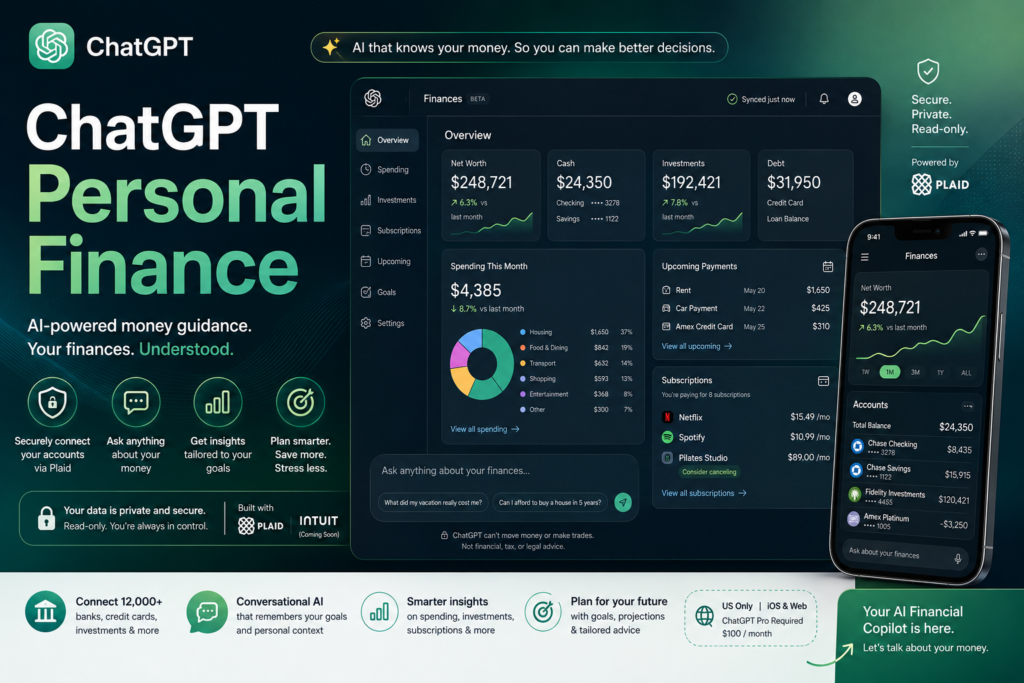
OpenAI just launched ChatGPT personal finance tools that let you connect your bank, investment, and credit card accounts directly inside ChatGPT — and it changes what AI-powered budgeting can actually do. If you’ve ever wished a budgeting app could just talk to you about your money with full context, this is the closest thing to that reality yet.
What Is ChatGPT Personal Finance and How Does It Work?
ChatGPT personal finance is a new feature released on May 15, 2026, that allows users to securely link their financial accounts to ChatGPT and receive personalized, context-aware money guidance. Instead of asking broad questions like “how do I save more money?” — and getting generic answers — you can now ask things grounded in your actual spending history, portfolio, and liabilities.
The product was built partly with the team from Hiro, a personal finance startup OpenAI acquired in April 2026. The Hiro team brought deep fintech expertise that accelerated the launch. The feature runs on GPT-5.5, OpenAI’s latest reasoning model, which the company describes as significantly stronger at the kind of context-dependent thinking that personal finance decisions require. OpenAI says GPT-5.5 Pro scored 82.5 out of 100 on an internal personal finance benchmark developed with more than 50 finance professionals.
How to Connect Your Bank Account to ChatGPT
Getting started with ChatGPT personal finance is straightforward:
- Open ChatGPT on the web or iOS and look for “Finances” in the left sidebar.
- Click “Get started” — or, from any conversation, type
@Finances, connect my accounts. - ChatGPT will guide you through Plaid’s secure account-linking flow.
- Once linked, ChatGPT will sync and categorize your data (this may take a few minutes).
- A personal finance dashboard will appear showing your spending, subscriptions, upcoming payments, and portfolio performance.
You can also give ChatGPT additional context — financial goals like saving for a house, paying off a loan, or building an emergency fund — and it will factor those into future responses.
Key Features of the ChatGPT Personal Finance Dashboard
Once your accounts are connected, the ChatGPT personal finance experience surfaces several tools and views that go well beyond what a standard chatbot can offer:
- Spending dashboard: A visual overview of where your money goes each month, automatically categorized.
- Portfolio performance: Real-time (synced) view of investment accounts like Fidelity, Schwab, and Robinhood.
- Subscription tracker: Identifies recurring charges and flags ones that may no longer serve you.
- Upcoming payments: Surfaces bills and scheduled payments so you’re never caught off guard.
- Conversational finance queries: Ask free-form questions like “What did my recent vacation actually cost me?” or “Help me build a plan to buy a house in my area in five years.”
- Financial memory: ChatGPT can remember your stated goals and personal context across conversations — unlike traditional budgeting apps that only process numbers.
That last point is what sets ChatGPT personal finance apart from tools like Mint, Rocket Money, or Monarch. According to OpenAI product manager Ty Geri, if you’ve switched jobs and your old Pilates studio is no longer near your new office, ChatGPT might flag that subscription as an unnecessary expense — because it already knows about your job change from a previous conversation.
ChatGPT Personal Finance vs. Traditional Budgeting Apps
How does the new ChatGPT personal finance experience stack up against established tools? Here’s a direct comparison:
| Feature | ChatGPT Finances | Mint / Rocket Money | Monarch Money |
|---|---|---|---|
| Bank/account linking | Yes (via Plaid) | Yes (via Plaid) | Yes (via Plaid/MX) |
| Spending dashboard | Yes | Yes | Yes |
| Natural language Q&A | Yes (conversational AI) | Limited/none | Limited |
| Personalized memory | Yes (cross-session) | No | No |
| Tax integration (coming) | Yes (via Intuit) | No | No |
| Investment tracking | Yes | Limited | Yes |
| Can move money / pay bills | No | No | No |
| Professional advice | No (not a licensed advisor) | No | No |
| Availability | US only, Pro plan ($100/mo) | Free / paid tiers | Paid subscription |
| Mobile support | iOS + web | iOS, Android, web | iOS, Android, web |
The table makes one key trade-off clear: ChatGPT personal finance offers unmatched conversational intelligence and cross-context memory, but it currently requires a $100/month Pro subscription and is limited to US users on iOS and web. Dedicated budgeting apps remain cheaper and more broadly accessible for basic tracking needs.
What Data Can ChatGPT Actually See?
This is one of the most important questions surrounding ChatGPT personal finance, and OpenAI has been explicit about the scope. When you connect accounts through Plaid, ChatGPT can read:
- Account balances across checking, savings, credit, and investment accounts
- Transaction history (purchases, payments, deposits)
- Investments and portfolio holdings
- Liabilities such as loan balances
What ChatGPT Cannot Do With Your Financial Data
Equally important is what the system cannot do. ChatGPT cannot see full account numbers, cannot move money between accounts, cannot place trades, cannot pay bills, and cannot file taxes on your behalf. OpenAI is also clear that the feature is not a replacement for licensed financial, legal, tax, or investment advice.
Users can remove their financial data at any time by going to Settings > Apps > Finances. Once you disconnect a financial service, your synced data is removed from ChatGPT within 30 days. Financial memories can also be viewed and deleted directly from the Finances page. Private (temporary) chats in ChatGPT will not use your connected financial data.
The Plaid and Intuit Partnership Explained
OpenAI chose Plaid as the infrastructure layer for account connections — a familiar choice for anyone who has used Venmo, Robinhood, or most major budgeting apps. Plaid connects to more than 12,000 financial institutions, including Chase, Citi, Fidelity, Schwab, American Express, Capital One, Affirm, and Robinhood.
The Intuit partnership, planned for a future update, is where ChatGPT personal finance gets significantly more powerful. According to OpenAI, the Intuit integration will enable experiences like:
- Understanding the tax implications of selling a stock position
- Estimating credit card approval odds based on your actual credit profile
- Scheduling a session with a local, live tax professional — all inside ChatGPT
This would push ChatGPT personal finance from a passive advisory layer into something that resembles an active financial services platform — without ChatGPT becoming a bank or broker itself.
Is ChatGPT Personal Finance Safe? Privacy and Risk Considerations
Any product that asks you to link financial accounts to an AI chatbot deserves serious scrutiny. Here’s an honest assessment of the privacy landscape:
What OpenAI says:
- Connections are managed by Plaid, a widely trusted financial data aggregator.
- ChatGPT cannot see full account numbers or initiate any transactions.
- Data is removed within 30 days of disconnecting an account.
- Your existing ChatGPT data training settings apply to the finance feature — so if you’ve opted out of model training, your financial prompts won’t be used to train future models.
What critics and security researchers have noted:
- The same model training settings that apply to regular ChatGPT chats apply here. Users who haven’t reviewed those settings may not realize their prompts could be used for training.
- Financial data is among the most sensitive data categories that exist. A breach or unauthorized access would have significant consequences.
- University of Illinois computer science professor Gang Wang has noted that information shared with AI systems could, in theory, be extracted through adversarial prompts in the event that it becomes training data.
- OpenAI’s history of walking back privacy commitments — and its current legal disputes — are legitimate reasons for some users to hesitate.
The fairest assessment is this: for users who already rely on Plaid-connected apps like Robinhood, Venmo, or Monarch, the underlying data infrastructure is familiar. The new variable is OpenAI’s role as the conversational layer over that data. Whether that trade-off is acceptable depends heavily on your comfort level with OpenAI’s data practices.
Who Can Use ChatGPT Personal Finance Right Now?
As of May 2026, access to ChatGPT personal finance is limited:
- Who: ChatGPT Pro subscribers only
- Where: United States only
- Platform: Web and iOS
- Cost: ChatGPT Pro is $100/month
ChatGPT Plus subscribers ($20/month) do not currently have access. OpenAI has stated that it will expand to Plus users after gathering feedback from the Pro preview. The long-term goal is to make ChatGPT personal finance available to all ChatGPT users.
OpenAI’s reasoning for the phased rollout is deliberate: the company wants to gather real-world usage data, surface edge cases, and improve the experience before broader deployment. This is a reasonable approach for a product handling sensitive financial information.
What This Means for the Future of AI-Powered Finance
More than 200 million people already ask ChatGPT finance-related questions every month — without any connection to their actual accounts. That number signals enormous latent demand for an AI financial advisor that goes beyond generic tips. OpenAI’s bet is that ChatGPT personal finance can become the conversational layer through which people interact with their money, sitting above banks, investment platforms, and tax tools rather than replacing any of them.
The competitive landscape is already heating up. Perplexity launched its own Plaid-connected personal finance feature just one day before OpenAI’s announcement, and its Computer for Professional Finance product — aimed at institutional users — launched on May 5. The race to own “share of mind” in consumer finance, as Javelin Research analyst Dylan Lerner described it, is now clearly a top priority for the leading AI platforms.
For everyday users, the implications are genuinely interesting:
- Budgeting apps face a new kind of competition — not from other budgeting apps, but from a conversational AI that already knows your goals, job, relationships, and preferences.
- The Intuit partnership signals tax and credit integration, which could make ChatGPT a one-stop shop for financial planning and filing.
- The personalization advantage is real. No traditional app knows that your old Pilates studio subscription is now irrelevant because you changed jobs — but a system with cross-conversation memory does.
Whether ChatGPT personal finance becomes the category-defining product for AI-driven money management depends on two things: how well it handles the privacy concerns that will inevitably arise, and whether the experience proves meaningfully better than the budgeting apps people already use. The early signs suggest OpenAI is taking both seriously — but the proof will be in the real-world rollout.
Frequently Asked Questions
Is ChatGPT personal finance free? No. It is currently available only to ChatGPT Pro subscribers in the US, who pay $100/month. There is no free tier access at this time, though OpenAI plans to expand to Plus subscribers in the future.
Can ChatGPT move my money or make trades? No. ChatGPT can only read your balances, transactions, investments, and liabilities. It cannot initiate transactions, move funds, place trades, or make any changes to your accounts.
Which banks are supported? Through its Plaid integration, ChatGPT personal finance supports more than 12,000 financial institutions, including Chase, Citi, Fidelity, Schwab, Robinhood, Capital One, American Express, and Affirm, among others.
How do I delete my financial data from ChatGPT? Go to Settings > Apps > Finances and disconnect your accounts. Synced data will be removed from ChatGPT within 30 days. You can also delete specific financial memories directly from the Finances page.
Is this a replacement for a financial advisor? No — and OpenAI explicitly says so. ChatGPT personal finance can help you understand your finances, spot patterns, and plan for decisions, but it is not a licensed financial, tax, investment, or legal advisor.