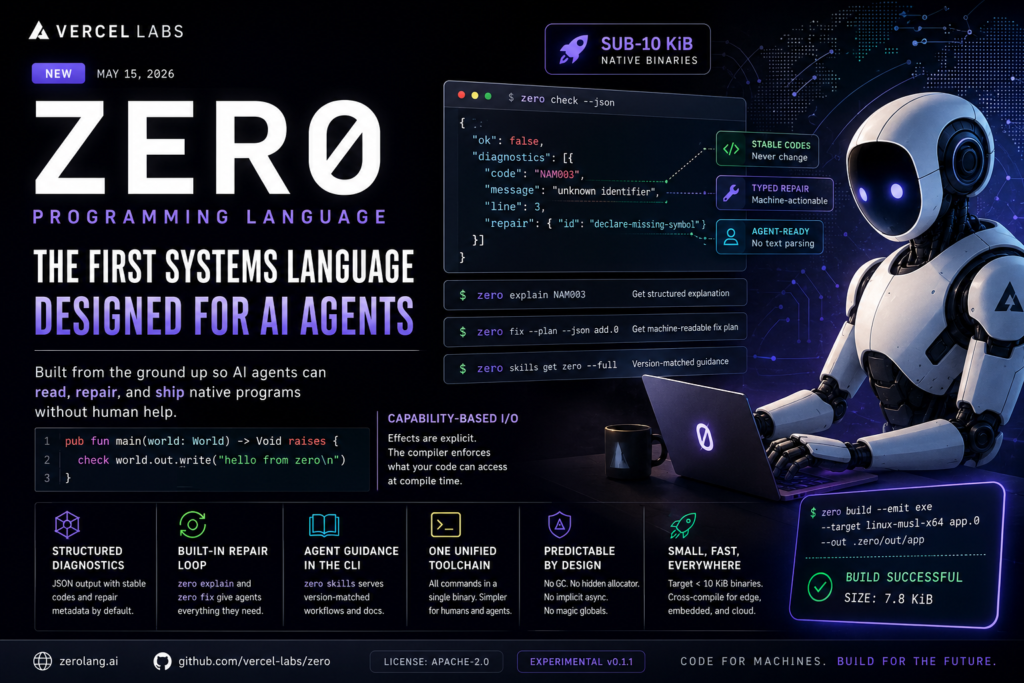
AI agents can now read, repair, and ship native programs without human help — and the Zero programming language from Vercel Labs is the reason why. Released on May 15, 2026, Zero is an experimental systems language that compiles to sub-10 KiB native binaries and ships a compiler toolchain built from the ground up to serve machine-readable workflows, not just human engineers.
What Is the Zero Programming Language?
Definition: The Zero programming language is an experimental, low-level systems language created by Vercel Labs that occupies the same design space as C and Rust — it compiles to native executables, gives programmers explicit memory control, and targets environments where binary size and latency matter.
What makes it different: Every other systems language was designed for human engineers who read error messages, interpret warnings, and manually trace stack output. The Zero programming language was designed so AI agents can consume the compiler’s output directly — without a human translating prose diagnostics into structured repair steps.
In short: it is the first systems language where the agent-facing API is treated as a first-class concern, not an afterthought.
The Core Problem Zero Solves
How Traditional Compilers Fail AI Agents
The standard agentic coding loop looks like this: the agent writes code, the compiler emits an error as unstructured text, and the agent must parse that text to determine what failed and how to fix it.
This loop is structurally fragile for three reasons:
- Unstable formats. Human-readable error messages change between compiler versions. An agent that relies on string patterns to parse
rustcoutput will silently break when the format shifts. - No repair semantics. Traditional compilers describe what went wrong. They do not describe what to do next in a machine-consumable format.
- Toolchain fragmentation. Agents must reason about which tool — linter, formatter, type checker, build system — to invoke for which task, multiplying the surface area for failures.
The Zero programming language addresses all three problems at the compiler level, not the agent-framework level.
Inside Zero’s Agent-Native Toolchain
Structured JSON Diagnostics
When you run zero check --json, the compiler emits structured output rather than prose. Every diagnostic carries four fields:
json
{
  "ok": false,
  "diagnostics": [{
    "code": "NAM003",
    "message": "unknown identifier",
    "line": 3,
    "repair": { "id": "declare-missing-symbol" }
  }]
}code— a stable identifier (e.g.,NAM003) that never changes between compiler versions.message— a human-readable description for engineers reviewing logs.repair— a typed repair ID that an agent can act on without parsing prose.
Humans read the message. Agents read the code and repair. The same command surfaces both — there is no separate mode or secondary tool to invoke.
zero explain and zero fix — the Repair Loop
Two subcommands complete the agent repair loop:
zero explain <diagnostic-code> returns a structured explanation of any diagnostic code. An agent encountering NAM003 can look it up directly without scraping external documentation. Because the explanation is served by the installed binary, it is always synchronized with the compiler version actually running.
zero fix --plan --json <file-or-package> emits a machine-readable fix plan — a structured description of exactly what changes to make to resolve a diagnostic. No inference required. No text parsing required. The agent receives an action list.
Together, these two commands give an autonomous agent everything it needs to close the repair loop without human intervention.
zero skills — Version-Matched Agent Guidance
Most tools require agents to scrape external documentation that may be out of sync with the installed toolchain. The Zero programming language solves this with zero skills, which serves guidance directly from the CLI — matched to the installed compiler version.
Running zero skills get zero --full returns focused workflows covering:
- Zero syntax and language fundamentals
- How to interpret and act on compiler diagnostics
- Build and package structure
- Testing and agent edit loop patterns
This means an agent working with the Zero programming language never needs to query an external documentation site. Its reference material is the binary itself.
A Unified Single-Binary Toolchain
The entire toolchain is consolidated into one binary: zero check, zero run, zero build, zero graph, zero size, zero routes, zero skills, zero explain, zero fix, and zero doctor are all subcommands of the same CLI. For agentic workflows, this matters enormously — agents do not need to reason about which tool handles which task.
Capability-Based I/O: Effects Are Explicit by Design
One of the most architecturally important decisions in the Zero programming language is that effects are explicit in function signatures.
pub fun main(world: World) -> Void raises {
  check world.out.write("hello from zero\n")
}
Every function that touches the outside world — standard output, the filesystem, the network — must receive a capability object (World or a derivative) to do so. A function without access to World cannot perform I/O. The compiler enforces this at compile time, not at runtime.
Two additional keywords make the control flow explicit:
check— handles fallible operations by surfacing failures up the call stack. No hidden exception mechanisms.raises— annotates that a function can propagate errors. Error paths are visible in the signature, not buried in runtime behavior.
This design makes the Zero programming language’s control flow and side-effect model fully predictable — a property that matters significantly when an AI agent is generating, modifying, or reviewing code without a human in the loop.
How Zero Compares to Other Systems Languages
The table below compares the Zero programming language with C and Rust on the dimensions most relevant to agentic AI workflows.
| Feature | Zero | Rust | C |
|---|---|---|---|
| Compiler output format | Structured JSON (default) | Human-readable text | Human-readable text |
| Stable diagnostic codes | Yes (NAM003, etc.) | Partial (error codes added later) | No |
| Typed repair metadata | Yes (repair.id field) | No | No |
| Built-in agent guidance CLI | Yes (zero skills) | No | No |
| Capability-based I/O | Yes (compile-time enforced) | No (but ownership model) | No |
| Single unified toolchain | Yes (one binary) | No (rustc + cargo + clippy + rustfmt) | No (compiler + linker + make) |
| Binary size target | < 10 KiB | Variable (often larger) | Variable |
| Mandatory GC | No | No | No |
| Hidden allocator | No | No | No |
| Implicit async | No | No (explicit) | No |
| License | Apache-2.0 | MIT / Apache-2.0 | N/A (spec) |
| Current status | Experimental (v0.1.1) | Stable | Stable (50+ years) |
The comparison makes clear that Zero’s differentiation is not raw performance or memory safety (Rust already handles both well) — it is machine-readable compiler output and structured agent tooling as first-class language features.
Binary Size and Memory Predictability
The Zero programming language targets environments where binary size and memory behavior matter. Its design achieves this through three mechanisms:
No mandatory garbage collector. Memory management is explicit, with no hidden runtime collecting allocations behind the scenes. This gives the agent (or engineer) a deterministic view of memory behavior.
No mandatory event loop. There is no implicit concurrency runtime. Zero has no magic globals, no hidden process object.
Static dispatch. Executables compiled by the Zero programming language use static dispatch, which eliminates the overhead associated with dynamic dispatch and contributes to the sub-10 KiB binary size target.
The zero size --json subcommand reports artifact size before code generation when possible, giving agents early feedback on whether a build will meet size constraints.
Cross-compilation is supported with a command like:
zero build --emit exe --target linux-musl-x64 add.0 --out .zero/out/addThis makes the Zero programming language usable in edge, embedded, and containerized environments where binary size directly affects cold-start time and resource consumption.
How to Get Started with the Zero Programming Language
Installing Zero requires a single command:
bash
curl -fsSL https://zerolang.ai/install.sh | bash
export PATH="$HOME/.zero/bin:$PATH"
zero --version
The installer downloads the latest binary from the GitHub release and places it in $HOME/.zero/bin/zero. No build step required.
Creating a new package:
bash
zero new cli hello
cd hello
zero check .  &&  zero test .  &&  zero run .
Source files use the .0 extension. Packages are defined with a zero.json manifest and a src/ directory.
A VS Code extension for .0 file syntax highlighting ships in the repository under extensions/vscode/.
Running the agent repair loop:
bash
# Check for errors in JSON format
zero check --json

# Look up a specific diagnostic
zero explain NAM003

# Generate a machine-readable fix plan
zero fix --plan --json add.0
These three commands form the complete agent repair loop that the Zero programming language was built to enable.
Why the Zero Programming Language Matters for Agentic AI
The emergence of AI coding agents — systems like Claude Code, GitHub Copilot, and Cursor — has exposed a structural mismatch between how programming languages produce output and how agents consume it. Agents are not humans. They do not benefit from prose designed for a developer reading a terminal window.
The Zero programming language represents a meaningful step toward resolving this mismatch at the language and toolchain level, rather than at the agent-framework level. Instead of building ever-more-sophisticated text parsers into agents so they can cope with unstructured compiler output, Zero asks a simpler question: what if the compiler just emitted structured data from the start?
This is not a small shift. It changes what kinds of autonomous repair loops are possible, and it raises the question of whether the next generation of systems languages will be designed with agent consumption as a first-class requirement — not an optional integration.
Zero is currently experimental (v0.1.1, Apache-2.0). It does not yet have a package registry, and its cross-compilation support is limited to documented targets. The language specification is not yet stable. It is, by Vercel Labs’ own description, a working experiment — but one worth tracking closely if you are building AI infrastructure or agentic development toolchains.
Key Takeaways
- The Zero programming language is an experimental systems language from Vercel Labs that compiles to sub-10 KiB native binaries — released May 15, 2026.
- Its compiler emits structured JSON diagnostics with stable error codes and typed
repairmetadata, so agents parse and act on errors without interpreting human-readable prose. - Two CLI commands —
zero explainandzero fix --plan --json— give agents direct, structured access to diagnostic explanations and machine-readable fix plans. zero skillsserves version-matched agent guidance directly from the CLI, eliminating the need to scrape external documentation that may be out of sync with the installed compiler.- Effects are explicit in function signatures via capability-based I/O: functions must declare what they access, and the compiler enforces this at compile time.
- Zero has no mandatory GC, no hidden allocator, no implicit async, and no magic globals — making memory and control flow fully predictable for AI-generated code.
- The entire toolchain lives in a single binary, removing the need for agents to reason about which tool handles which task.
- Current status: v0.1.1, Apache-2.0, experimental. Not production-ready, but architecturally significant.
Frequently Asked Questions
What is the Zero programming language? Zero is an experimental systems language from Vercel Labs designed so AI agents can read, interpret, and repair native programs without human intervention. It compiles to native executables with a sub-10 KiB binary size target and ships a unified CLI with structured JSON compiler output.
How is Zero different from Rust or C? While Rust and C produce human-readable error messages, the Zero programming language emits JSON diagnostics with stable error codes and typed repair metadata by default. It also includes zero explain, zero fix, and zero skills as built-in CLI commands that give AI agents structured access to the repair loop — features that have no equivalent in Rust or C toolchains.
Is the Zero programming language production-ready? No. As of v0.1.1, Zero is explicitly experimental. The language specification, standard library, and compiler are not stable. It has no package registry and limited cross-compilation targets. It is best approached as an architectural experiment and a signal of where agent-native toolchain design is heading.
Where can I find the Zero programming language? The source is available at github.com/vercel-labs/zero under the Apache-2.0 license. The project page and installer are at zerolang.ai.