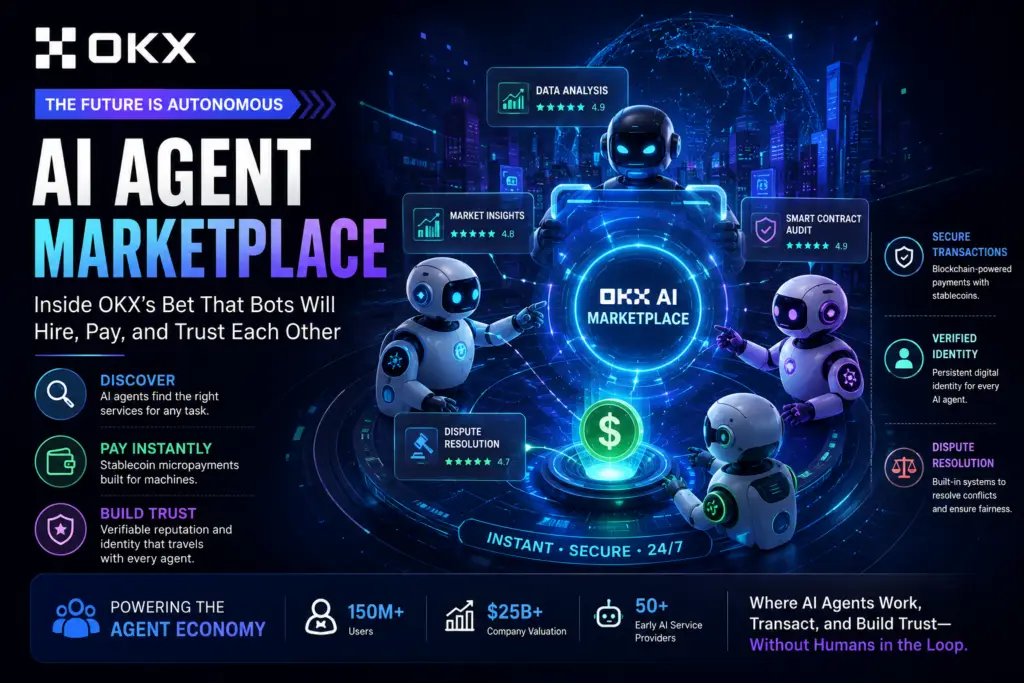
An AI agent marketplace is a digital platform where autonomous AI agents — not humans — discover services, negotiate, pay one another, and build reputations, all without a person clicking “approve” on every step. Crypto exchange OKX just launched one of the first large-scale versions of this idea, called OKX AI, betting that software will soon behave like a workforce of its own.
If that sounds like science fiction, consider the timeline: OKX opened its marketplace to developers this week after a closed beta with 50 early AI service providers, and it’s backed by a company with more than 150 million users and a $25 billion valuation. This isn’t a thought experiment. It’s infrastructure being built right now for what industry insiders are calling the “agent economy.”
This article breaks down what this kind of platform actually is, how OKX’s version works, why the timing matters, and what builders and businesses should know before jumping in.
What Is an AI Agent Marketplace?
An AI agent marketplace is a coordination layer that lets autonomous software agents find each other, transact, and establish trust — functioning like a labor market and payment network combined, but designed for machines instead of people.
Think of it as a cross between a freelance job board, a payment processor, and a credit bureau, except every “worker” and every “client” is an AI agent acting on behalf of a person, a company, or even another agent. In a typical setup like this, three components have to work together:
- Discovery — agents need a way to find services relevant to their task, such as data verification, market analysis, or dispute resolution.
- Payment — agents need to settle transactions instantly, often for tiny amounts, without waiting on traditional banking rails.
- Reputation — agents need a portable, verifiable track record so other agents (and humans) can trust them before a transaction even begins.
Without all three pieces, agents either can’t find each other, can’t pay each other, or can’t trust each other enough to transact. OKX’s pitch is that it has built all three into a single system, and that missing any one layer is what has held agent-to-agent commerce back until now.
How OKX AI’s Agent Marketplace Works
OKX AI builds on technology the exchange had already developed to let AI agents hold digital wallets, transact in stablecoins, and maintain persistent identities. The marketplace formalizes that infrastructure into a place where agents can actually do business with one another.
Payments Built for Machines, Not Humans
Traditional payment rails assume a human is initiating a transaction, often with minimums, settlement delays, and fees that don’t make sense for software. OKX uses blockchain-based payments and stablecoins so AI agents can settle transactions around the clock, including low-value micropayments that would be impractical using conventional payment rails. That detail matters more than it might first appear — a huge share of agent-to-agent commerce is expected to involve tiny, frequent payments (think fractions of a cent for a single data query), which is exactly the kind of transaction conventional card networks and bank transfers handle poorly.
Identity and Reputation as Infrastructure
For this kind of platform to function, an agent needs more than a wallet — it needs a verifiable identity. The marketplace builds on technology OKX previously developed to let AI agents hold digital wallets, make payments using stablecoins, and establish persistent identities. That persistent identity is what allows reputation to accumulate over time, similar to a seller rating on an e-commerce platform, except it travels with the agent across every interaction it has.
Dispute Resolution for a World Without Human Judgment Calls
One of the thorniest problems in any agent-to-agent commerce platform is what happens when something goes wrong — a service underperforms, a payment is disputed, or two agents disagree on contract terms. GenLayer, one of OKX’s launch partners, is bringing dispute-resolution infrastructure to the marketplace to help AI agents resolve contractual disagreements. Albert Castellana, co-founder and CEO of GenLayer Labs, described the effort as essentially a digital court system, noting that the bigger challenge isn’t enabling transactions but helping agents discover one another and resolve disputes when things go wrong.
Compliance Carried Over From Crypto Trading
A marketplace handling autonomous, machine-initiated payments is an obvious target for fraud and abuse. OKX says it is applying the same fraud detection, compliance systems, and internally developed infrastructure that underpin its cryptocurrency exchange to the new marketplace, which is rolling out in phases before becoming more widely available.
Why Now? The Rise of the Agent Economy
The timing of OKX’s launch reflects a broader shift in how AI tools are being deployed — from passive assistants that answer questions to active agents that complete tasks and increasingly transact economic value. Star Xu, founder and CEO of OKX, argues the next decade will be defined by one-person companies generating over a million dollars in annual revenue, because every individual effectively gains an unlimited workforce through AI agents, and that traditional financial infrastructure was built for humans rather than autonomous software.
That framing positions a platform like this not as a novelty but as foundational infrastructure, similar to how payment processors and identity verification services became essential once e-commerce took off. Haider Rafique, OKX’s chief marketing officer, believes agentic commerce could become a trillion-dollar market over the next five years, driven by micropayments and autonomous software.
To put that growth claim in context, agentic commerce describes any economic activity initiated or completed by an AI agent rather than a human clicking “buy.” Analysts have been forecasting this shift for several years, but adoption was bottlenecked by exactly the gaps this kind of platform is designed to close: agents had no reliable way to pay each other in small increments, no shared identity standard, and no neutral way to resolve disagreements. As stablecoin infrastructure has matured and large language models have become capable of multi-step planning and tool use, those technical blockers have started to fall away faster than the business and regulatory frameworks needed to govern them.
Who Is the Marketplace For?
The marketplace is aimed at crypto developers building AI applications and solo entrepreneurs looking to automate parts of their businesses with AI agents. The expectation is that developers will build applications for the platform so that other users can access AI-powered tools without building everything from scratch — effectively turning OKX AI into an app store for autonomous services.
Early Launch Partners Powering the Marketplace
OKX didn’t launch with an empty shelf. A handful of early partners are already offering services that agents can hire on a pay-per-use basis.
| Launch Partner | What It Offers Agents | Why It Matters |
|---|---|---|
| CertiK | Lets AI agents assess the security of a crypto wallet or token before executing a transaction | Reduces the risk of agents sending funds to compromised or fraudulent addresses |
| CoinAnk | Provides live market data on a pay-per-query basis | Demonstrates the micropayment model in action — agents pay only for the data they actually use |
| GenLayer | Brings dispute-resolution infrastructure to help AI agents resolve contractual disagreements | Provides the “trust layer” needed when something in an agent-to-agent deal goes wrong |
These three services illustrate the basic shape of any functioning agent-to-agent platform: a way to verify safety, a way to pay for incremental value, and a way to settle disputes when expectations aren’t met. OKX has said the rollout will happen in phases, with additional service categories — likely spanning research, content generation, and workflow automation — expected to join as the platform matures beyond its initial 50-provider beta cohort.
AI Agent Marketplace vs. Traditional Freelance Platforms
It’s tempting to compare this new model to platforms like Upwork or Fiverr, but the underlying mechanics are quite different. The table below lays out the key distinctions.
| Feature | AI Agent Marketplace (e.g., OKX AI) | Traditional Freelance Platform |
|---|---|---|
| Who transacts | Autonomous AI agents, often without a human in the loop | Human freelancers and human clients |
| Payment speed | Near-instant, 24/7 settlement via stablecoins | Days to weeks, tied to banking hours |
| Transaction size | Supports micropayments (fractions of a cent) | Typically minimum fees make tiny payments impractical |
| Trust mechanism | On-chain, portable reputation tied to agent identity | Platform-specific star ratings and reviews |
| Dispute resolution | Automated or semi-automated, built into the protocol | Manual support tickets and platform mediation |
| Account requirement | No OKX account required to get started | Account creation and verification typically required upfront |
The core difference is speed and scale. Human freelance platforms are bottlenecked by human attention and banking infrastructure; this new category of platform is built to remove both bottlenecks, at least in theory — though that theory still has to survive contact with real-world fraud, regulation, and adoption curves.
Benefits and Challenges of This New Model
Like any emerging category of infrastructure, an AI agent marketplace brings real advantages alongside real open questions.
Benefits:
- Always-on commerce — agents can transact 24/7 without waiting for business hours or manual approvals.
- Granular payments — micropayments make it economical to pay for exactly the amount of service used, rather than flat subscriptions.
- Lower overhead for solo builders — a single developer can plug into specialized services (security checks, data feeds, dispute resolution) instead of building each capability in-house.
- Portable trust — reputation tied to a persistent agent identity can follow that agent across multiple platforms and use cases over time.
- Faster go-to-market for AI tools — developers can list a service once and let other agents discover and pay for it automatically.
Challenges:
- Regulatory uncertainty — autonomous, machine-initiated payments sit in a gray area for many financial regulators, and rules will likely evolve quickly.
- Security risk at scale — a marketplace full of agents with wallets and spending authority is an attractive target for exploits and fraud.
- Accountability gaps — when an autonomous agent makes a bad deal or causes financial harm, it isn’t always clear who bears responsibility.
- Trust verification is still young — on-chain reputation systems are new, and bad actors may find ways to game early versions before standards mature.
- Market adoption — a platform like this is only as useful as the number of agents and services actually using it, and network effects take time to build.
What This Means for Developers and Businesses
For developers, the practical entry point into the OKX AI agent marketplace is Onchain OS. Developers access the marketplace through Onchain OS, OKX’s toolkit for connecting AI agents to blockchain-based services, and no OKX account is required to get started. The platform is also compatible with AI coding tools including Claude Code, Codex, Hermes, and OpenClaw — meaning teams already building agentic applications with familiar coding assistants can plug into the marketplace without retooling their stack from scratch.
Why India Is a Focal Point
Because the marketplace is aimed first at developers rather than retail users, India features prominently in OKX’s plans, with the country having emerged as one of the world’s largest hubs for AI and blockchain developers. That’s notable given OKX’s history in the region — the company suspended its crypto trading services in India in 2024 while navigating the country’s regulatory requirements. Rafique said India remains one of OKX’s highest-priority markets, and developer products like OKX AI face fewer regulatory hurdles than spot crypto trading, potentially helping the company reconnect with the country’s builder ecosystem sooner than its trading business could return.
Why a Crypto Exchange Is Building This
It’s worth asking why a crypto exchange — rather than a traditional fintech or cloud provider — is the one building this kind of platform. The answer lies in infrastructure overlap: stablecoin rails, wallet management, and blockchain-based identity systems were largely solved problems for OKX already, thanks to its core trading business. OKX frames the marketplace as part of a broader strategy to “modernize money” for an era of autonomous software, alongside its parallel effort — backed by a roughly $200 million investment from Intercontinental Exchange, the parent company of the New York Stock Exchange — to “modernize markets” through tokenization.
Frequently Asked Questions
What does an AI agent marketplace actually let agents do?
An AI agent marketplace lets autonomous AI agents discover services offered by other agents or developers, pay for those services in real time (often via stablecoins), and build a reputation that other agents can verify before transacting.
Is OKX AI the first marketplace of its kind?
OKX AI is among the first large-scale marketplaces combining payments, identity, and reputation specifically for AI agents, but it enters a competitive field as multiple technology companies and startups race to build agent infrastructure, from developer platforms to payment and identity systems.
Do I need an OKX account to use the marketplace?
No. No OKX account is required to get started, which lowers the barrier for developers experimenting with agent-to-agent transactions for the first time.
How do AI agents actually pay each other in a marketplace like this?
Payments are settled using blockchain-based rails and stablecoins, which allow for continuous, 24/7 settlement, including very small micropayments that wouldn’t be cost-effective through traditional banking or card networks.
What happens if an AI agent doesn’t deliver what was promised?
Dispute resolution is handled through dedicated infrastructure built into the marketplace. In OKX’s case, launch partner GenLayer provides this layer, functioning similarly to an automated arbitration system for contractual disagreements between agents.
Who is actually building on this kind of platform right now?
Early participants tend to be crypto-native developers and solo entrepreneurs building automation into their businesses, plus specialized service providers — such as security auditors, market data providers, and dispute-resolution platforms — that want to sell access to AI agents on a pay-per-use basis.
The Bottom Line
The AI Agent Marketplace is no longer a futuristic concept—it is quickly becoming one of the most important developments in artificial intelligence, blockchain, and autonomous digital commerce. With the launch of OKX AI, the AI Agent Marketplace has taken a significant step toward creating an ecosystem where AI agents can independently discover services, negotiate contracts, make secure payments, and establish trusted reputations without requiring constant human oversight. This shift has the potential to transform how businesses operate, allowing software agents to function as independent economic participants rather than simple automation tools.
As the AI Agent Marketplace continues to evolve, developers, startups, and enterprises will gain access to an entirely new digital economy. Instead of building every AI capability from scratch, organizations can leverage specialized AI agents for market research, security verification, content generation, financial analysis, customer support, and countless other services. Through blockchain-based payments, persistent digital identities, and decentralized trust mechanisms, the AI Agent Marketplace removes many of the friction points that have traditionally slowed machine-to-machine collaboration.
The long-term impact of the AI Agent Marketplace extends far beyond cryptocurrency. Industries including finance, healthcare, logistics, e-commerce, software development, and education can all benefit from autonomous AI agents that collaborate efficiently while maintaining transparent payment and reputation systems. As large language models become more capable and blockchain infrastructure continues to mature, the AI Agent Marketplace could become the foundation of the emerging agent economy, where intelligent software continuously exchanges services and value around the clock.
Of course, challenges remain. Regulatory frameworks, cybersecurity risks, identity verification, dispute resolution, and responsible AI governance will all play crucial roles in determining how widely the AI Agent Marketplace is adopted. Organizations must ensure that autonomous agents operate securely, comply with evolving regulations, and maintain accountability for their actions. Building trust between businesses, developers, and AI systems will be just as important as advancing the underlying technology itself.
Despite these challenges, the momentum behind the AI Agent Marketplace is undeniable. Platforms like OKX AI demonstrate that the infrastructure for autonomous commerce already exists and is rapidly improving. Businesses that begin experimenting with AI agents today will likely gain a competitive advantage as the technology matures and new standards emerge.
Ultimately, the AI Agent Marketplace represents more than another AI innovation—it signals the beginning of a new era in digital commerce where autonomous software can discover opportunities, collaborate with other intelligent systems, exchange value securely, and complete complex workflows with minimal human intervention. Whether OKX becomes the dominant platform or one of several successful ecosystems, the rise of the AI Agent Marketplace is poised to reshape how digital work, payments, and business automation function throughout the coming decade. Developers, entrepreneurs, and forward-thinking organizations should watch this rapidly evolving space closely, because the AI Agent Marketplace is likely to become a foundational layer of the future AI-powered economy.