Primary Keyword: privacy-focused AI chatbot Secondary Keywords: Lumo 2.0, Proton AI assistant, zero-access encryption, encrypted AI chatbot
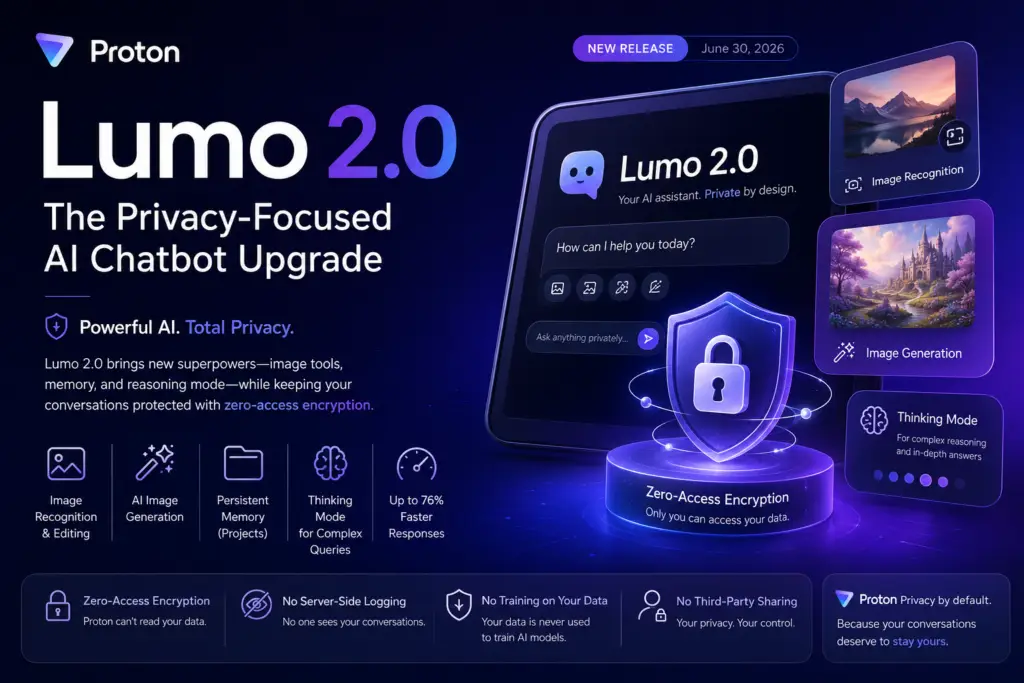
Proton just gave its privacy-focused AI chatbot a major overhaul. Lumo 2.0, released on June 30, 2026, adds image recognition, image generation, persistent memory, and a new “thinking mode” — all while keeping the zero-access encryption that made the original Lumo stand out from ChatGPT and Gemini.
If you’ve been searching for an AI assistant that doesn’t quietly harvest your conversations for training data, this update is worth understanding in detail. Below, we break down exactly what changed, how Lumo’s privacy architecture works, and how it stacks up against the mainstream chatbots you’re probably already using.
What Is Lumo? A Quick Definition
Lumo is <cite index=”1-1″>a public AI chatbot released by Proton, the privacy-focused productivity app company, in 2025</cite>. Unlike most consumer chatbots, Lumo was built from the outset as a privacy-focused AI chatbot, meaning its core design principle isn’t just “answer questions well” — it’s “answer questions well without exposing what you asked.”
Proton is best known for Proton Mail and Proton Drive, both of which use end-to-end encryption as a selling point. Lumo extends that same philosophy into generative AI, positioning itself as the alternative for people who like the convenience of an AI assistant but distrust how larger providers handle personal data.
Why This Matters Right Now
AI chatbots have become daily tools for research, writing, coding, and personal organization. That also means they’ve become one of the largest repositories of sensitive personal information in existence — medical questions, financial details, legal concerns, unfinished business ideas. A privacy-focused AI chatbot addresses a real and growing anxiety: what happens to everything you type into that chat box?
What’s New in Lumo 2.0?
Lumo 2.0 is a ground-up re-engineering of the assistant, not a minor patch. <cite index=”1-1″>The update gives the chatbot a variety of newfound powers, including image recognition and image generation capabilities</cite>. Here’s a breakdown of each major addition.
Image Recognition and Generation
<cite index=”1-1″>Users can now upload pictures into Lumo, then use the chatbot to analyze or edit them. Similar to other LLMs, Lumo can also generate imagery based on a user’s prompt.</cite> This closes a significant functionality gap — until now, Lumo was text-only, which put it at a disadvantage against multimodal competitors like ChatGPT and Gemini.
Persistent Memory for Projects
<cite index=”1-1″>Version 2.0 also expands Lumo’s capabilities for Projects — the widget that allows users to upload documents and conduct work via Proton’s other products like email and cloud storage.</cite> <cite index=”1-1″>Projects now come with user-controlled persistent memory, which is a function that allows Lumo to recall a user’s preferences across various conversational sessions.</cite>
The “user-controlled” part matters for a privacy-focused AI chatbot: memory is opt-in and managed by the person using it, rather than silently accumulated in the background.
Thinking Mode for Complex Queries
<cite index=”1-1″>The chatbot also comes with a new “thinking mode” for more complex problems or questions.</cite> This mirrors the reasoning-mode approach other major AI labs have adopted, letting the model work through multi-step problems more deliberately instead of producing a single fast pass at an answer.
Faster Response Times
Speed was also a focus of this release. <cite index=”1-1″>The 2.0 version responds to most queries up to 76% faster than its previous iteration, the company says.</cite> Combined with thinking mode, this suggests Proton optimized both the “fast, simple answer” and “slow, complex answer” paths simultaneously — rather than trading one for the other.
Quick summary of what’s new:
- Image upload, analysis, and editing
- AI image generation from text prompts
- User-controlled persistent memory in Projects
- New “thinking mode” for complex reasoning
- Up to 76% faster response times overall
How Does Lumo’s Privacy Architecture Work?
Question: What actually makes Lumo different from ChatGPT or Gemini on privacy?
Direct answer: Lumo encrypts your data so that Proton itself cannot read your conversations, doesn’t retain server-side logs of your sessions, and doesn’t use your data to train its models.
That’s the core distinction. Most mainstream AI providers can technically access user conversations for abuse monitoring, product improvement, or model training unless a user actively opts out. Proton’s architecture is designed so that option isn’t necessary — the company says it structurally cannot see the content, regardless of settings.
Zero-Access Encryption Explained
<cite index=”1-1″>Proton distinguishes Lumo from other chatbot providers with its privacy protections. It uses what it calls zero-access encryption architecture, which encrypts users’ data in transit and at rest, only allowing access to the user.</cite>
In plain terms: your prompts and Lumo’s responses are encrypted before they leave your device and while they sit on Proton’s servers. The encryption keys are controlled in a way that keeps Proton employees, and by extension anyone who might compromise Proton’s servers, locked out of the readable content.
No Server-Side Logging
<cite index=”1-1″>The company also claims that no server-side logging of sessions is retained, so nobody at Proton can see the contents of conversations.</cite> This is a meaningful departure from typical chatbot infrastructure, where conversation logs are often retained for debugging, safety review, or analytics purposes.
No Training on User Data
<cite index=”1-1″>Proton also promises to never use customer data for AI training or share it with third-parties.</cite> For anyone who has hesitated to paste a work document or personal medical question into a chatbot, this is the specific guarantee that matters most.
Lumo vs. ChatGPT vs. Gemini: A Privacy-Focused AI Chatbot Comparison
Here’s how Lumo 2.0 compares to the two dominant general-purpose assistants on the dimensions that matter most for privacy-conscious users.
| Feature | Lumo 2.0 (Proton) | ChatGPT | Gemini |
|---|---|---|---|
| Core positioning | Privacy-focused AI chatbot | General-purpose assistant | General-purpose assistant |
| Encryption approach | Zero-access encryption (data unreadable by provider) | Standard transport/storage encryption | Standard transport/storage encryption |
| Server-side conversation logging | None, per company claims | Retained by default unless configured otherwise | Retained by default unless configured otherwise |
| Uses conversations for model training | No | Configurable by user | Configurable by user |
| Image recognition & generation | Yes (new in 2.0) | Yes | Yes |
| Persistent memory | Yes, user-controlled (Projects) | Yes | Yes |
| Advanced reasoning mode | Yes (“thinking mode”) | Yes | Yes |
| Free tier available | Yes | Yes | Yes |
| Paid tiers | Plus, Professional | Plus, Pro, Team, Enterprise | Various Google One/Workspace tiers |
The functional gap between Lumo and its bigger competitors has narrowed considerably with this release. <cite index=”1-1″>The public version of Lumo appears roughly equivalent to other major chatbots in terms of usefulness. It answers questions in a similar format as Gemini and ChatGPT, with approximately the same level of detail and context.</cite> The differentiator isn’t raw capability anymore — it’s what happens to your data after you hit send.
Who Should Use Lumo 2.0?
A privacy-focused AI chatbot isn’t the right fit for every use case, but it’s a strong option for specific groups of users:
- Journalists and researchers handling sensitive sources or unpublished material
- Legal and healthcare professionals who can’t risk client or patient data landing in a training set
- Existing Proton users who already rely on Proton Mail or Proton Drive and want a consistent privacy posture across tools
- Privacy-conscious professionals drafting confidential business strategy, financial plans, or contracts
- Anyone uncomfortable with the idea that a chatbot provider could theoretically read their conversation history
If your primary use case is casual brainstorming, general knowledge questions, or public-facing content, the privacy gap between Lumo and mainstream tools matters less. But for anything involving confidential, regulated, or personally sensitive information, the encrypted approach is a genuine practical advantage.
Lumo Pricing: Free, Plus, and Professional Tiers
<cite index=”1-1″>Lumo 2.0 is available immediately. In addition to the free public version, Proton offers paid tiers (Plus and Professional) that give those users significantly more access and resources.</cite>
Question: Do you need a paid plan to use Lumo 2.0?
Direct answer: No. The free tier includes access to Lumo 2.0’s core features, including the new image capabilities and thinking mode, while paid tiers unlock higher usage limits and additional resources for heavier or professional use.
This tiered structure mirrors how most competing chatbots monetize — a usable free layer with paid plans reserved for power users and organizations that need higher throughput.
Is Lumo 2.0 Available Now?
Yes. Proton confirmed the rollout is live as of this week, with no waitlist mentioned for the core feature set. Existing Lumo users should see the new capabilities — image tools, thinking mode, and persistent memory in Projects — appear automatically, while new users can sign up through Proton’s free tier to try the privacy-focused AI chatbot firsthand.
FAQs About Proton’s Privacy-Focused AI Chatbot
Is Lumo actually more private than ChatGPT or Gemini? Based on Proton’s stated architecture — zero-access encryption, no server-side session logs, and no use of conversations for training — Lumo is structurally designed to limit what the company itself can access, which goes beyond the privacy controls typically offered by mainstream chatbots.
Can Lumo generate and analyze images now? Yes. Lumo 2.0 introduced both image upload/analysis and text-to-image generation, bringing it in line with multimodal competitors.
What is “thinking mode” in Lumo 2.0? It’s a reasoning mode designed for more complex questions, allowing the model to work through problems more thoroughly before responding, rather than optimizing purely for speed.
Does Lumo remember previous conversations? Within Projects, yes — persistent memory is available and is described as user-controlled, meaning the person using it manages what gets remembered.
Is Lumo free to use? Yes, a free tier is available, with Plus and Professional paid tiers offering expanded access and resources.
Who created Lumo? Lumo is built by Proton, the company behind Proton Mail and Proton Drive, and led by founder and CEO Andy Yen.
Final Thoughts
Lumo 2.0 signals something worth paying attention to: the assumption that you have to trade privacy for capability is starting to break down. As Proton’s CEO put it, <cite index=”1-1″>”Lumo 2.0 demonstrates that users no longer need to choose between powerful AI capabilities and meaningful privacy protections.”</cite>
With image generation, persistent memory, a faster response engine, and a new reasoning mode, this update closes most of the functional gap between Lumo and the biggest names in the category — while keeping the zero-access encryption that defines it as a genuine privacy-focused AI chatbot rather than just a privacy-branded one. For anyone who has been waiting for a serious, encrypted alternative to ChatGPT and Gemini, Lumo 2.0 is the strongest case yet.