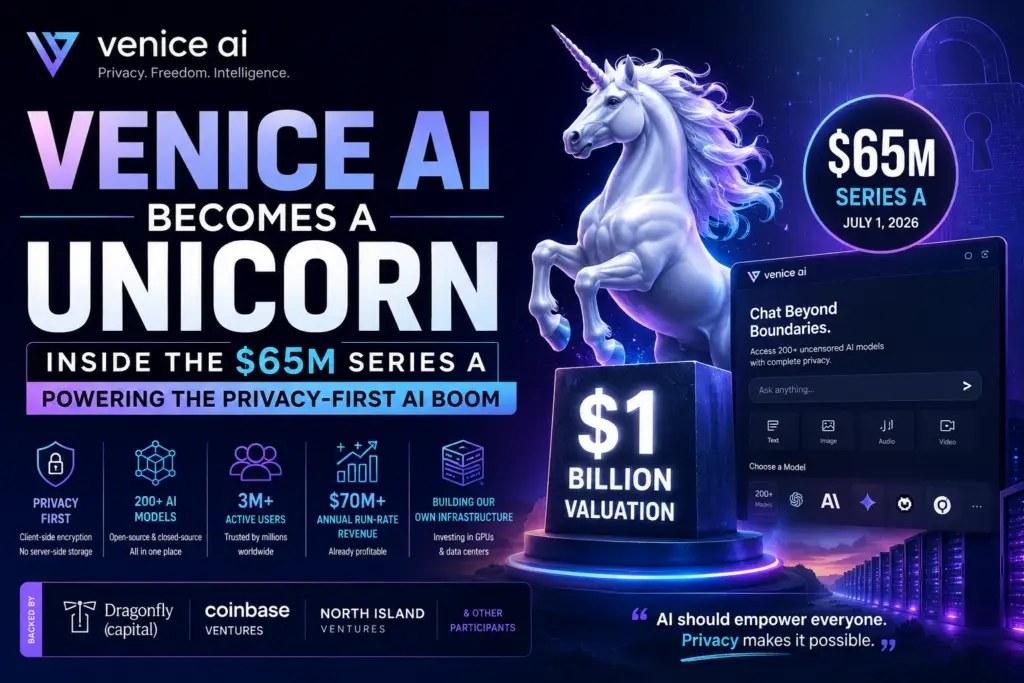
Venice AI, a privacy-first AI platform that gives users access to more than 200 uncensored AI models, became a unicorn on July 1, 2026, after raising a $65 million Series A at a $1 billion valuation. The round was led by crypto-focused venture firm Dragonfly, with participation from Coinbase Ventures and North Island Ventures, and lands on top of a company that is already profitable, with more than $70 million in annualized run-rate revenue.
That’s the headline. Below, we break down exactly what Venice AI does, why investors are betting on privacy over safety-first alternatives like ChatGPT and Claude, and what this deal signals about the future of the AI industry.
What Is Venice AI?
Venice AI is a platform that routes user queries to more than 200 different AI models — including open-source, “uncensored” models hosted on its own infrastructure, as well as closed-source models from providers like OpenAI and Anthropic — while promising not to store any of that data.
Here’s how it works in practice:
- Client-side encryption. User input is encrypted and unencrypted on the client’s own device.
- No server-side storage. Queries route through an external proxy before processing, and Venice AI says it doesn’t retain the data on its own systems.
- Optional end-to-end encryption. Available on some models, but gated behind a paid subscription.
- Model choice across formats. Users can generate text, images, audio, and video, with each model varying in performance, quality, and how much content moderation is applied.
- Customizable AI “characters.” The platform prominently features chat personas that users can tailor to their preferences.
Founded roughly two years before this raise, Venice AI has grown to more than 850,000 unique website visitors, over 3 million active users, and an average of 1.7 million API calls per day, according to the company.
Definition: What Does “Privacy-First AI Platform” Actually Mean?
A privacy-first AI platform is one designed so that user conversations, prompts, and outputs are not logged, stored, or used to retrain models without explicit consent. For Venice AI, this goes a step further than typical “we don’t train on your data” disclaimers — the architecture itself is built so the company says it structurally cannot access most user content, because encryption and routing happen before data ever reaches its servers.
This distinction matters because it shifts privacy from a policy promise to an architectural guarantee — a difference that’s becoming a major selling point as trust in mainstream AI chatbots wavers.
Why Did Venice AI Raise $65 Million?
Venice AI raised its $65 million Series A to fund two priorities: buying its own GPUs and building dedicated data centers, so the company can stop leasing compute and improve its gross margins. This is the company’s first external fundraise since launching, and it comes at a moment when the startup is already cash-flow positive.
CEO Erik Voorhees told TechCrunch the company is already profitable, with annualized run-rate revenues exceeding $70 million — a rare claim among AI startups still burning cash to scale.
Who Invested in Venice AI’s Series A?
| Investor | Type | Notable Focus |
|---|---|---|
| Dragonfly | Lead investor | Crypto-focused venture capital |
| Coinbase Ventures | Participant | Crypto exchange investment arm |
| North Island Ventures | Participant | Venture capital |
| Others (undisclosed) | Participant | — |
The investor lineup is telling. Rather than the usual roster of AI-focused funds, Venice AI’s round is dominated by crypto-native capital — a reflection of both its founder’s background and the two crypto tokens tied to its ecosystem.
Who Is Erik Voorhees, and Why Does His Background Matter?
Erik Voorhees is Venice AI’s CEO and an early bitcoin advocate with a long history in cryptocurrency, having previously founded the bitcoin gambling site Satoshi Dice and the cryptocurrency exchange ShapeShift. That track record explains why crypto investors were quick to back his newest venture — and why privacy, not moderation, sits at the center of Venice AI’s pitch.
Voorhees has publicly defended minimal identity verification before. When a Wall Street Journal investigation years ago accused ShapeShift of processing suspect funds because it didn’t initially require user identification, Voorhees pushed back on the premise that mass identity tracking was worth the tradeoff.
He’s carried that same philosophy into Venice AI’s approach to AI safety. Asked how the platform thinks about controversial use cases — including recent, widely covered incidents of AI-linked psychological harm — Voorhees described Venice AI as a “neutral tool or a neutral platform,” comparing it to Bitcoin’s role as a neutral protocol that treats every user the same way.
“I think it’s actually quite dangerous from a safety perspective, for the world to enter this next phase and have everyone be constantly watched,” Voorhees said, arguing that mass surveillance poses a bigger risk than individual users asking controversial questions.
How Does Venice AI Compare to Mainstream AI Chatbots?
The core distinction between Venice AI and platforms like ChatGPT, Gemini, or Claude comes down to two things: how much content moderation is applied, and whether user data is retained.
| Feature | Venice AI | Typical Mainstream Chatbot |
|---|---|---|
| Content moderation | Minimal; markets itself as “uncensored” | Extensive safety guardrails |
| Data retention | Client-side encryption; no server-side storage claimed | Data often stored, sometimes used for training |
| Model access | 200+ models, open- and closed-source | Usually one proprietary model family |
| Output formats | Text, image, audio, video | Varies by product |
| Payment options | Subscription or crypto (VVV/DIEM tokens) | Subscription, primarily fiat |
| Business model | Consumer + API access | Consumer + API access |
This positioning has clearly resonated with a segment of users who feel that safety-driven restrictions on mainstream AI tools have gone too far. As Voorhees put it, Venice AI is “optimizing for freedom and actually respecting users as adults.”
Question: Is Venice AI Actually Competitive with ChatGPT?
Direct answer: Yes, increasingly so, according to its own CEO. Voorhees credited Venice AI’s growth to closing the performance gap with ChatGPT over time. Early on, users chose the privacy-first AI platform despite it lagging behind ChatGPT’s capabilities, purely for the privacy benefit. As Venice AI’s model access and quality improved, it became what Voorhees called “an increasingly compelling alternative” — not just a niche privacy tool, but a genuine substitute for mainstream use.
What Role Do Crypto Tokens Play at Venice AI?
Venice AI operates two associated crypto tokens as part of its growth and monetization strategy:
- VVV — launched in early January, designed to attract users to the platform.
- DIEM — launched the previous August; users stake VVV to mint DIEM, which generates $1 worth of AI credits per day that can be spent on the platform.
Despite the prominence of this token system, Voorhees said only about 8% of Venice AI’s users actually pay using crypto — meaning the vast majority of revenue still comes through traditional subscription payments. The tokens appear to function more as a growth and loyalty mechanism than a primary revenue driver, though their performance has still contributed meaningfully to the company’s expansion, according to its CEO.
Why Is This Deal Significant for the AI Industry?
Venice AI’s unicorn status arrives at a moment when the broader AI industry is grappling with mounting scrutiny over chatbot safety, including lawsuits and reporting connecting AI systems to user harm. Venice AI’s success suggests a real and growing market exists on the opposite end of that spectrum: users actively seeking fewer restrictions, not more.
A few takeaways stand out:
- Profitability without heavy VC subsidy. Venice AI reached over $70 million in annualized revenue and profitability before taking outside capital — a notable contrast to many AI startups still operating at a loss.
- Crypto capital is flowing into AI infrastructure. Dragonfly, Coinbase Ventures, and North Island Ventures betting on an AI platform signals growing overlap between the crypto and AI investment worlds.
- “Uncensored” AI is now a fundable category. A $1 billion valuation validates that reduced content moderation, positioned around user privacy and autonomy, can be a durable business model rather than a fringe experiment.
- Vertical integration is the next phase. Venice AI’s plan to buy GPUs and build data centers mirrors a broader industry trend of AI companies trying to control their own compute costs rather than renting capacity indefinitely.
Frequently Asked Questions
What is Venice AI’s valuation after the Series A?
Venice AI is now valued at $1 billion following its $65 million Series A funding round, officially making it a unicorn.
Who led Venice AI’s funding round?
Dragonfly, a crypto-focused venture capital firm, led the round, with Coinbase Ventures, North Island Ventures, and other investors also participating.
Is Venice AI profitable?
Yes. CEO Erik Voorhees told TechCrunch that Venice AI is already profitable, with annualized run-rate revenue exceeding $70 million at the time of the raise.
How many users does Venice AI have?
Venice AI reports more than 850,000 unique website visitors, over 3 million active users, and an average of 1.7 million API calls per day.
What will Venice AI do with the new funding?
The company plans to use the capital to purchase GPUs and build its own data centers, moving away from leased compute to improve gross margins.
How does Venice AI make money?
Primarily through subscriptions, with a smaller portion of users (about 8%) paying via its VVV and DIEM crypto tokens.
The Bottom Line
Venice AI has rapidly emerged as one of the most talked-about companies in the artificial intelligence industry, proving that there is significant demand for AI platforms built around privacy, user choice, and flexible model access. By reaching a $1 billion valuation after raising a $65 million Series A, Venice AI has achieved unicorn status in just two years while accomplishing something many AI startups have yet to do—becoming profitable before relying heavily on venture capital. That milestone alone sets the company apart in an industry where many competitors continue to prioritize rapid growth over sustainable business fundamentals.
Unlike traditional AI assistants that primarily focus on a single proprietary model, Venice AI offers users access to more than 200 AI models spanning text generation, image creation, audio production, and video generation. This multi-model approach allows individuals and businesses to choose the AI model that best fits their specific workflow instead of being locked into a single ecosystem. As organizations increasingly seek flexibility and vendor independence, this strategy gives Venice AI a competitive advantage in an evolving AI market.
Another defining characteristic of Venice AI is its privacy-first architecture. Instead of relying solely on privacy policies that promise not to misuse customer data, the platform has been designed so that user prompts are encrypted and, according to the company, are not stored on its servers. In an era where enterprises and individual users are becoming more concerned about confidential information, intellectual property, and AI training practices, this architectural approach addresses one of the biggest trust challenges facing the AI industry today. The emphasis on protecting user conversations has become a major reason why businesses and developers are beginning to evaluate alternatives to mainstream AI platforms.
The company’s leadership also deserves attention. CEO Erik Voorhees has spent years advocating for decentralized technologies and user sovereignty through his work in the cryptocurrency industry. That philosophy now extends to Venice AI, where privacy, openness, and user autonomy form the foundation of the product strategy. Rather than treating AI as a tightly controlled ecosystem, the company positions itself as an open platform that empowers users to select different models based on their own requirements. Whether users need advanced reasoning, creative writing, software development assistance, or multimedia generation, the platform offers a broad range of options under one interface.
Financially, the company’s progress is equally impressive. Generating more than $70 million in annualized run-rate revenue while remaining profitable demonstrates that Venice AI has found product-market fit much earlier than many AI startups. The fresh capital from its Series A round will primarily be used to purchase GPUs and expand its own computing infrastructure. Owning more of its infrastructure should reduce long-term operating costs, improve gross margins, and give the company greater control over performance as user demand continues to grow. This strategy mirrors a broader trend among successful AI companies that are investing directly in compute resources rather than depending entirely on rented cloud capacity.
The investor lineup further reinforces confidence in the company’s future. Dragonfly led the funding round, joined by Coinbase Ventures and North Island Ventures, highlighting increasing overlap between cryptocurrency investors and artificial intelligence startups. These investors are betting not only on the company’s current business but also on the belief that privacy-focused AI will become an increasingly important segment of the broader AI economy. Their support signals that investors see long-term potential in platforms that emphasize transparency, decentralization, and user ownership.
Another factor contributing to the growing popularity of Venice AI is its support for cryptocurrency payments and token-based incentives. Although only a relatively small percentage of users currently pay through the platform’s crypto ecosystem, the VVV and DIEM tokens create an additional engagement layer that differentiates the service from conventional subscription-only AI products. While traditional payment methods remain the primary revenue source, these digital assets strengthen community participation and align well with the founder’s broader vision of decentralized digital infrastructure.
Competition within the AI industry will continue to intensify as companies like ChatGPT, Gemini, Claude, and other enterprise AI solutions expand their capabilities. However, Venice AI is not attempting to compete solely on raw model performance. Instead, it differentiates itself through user privacy, broader model selection, architectural transparency, and reduced restrictions on how users interact with AI systems. This alternative positioning allows the company to serve a growing audience that values flexibility and confidentiality alongside high-quality AI capabilities.
Looking ahead, the future of Venice AI will depend on its ability to maintain rapid innovation while scaling its infrastructure efficiently. Building data centers, purchasing GPUs, supporting additional AI models, and continuing to improve performance will require disciplined execution. The company must also navigate evolving regulatory environments surrounding artificial intelligence, data privacy, and responsible AI deployment. Successfully balancing innovation, user freedom, and regulatory compliance will be essential for sustaining long-term growth.
More broadly, the success of Venice AI reflects a larger transformation taking place across the AI landscape. Early competition centered almost entirely on developing the most capable language models. Today, buyers increasingly evaluate AI platforms based on security, privacy, deployment flexibility, pricing, infrastructure, ecosystem integrations, and overall user trust. This shift creates opportunities for companies that can differentiate themselves beyond model performance alone. Venice AI has recognized this transition early and built its business around solving real concerns that many users and enterprises now consider essential.
Ultimately, Venice AI represents more than another AI startup achieving unicorn status. It demonstrates that there is room in the market for AI platforms offering meaningful alternatives to the dominant technology providers. By combining privacy-first engineering, access to hundreds of AI models, profitable operations, strategic infrastructure investment, and strong investor confidence, the company has established a unique position within one of the fastest-growing sectors in technology. As artificial intelligence becomes increasingly integrated into business operations and everyday life, Venice AI will be closely watched as an example of how privacy-focused innovation can evolve into a sustainable, billion-dollar business. Its continued progress may ultimately influence how future AI platforms are designed, funded, and trusted by users around the world.