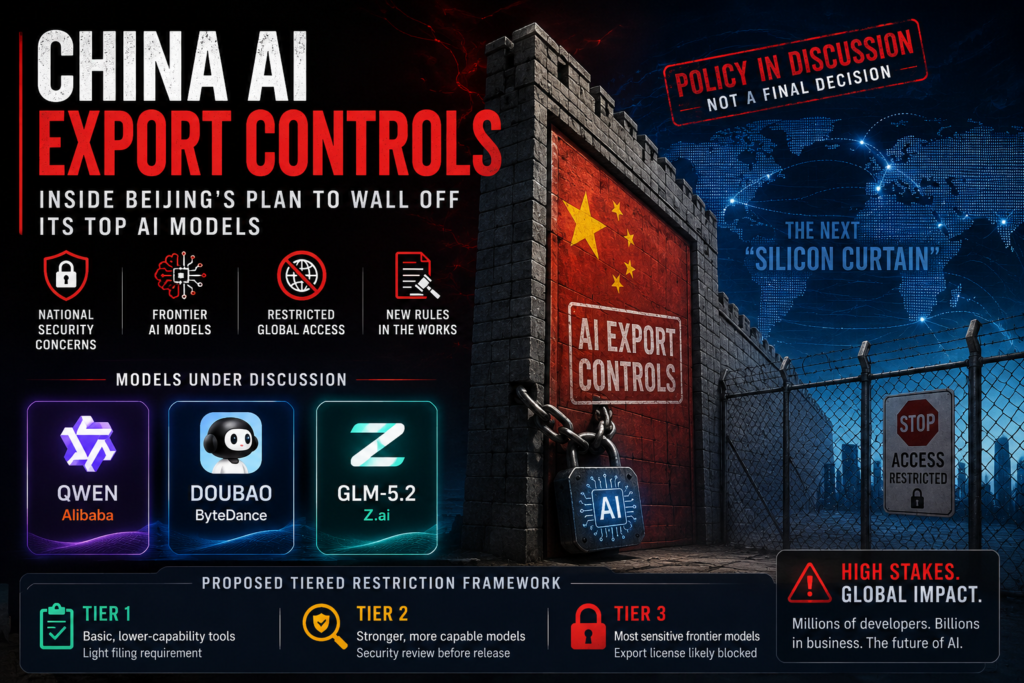
Beijing is weighing new China AI export controls that could cut off foreign access to the country’s most advanced AI systems, according to a Reuters report published this week. The proposed rules would apply to both closed and open-weight models — including ones that haven’t even launched yet — marking a sharp reversal of the open-access strategy that made Chinese AI a global force over the past 18 months.
If adopted, these China AI export controls wouldn’t just affect a handful of enterprise API customers. They would touch millions of developers worldwide who have built products on freely downloadable Chinese models, and they would reshape how the global AI market prices access to frontier-level capability.
What Are China’s New AI Export Controls?
China AI export controls, as currently discussed, refer to a proposed regulatory framework that would restrict who outside mainland China can access the country’s most capable AI models. The talks are being led by China’s Ministry of Commerce, which met with representatives from Alibaba, ByteDance, and the startup Z.ai over the past month to review the options.
Unlike a conventional export ban that targets hardware or a narrow list of applications, this version of China AI export controls would reach further. It’s designed to catch:
- Closed, proprietary models offered through paid APIs
- Open-weight models that anyone can download and run locally
- Future, unreleased systems that haven’t launched yet
Two additional measures reportedly came up in the discussions. One would classify the leak or theft of proprietary Chinese AI technology as a national security offense, raising the legal stakes for anyone caught extracting or redistributing restricted model weights. The other would restrict which foreign investors are allowed to fund Chinese AI startups going forward.
It’s worth stressing what this is not, at least not yet: <cite index=”2-1″>sources cautioned that officials have decided nothing, that any curbs might apply only to future models, and that no timeline exists</cite>. This is a policy conversation, not a signed law.
Why Is Beijing Considering AI Export Controls Now?
The short answer: China’s open AI models became too good, too fast, and too popular abroad for Beijing to treat as a purely commercial success story anymore.
The “Silicon Curtain” Behind the Policy
Historian Yuval Noah Harari has described the growing technological split between US and Chinese AI ecosystems as a “Silicon Curtain” — an echo of the Iron Curtain that divided Cold War spheres of influence. Instead of physical borders, this divide runs through model weights, training data, and API access rules.
That divide is no longer theoretical. Just last month, Meta cut off all operations and data-sharing with the Chinese-founded startup Manus on Beijing’s orders, roughly six months after acquiring it in a $2 billion deal. Around the same time, Chinese AI developers began shifting away from Nvidia chips toward domestic silicon providers, backed by a Beijing pledge worth roughly $294 billion toward homegrown compute.
China AI export controls would be the next brick in that wall — this time restricting what flows out of China rather than what flows in.
A Mirror of US Restrictions on Anthropic
Beijing’s deliberations track closely with what already happened on the American side. In June, the Trump administration restricted foreign national access to Anthropic’s Fable and Mythos models over national security concerns, which temporarily forced Anthropic to disable both models worldwide because user location couldn’t be verified in real time. Fable’s restrictions were later eased after new safeguards were added; Mythos access remains limited to a small number of trusted organizations.
Chinese officials reportedly view Anthropic’s Mythos model with particular concern, given its strength at detecting software vulnerabilities — a capability with obvious dual-use implications for cybersecurity. That concern is part of what’s driving the current round of China AI export controls: if the US can wall off its frontier model, Beijing wants the same option available for its own frontier systems.
Which Companies and Models Are on the List?
The proposed China AI export controls would apply to the models that made Chinese AI a genuine global competitor over the past year and a half.
Alibaba’s Qwen
Qwen is Alibaba’s flagship open-weight model family and one of the most downloaded AI model series on Hugging Face. Its broad international footprint is exactly the kind of overseas distribution that new China AI export controls would restrict.
ByteDance’s Doubao
Doubao is ByteDance’s leading AI product and one of the dominant assistants used inside China. While its footprint is currently more domestic-facing, it’s explicitly named among the systems Ministry of Commerce officials discussed.
Z.ai’s GLM-5.2
Z.ai’s GLM-5.2 has drawn the most attention from Silicon Valley researchers, reportedly performing comparably to leading US models on key cybersecurity benchmarks while costing a fraction as much to train. That performance-per-dollar story is precisely why GLM-5.2 sits near the center of the China AI export controls debate — it’s the clearest proof point that Chinese frontier AI has closed the gap.
How Would the Tiered Restriction System Work?
Reuters reports that a panel of Chinese legal scholars has floated a three-tier framework for how China AI export controls could be structured in practice, rather than a blanket ban.
| Tier | Model Type | Proposed Treatment |
|---|---|---|
| Tier 1 | Basic, lower-capability tools | Light filing requirement with regulators |
| Tier 2 | Stronger, more capable models | Formal security review before release |
| Tier 3 | Most sensitive frontier models | Domestic-only use; barred from public/overseas release |
This tiered approach would let smaller, less risky tools continue reaching international users largely unimpeded, while reserving the toughest China AI export controls for the handful of systems Beijing considers most strategically sensitive — the same models, notably, that companies like Alibaba, ByteDance, and Z.ai have been using to build global mindshare.
What Do China’s AI Export Controls Mean for Global Businesses?
Chinese open-weight models became popular internationally for a simple reason: they were free, capable, and required no licensing negotiation. A RAND analysis cited in reporting on this story found Chinese LLMs’ global market share climbed from roughly 3% to 13% in the two months after DeepSeek’s R1 launch, with the sharpest gains in developing markets. New China AI export controls would directly threaten that access. Businesses and developers should watch for:
- Rising costs for AI infrastructure if free or cheap open-weight Chinese models become harder to access, pushing more workloads back toward paid US or European APIs
- Reduced pricing pressure on US labs like OpenAI, Anthropic, and Google, which have had to compete partly on price against low-cost Chinese alternatives
- Supply-chain risk for products built on Qwen, Doubao, or GLM weights, especially in regions that leaned on them as affordable substitutes for pricier Western systems
- Slower access to future frontier releases, since the proposed China AI export controls explicitly cover models that haven’t launched yet
- Increased legal exposure for anyone handling Chinese model weights if leak-related conduct is reclassified as a national security matter
None of this is locked in. But companies that built products around the assumption of permanently free, permanently open Chinese weights are now facing a supply question they didn’t have to ask a year ago.
China vs. US AI Export Controls: Key Differences
China AI export controls and their American counterpart share a common driver — treating frontier AI as a strategic national asset — but they differ in scope, enforcement, and maturity.
| Factor | China’s Proposed Controls | US Controls (Anthropic Fable/Mythos) |
|---|---|---|
| Status | Under discussion; no rules finalized | Implemented in June, partially eased in July |
| Scope | Both closed and open-weight models, including unreleased ones | Specific frontier models for general and specialized use |
| Enforcement mechanism | Proposed tiered filing/review/lockdown system | Location-based access restriction, national security review |
| Trigger | Concern over leaks, foreign funding, and capability parity | Concern over foreign nationals accessing advanced capabilities |
| Current impact | None yet — companies still operating normally | Fable restored; Mythos still limited to trusted organizations |
The direction of travel on both sides is the same: frontier AI models are increasingly being regulated like strategic technology rather than ordinary software products.
Frequently Asked Questions
Is China actually banning AI model exports right now? No. As of this writing, China AI export controls exist only as a policy discussion between the Ministry of Commerce and companies like Alibaba, ByteDance, and Z.ai. No rule has been finalized, and any measures may only apply to future models.
Which Chinese AI models would be affected by these export controls? The models named in reporting include Alibaba’s Qwen, ByteDance’s Doubao, and Z.ai’s GLM-5.2 — three of the most widely used Chinese AI systems both domestically and internationally.
Would China AI export controls affect open-source models that are already downloaded? Practically, no. Model weights that have already been publicly released and downloaded are effectively uncollectable. Any new China AI export controls would more realistically apply to future releases and continued distribution channels, not clawing back existing downloads.
Why is Beijing considering these restrictions after years of open AI releases? Chinese labs used free, open-weight models to build global reach and influence at low cost. As those models approached US-level performance — particularly Z.ai’s GLM-5.2 — Beijing appears to be weighing whether that openness has become a strategic liability rather than a marketing advantage.
How does this compare to what happened with Anthropic’s Mythos model? It closely mirrors it. The US restricted foreign national access to Anthropic’s Fable and Mythos models in June over national security concerns; China AI export controls would apply the same logic in reverse, restricting foreign access to its own top-tier systems.
The Bottom Line
China AI export controls are still a proposal, not policy — but the direction is unmistakable. A country that spent the last 18 months winning global market share through free, open AI models is now asking whether that openness has become a strategic risk. Whether or not the final rules match today’s reporting, businesses relying on Qwen, Doubao, or GLM-5.2 should start planning for a world where Chinese frontier AI isn’t guaranteed to stay free — or fully accessible — for long.