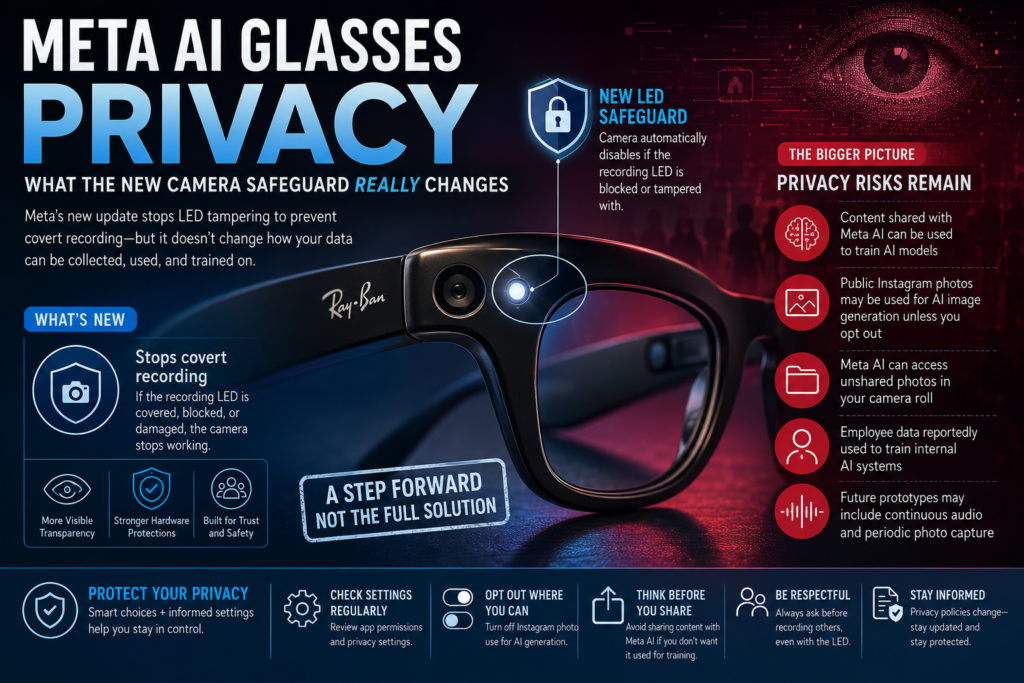
Meta AI glasses privacy just got a new layer of protection: the company is rolling out a feature that automatically disables the camera if someone tampers with the recording LED. But this single fix doesn’t resolve the bigger picture — Meta is simultaneously expanding how much personal data its AI systems collect, train on, and use across its product line.
This tension is at the center of a growing public debate. Meta wants its smart glasses to be seen as safe, stylish everyday tech. Yet regulators, journalists, and consumers keep surfacing evidence that the same devices — and the AI ecosystem behind them — depend on collecting more personal data, not less.
This article breaks down exactly what changed, why it happened, and what it does and doesn’t mean for anyone wearing or standing near a pair of Meta AI glasses.
What Is Meta’s New AI Glasses Camera Safeguard?
Meta’s new safeguard is a feature that shuts off the camera on its smart glasses if the recording indicator LED is physically blocked, covered, or damaged. In simple terms: if someone tries to defeat the “recording” light so they can film secretly, the camera itself stops working.
This addresses a documented weakness in the original design. Meta’s glasses were built with a small LED that lights up whenever the camera is active, intended as a visible cue to bystanders that they might be recorded. In practice, some users found ways around it — covering the light with tape or physically damaging it to record without detection. Meta’s engineering response was to link camera function directly to LED integrity, so tampering disables recording rather than just hiding the signal.
Meta itself described this as an industry first, stating that no other camera maker has built this kind of safeguard before. That claim frames the update as a leadership move on hardware-level privacy protection — but it also reveals something important: Meta built this specifically because people were already exploiting the LED’s weakness to record others without consent.
The Recording LED Problem
The original LED indicator was meant to solve a basic trust problem: how do bystanders know they’re being filmed by a device disguised as ordinary eyewear? The answer — a small light — turned out to be easy to defeat with basic tools like tape or physical damage. Once Meta noticed people covering the LED to record secretly, it first updated the glasses to disable recording when the light was blocked. When people then escalated to more sophisticated tampering, Meta rolled out the newer, deeper safeguard covered in this article.
Real-World Misuse Cases
Public criticism of the glasses has centered on their potential for covert surveillance, with the devices drawing comparisons to hidden camera tools rather than fashion accessories. Reports and social commentary have repeatedly flagged that the people most often targeted by this kind of covert recording tend to be women filmed without their knowledge or consent. That pattern of misuse is precisely what pushed Meta toward a hardware-level fix rather than relying on user honesty or a simple visual cue.
Why Meta AI Glasses Privacy Concerns Exist in the First Place
Meta AI glasses privacy concerns didn’t start with this camera update — they’ve built up over roughly two years of expanding AI features layered onto a wearable camera. The core issue is structural: a device designed to look like ordinary glasses is also a discreet recording tool connected to one of the world’s largest AI and advertising companies.
That combination creates two separate privacy questions. First, can the people around you tell when you’re recording them? Second, once footage or images are captured, how does Meta use that data afterward? The LED safeguard only answers the first question. It does nothing to change how captured content, once shared with Meta’s AI systems, may be used for training or product development.
Does the New Safeguard Actually Fix Meta AI Glasses Privacy?
No — the camera safeguard addresses covert recording by strangers, but it does not change how Meta collects, stores, or uses your data once it’s shared with its AI systems.
The update is a real, meaningful fix for one specific problem: bystanders being secretly filmed without any visual warning. That’s worth acknowledging. But Meta AI glasses privacy involves more than just the camera light. Meta’s own privacy policy allows images and video shared with Meta AI to be used for AI training. Photos stored only on the device and never shared with Meta AI are handled differently, but the moment content is sent to Meta’s AI systems — including through everyday use of the assistant — it can become training data.
Meta also continues to build features that expand data collection elsewhere in its ecosystem, including AI tools that can analyze photos in a user’s camera roll before they’re ever posted, and image-generation tools that draw on public Instagram photos unless a user actively opts out. None of that is addressed by a safer LED.
Meta’s Broader AI Data Strategy vs. Its Privacy Messaging
The gap between Meta’s public privacy messaging and its underlying AI data strategy is the central tension driving ongoing scrutiny. The table below lays out where the two diverge.
| Area | Meta’s Public Messaging | Meta’s Actual AI Data Practice |
|---|---|---|
| Camera recording | New LED safeguard prevents covert filming | Only stops tampering-based misuse; doesn’t limit data use after capture |
| Photos/videos on glasses | “You, and only you — unless you choose to share them” | Content shared with Meta AI can be used to train AI models |
| Instagram photos | Framed as user choice and control | Public photos usable for AI image generation unless users manually opt out |
| Camera roll access | Presented as an optional AI convenience feature | Meta AI can be applied to unshared camera roll photos |
| Employee data | Not typically discussed publicly | Employee keystrokes reportedly used to train internal AI systems |
| Future hardware | Framed around safety improvements like the LED fix | Reported prototypes explore continuous audio capture and periodic photo capture |
This comparison shows a consistent pattern: safety-oriented announcements tend to be specific and narrow, while data-expanding features are often opt-out by default rather than opt-in, and disclosed through policy documents rather than headline announcements.
Meta AI Glasses Privacy Timeline: Lawsuits, Investigations & Past Incidents
Meta AI glasses privacy issues sit inside a much longer pattern of privacy controversies at the company. Recent and ongoing developments include:
- State-level investigations into whether Meta’s smart glasses violate consumer privacy protections.
- Active lawsuits alleging false advertising and privacy violations tied to the glasses’ recording capabilities.
- A separate lawsuit filed after outsourced content moderators reviewing AI-glasses footage reportedly encountered graphic and explicit material, including nudity, while training Meta’s AI systems.
- Historical precedent, including the 2018 Cambridge Analytica data scandal and later server-side data exposures, both of which shaped Meta’s current public “privacy progress” messaging.
- Child safety litigation, with separate lawsuits and internal document leaks alleging Meta prioritized growth over safety protections for younger users.
Taken together, this history is part of why a single hardware fix — however genuine — hasn’t been enough to change the overall public perception of Meta AI glasses privacy.
How to Protect Your Own Privacy Around AI Glasses
Whether you wear Meta’s glasses yourself or simply spend time around people who do, a few practical habits can reduce your privacy exposure:
- Check app permissions regularly for Meta AI and related apps, since default settings often favor broader data sharing.
- Opt out of Instagram photo use for AI image generation if you don’t want public photos used in AI-generated content.
- Avoid sharing images or video with Meta AI directly if you don’t want that content eligible for AI training.
- Ask before recording in situations involving other people, even though the LED safeguard reduces covert recording risk.
- Review Meta’s privacy policy updates periodically, since AI data-use terms have changed multiple times as new features roll out.
- Treat the LED light as a partial signal, not a guarantee — it indicates active recording, not how footage will eventually be used.
FAQ: Meta AI Glasses Privacy
Does the new LED safeguard stop Meta from using my data? No. It only prevents the camera from recording when the LED is tampered with. It has no effect on how Meta uses images or video you actively share with Meta AI.
Can Meta train its AI on photos I take with my glasses? Yes, if you share those photos or videos with Meta AI. Meta’s privacy policy states that content shared with its AI systems can be used for training, even though photos kept only on the device are treated differently.
Are Meta AI glasses currently facing legal action over privacy? Yes. Multiple state investigations and lawsuits are currently active, including claims related to false advertising and to how footage was reportedly handled by outsourced content reviewers.
Is Meta building glasses with even more continuous data collection? Reports indicate Meta has tested prototypes capable of continuously capturing audio and taking photos at short intervals, which would represent a significant expansion beyond current on-demand recording.
What’s the simplest way to reduce my Meta AI glasses privacy risk? Limit what you actively share with Meta AI, regularly check opt-out settings for features like Instagram photo use in AI image generation, and treat the recording LED as one signal among several rather than a full privacy guarantee.