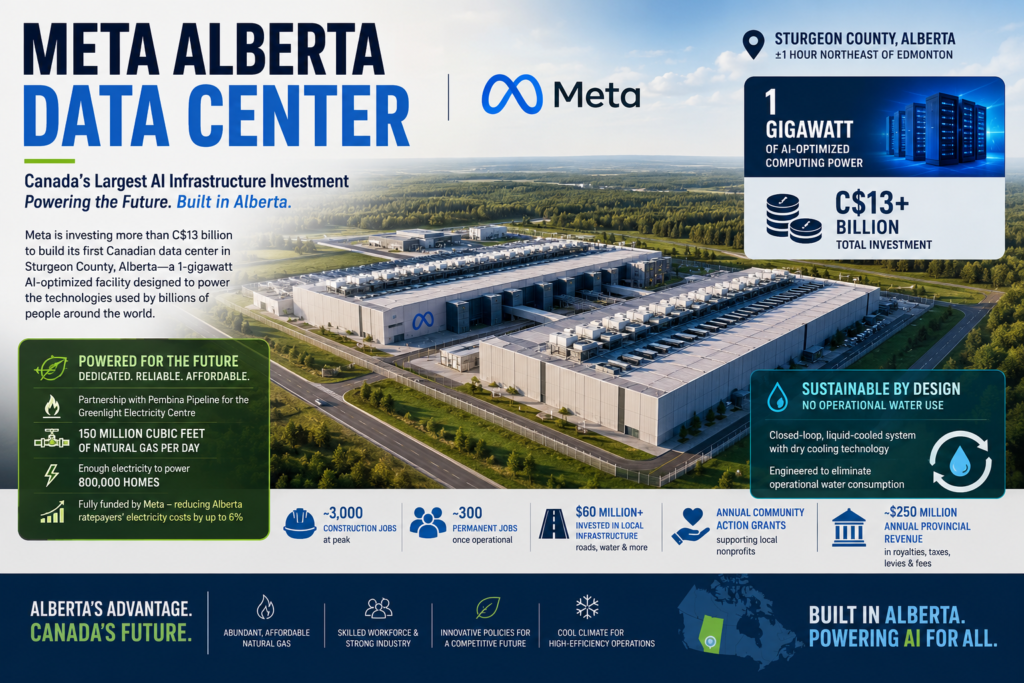
Meta is building its first-ever Canadian data center in Sturgeon County, Alberta, in a project worth more than $13 billion. The 1-gigawatt facility marks a major step in Meta’s global AI buildout and positions Alberta as a serious contender in North America’s data center race.
If you’ve been searching for what this project means, where it’s located, and why Meta picked Alberta over other regions, this guide breaks down every important detail — from the power deal behind it to its ripple effects on Canada’s AI economy.
What Is the Meta Alberta Data Center?
The Meta Alberta data center is a 1-gigawatt, AI-optimized computing facility being built in Sturgeon County, roughly an hour northeast of Edmonton. <cite index=”7-1″>Meta describes it as the company’s first data center in Canada and its 33rd facility in its global fleet.</cite> The project is designed specifically to support Meta’s AI workloads, rather than general-purpose cloud computing.
Definition: A hyperscale data center like this one is a large-scale facility built to run massive computing workloads — in this case, the machine learning training and inference behind Meta’s AI products — at a scale far beyond a typical enterprise data center.
Expansion: What makes the Meta Alberta data center notable isn’t just its size. It’s part of a broader pattern of tech giants relocating AI infrastructure to regions with abundant, low-cost energy. <cite index=”1-1″>Meta has pledged hundreds of billions of dollars toward large AI data centers in the U.S., and the Alberta project extends that strategy north of the border.</cite>
Key Facts at a Glance
- Location: Sturgeon County, Alberta, near Edmonton
- Capacity: 1 gigawatt of computing power
- Total investment: More than C$13 billion (approximately $9.17 billion USD)
- Construction jobs: <cite index=”3-1″>Roughly 3,000 skilled trade workers expected onsite at peak construction</cite>
- Permanent jobs: <cite index=”3-1″>About 300 operational positions once the facility is running</cite>
- General contractor: <cite index=”3-1″>Frost Collective, a joint venture between Clark Builders and PCL Construction</cite>
- Local infrastructure spending: <cite index=”5-1″>Approximately $60 million earmarked for road and water infrastructure improvements</cite>
Why Did Meta Choose Alberta for Its First Canadian Data Center?
Meta’s decision to build its first Meta Alberta data center didn’t happen by accident. Alberta has spent years actively courting large technology investors.
Alberta’s Energy and Policy Pitch
<cite index=”1-1″>The announcement was made in Calgary alongside Alberta Premier Danielle Smith and other provincial officials, who have worked for several years to attract Silicon Valley companies to invest in the province.</cite> Alberta’s pitch centers on three advantages: energy availability, industrial construction capacity, and a regulatory environment favorable to self-generated power.
<cite index=”6-1″>Last fall, Alberta passed legislation allowing data centers to generate their own power</cite> — a policy shift that directly enabled the structure of the Meta deal. Premier Smith also pointed to <cite index=”6-1″>the province’s cool climate and skilled workforce as additional draws for AI companies</cite>, adding that Alberta aims to become a central hub in the broader AI infrastructure economy.
The Role of Cheap Natural Gas
Question: Why does natural gas matter to the Meta Alberta data center?
Direct Answer: AI data centers consume enormous amounts of electricity, and Alberta’s natural gas reserves give it a cost advantage other regions can’t easily match. <cite index=”1-1″>Meta, like other tech giants, faces rapidly expanding power needs due to AI growth, and Alberta’s natural gas sells at a significant discount compared to U.S. prices.</cite> That discount translates directly into lower long-term operating costs for power-hungry AI infrastructure.
How Will the Meta Alberta Data Center Be Powered?
This is one of the most distinctive parts of the deal — Meta isn’t simply drawing from the existing grid.
The Pembina Pipeline Partnership
Question: Who is supplying power to the Meta Alberta data center?
Direct Answer: Meta has partnered with Alberta-based Pembina Pipeline on a dedicated natural gas power facility. <cite index=”1-1″>Pembina announced it will move forward with its Greenlight Electricity Centre, a new natural gas-fired power plant in Sturgeon County, under a long-term tolling agreement with Meta. The facility is expected to be in service by late 2030.</cite> <cite index=”1-1″>The project will require approximately 150 million cubic feet of natural gas per day</cite>, which is expected to boost demand for Western Canadian gas producers.
The scale of the power commitment is significant: <cite index=”4-1″>Meta said it will fully fund new generation and grid infrastructure for the facility, which will consume roughly as much electricity as 800,000 homes.</cite> Notably, <cite index=”5-1″>the Pembina partnership is also expected to reduce Alberta ratepayers’ electricity costs by up to 6 percent</cite>, since the new generation capacity adds supply to the broader grid.
Closed-Loop Cooling and Water Use
Water consumption is often a major concern with hyperscale data centers. Meta has addressed this directly for its Alberta project: <cite index=”6-1″>the facility will use a closed-loop, liquid-cooled system with dry cooling designed to eliminate operational water use</cite>. Power for the site will come from a mix of grid electricity and on-site natural gas generation.
What Economic Impact Will the Project Have on Alberta?
The Meta Alberta data center is being framed by provincial officials as a landmark economic event. <cite index=”5-1″>It’s described as one of the largest private-sector investments in Canadian history, expected to generate approximately $250 million annually for the province through royalties, taxes, levies, and fees.</cite> Premier Smith echoed that figure, <cite index=”6-1″>saying the project would generate at least $250 million for Alberta each year.</cite>
| Phase | Workforce | Duration/Timing | Economic Contribution |
|---|---|---|---|
| Construction | ~3,000 skilled trade workers at peak | Multi-year build-out | $60M+ in local infrastructure upgrades |
| Operations | ~300 permanent jobs | Ongoing | ~$250M annually in provincial revenue |
Beyond direct jobs, <cite index=”5-1″>Meta is also funding local infrastructure improvements, including roads and water systems, and will introduce annual Data Center Community Action Grants for local nonprofits</cite>. For Sturgeon County specifically, the project is being positioned as a catalyst that could turn the region into a significant node in Canada’s AI infrastructure landscape.
How Does This Fit Into Meta’s Global AI Infrastructure Strategy?
Meta’s 33rd Data Center Worldwide
The Meta Alberta data center isn’t an isolated bet — it’s one piece of a much larger global expansion. <cite index=”7-1″>Meta confirmed the Sturgeon County facility is its 33rd data center globally, and that it will be optimized specifically for AI workloads supporting the technologies used by billions of people across Meta’s platforms.</cite>
This matters for a simple reason: AI model training and inference require geographically distributed compute capacity, both to manage latency and to secure access to affordable power at scale. Building outside the U.S. — in a jurisdiction with cheap natural gas and a cooperative regulatory environment — gives Meta a hedge against rising U.S. energy costs and grid constraints.
<cite index=”6-1″>Canada’s federal government laid out a national AI strategy last month, highlighting the country’s largely renewable and low-emission electricity grid as an advantage for future data center growth.</cite> The Meta Alberta data center is likely to be viewed as an early test case for how well that national strategy translates into real investment.
Meta Alberta Data Center vs. Other Recent Hyperscale AI Investments
| Feature | Meta Alberta Data Center | Typical U.S. Hyperscale AI Facility |
|---|---|---|
| Capacity | 1 gigawatt | Varies, often 0.5–1+ GW |
| Primary power source | Dedicated natural gas + grid | Grid, sometimes with on-site gas or renewables |
| Investment | C$13 billion+ | Often $8–15 billion depending on scale |
| Water strategy | Closed-loop, dry cooling (no operational water use) | Varies widely; water-cooled systems still common |
| Regulatory driver | New Alberta self-generation legislation | State-by-state incentive and permitting frameworks |
| Community commitment | $60M infrastructure fund + annual grants | Varies by state and local negotiated agreements |
Frequently Asked Questions
Where is the Meta Alberta data center located? The facility is being built in Sturgeon County, Alberta, roughly an hour northeast of Edmonton.
How much is Meta investing in the Alberta data center? Meta’s investment totals more than C$13 billion, equivalent to roughly $9.17 billion USD.
How many jobs will the project create? Around 3,000 construction workers at peak building activity, with about 300 permanent operational jobs once complete.
How will the Meta Alberta data center get its power? Through a mix of grid electricity and a dedicated natural gas power plant built by Pembina Pipeline under a long-term supply agreement with Meta.
Will the data center use a lot of water? No — Meta says the facility will use a closed-loop, dry-cooling system designed to eliminate operational water use entirely.
Is this Meta’s only data center in Canada? Yes, it’s Meta’s first data center in Canada, and the 33rd in the company’s global network.
Final Takeaway
The Meta Alberta data center represents far more than a single construction project — it’s a signal that AI infrastructure investment is actively reshaping regional economies, energy markets, and national AI policy. With a dedicated natural gas power deal, a strong government partnership, and one of the largest private investments in Canadian history, Sturgeon County is now positioned at the center of Canada’s emerging AI infrastructure economy. As Meta continues expanding its global data center footprint, the Alberta project may become a template for how hyperscale AI facilities get built outside the traditional U.S. hubs.