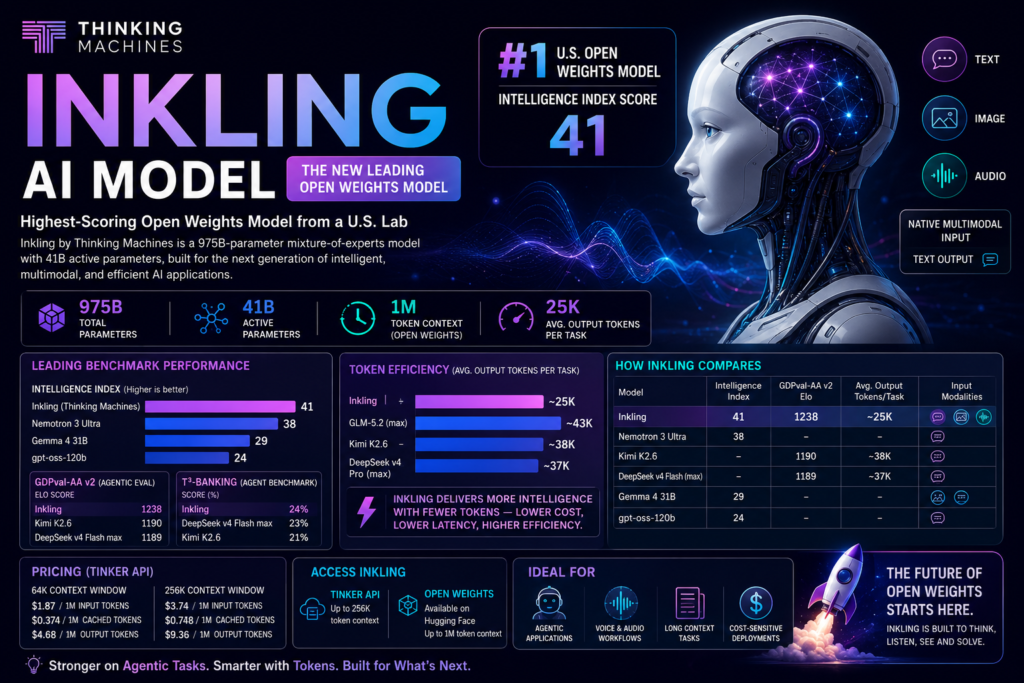
Thinking Machines just released the Inkling AI model, and it’s now the highest-scoring open weights model from a U.S. lab. If you’re deciding whether Inkling belongs in your AI stack, here’s the short answer: it’s a 975B-parameter mixture-of-experts model with 41B active parameters, native text/image/audio input, and benchmark results that beat Nemotron 3 Ultra, Gemma 4, and gpt-oss-120b on overall intelligence.
That single release reshuffles the leaderboard for open weights models, and it raises a bigger question for engineering teams: does “leading open weights model” actually translate into a better fit for your product? This guide breaks down what the Inkling AI model is, how it performs, what it costs, and where it fits (or doesn’t) next to its closest competitors.
What Is the Inkling AI Model?
The Inkling AI model is Thinking Machines’ first production-grade language model release, following earlier research previews from the company. It’s a large mixture-of-experts (MoE) system: 975 billion total parameters, with only 41 billion active per forward pass, which keeps inference costs lower than a dense model of similar scale would require.
Unlike many open weights releases that stick to text, the Inkling AI model was built as a multimodal system from the start. It accepts text, image, and audio as input (output remains text-only), which puts it in a small group of open weights models that handle more than one input type natively.
Quick Facts: Inkling AI Model at a Glance
| Attribute | Detail |
|---|---|
| Developer | Thinking Machines |
| Total parameters | 975B |
| Active parameters | 41B |
| Input modalities | Text, image, audio |
| Output modality | Text |
| Context window (Tinker API) | 256K tokens |
| Context window (open weights) | 1M tokens |
| Intelligence Index score | 41 |
| Release type | First production model (prior releases were research previews) |
Inkling AI Model Benchmark Performance
Benchmarks are where the Inkling AI model makes its strongest case. It debuts at a score of 41 on the Artificial Analysis Intelligence Index, which is the metric used to rank general model capability across a broad task suite.
Intelligence Index Score
At 41 points, the Inkling AI model edges out Nemotron 3 Ultra (38), the previous top U.S. open weights model, by 3 points. It also outperforms Gemma 4 31B (29) and gpt-oss-120b (24) by a wider margin. That 3-point gap over Nemotron 3 Ultra may look modest, but at this end of the leaderboard, a few points typically reflect meaningful differences in reasoning consistency and task coverage.
Agentic Task Performance
Where the Inkling AI model really separates itself is agentic work — the kind of multi-step, tool-using tasks that matter for real-world automation:
- GDPval-AA v2 (agentic evaluation): Inkling scores an Elo of 1238, ahead of Kimi K2.6 (1190) and DeepSeek v4 Flash max (1189).
- 𝜏³-Banking (domain-specific agent benchmark): Inkling scores 24%, slightly ahead of DeepSeek v4 Flash max (23%) and Kimi K2.6 (21%).
These aren’t massive leads, but consistency across two different agentic benchmarks suggests the advantage isn’t a fluke tied to one test format.
Token Efficiency
A model can score well on intelligence benchmarks while quietly burning through tokens to get there. This is one area where the Inkling AI model stands out for practical deployment: it averages roughly 25K output tokens per Intelligence Index task, compared to 43K for GLM-5.2 (max), 38K for Kimi K2.6, and 37K for DeepSeek v4 Pro (max).
Why this matters: lower token usage per task directly reduces inference cost and latency, especially at scale. A model that reasons to the same conclusion in fewer tokens is often the more economical choice even before you factor in per-token pricing.
Inkling AI Model vs Other Open Weights Models
Here’s how the Inkling AI model stacks up against its closest open weights competitors across the metrics that matter most for deployment decisions.
| Model | Intelligence Index | GDPval-AA v2 Elo | Avg. Output Tokens/Task | Input Modalities |
|---|---|---|---|---|
| Inkling | 41 | 1238 | ~25K | Text, image, audio |
| Nemotron 3 Ultra | 38 | — | — | Text |
| Kimi K2.6 | — | 1190 | ~38K | Text |
| DeepSeek v4 Flash (max) | — | 1189 | ~37K | Text |
| Gemma 4 31B | 29 | — | — | Text, image |
| gpt-oss-120b | 24 | — | — | Text |
Two things jump out from this comparison. First, the Inkling AI model is the only entry with native audio input, which matters for voice-driven applications, transcription-adjacent workflows, or any product that needs to reason over spoken content without a separate speech-to-text pipeline. Second, it’s the only model in this table pairing a top-tier Intelligence Index score with better-than-average token efficiency — most high-scoring models trade efficiency for accuracy.
Multimodal Capabilities of the Inkling AI Model
What makes Inkling’s multimodal handling different? It processes images, video frames, and audio through dedicated encoders and then projects everything into a shared hidden space that the decoder processes jointly. Images and video are handled through a hierarchical patch encoder, while audio uses discrete token encoding.
In practical terms, this means the Inkling AI model isn’t bolting a vision or audio adapter onto a text-only backbone after the fact — the architecture was designed to reason across modalities together. For teams building products that mix input types (a support agent that takes voice notes and screenshots, for example), this native handling can reduce the complexity of stitching together multiple specialized models.
Pricing and Access: How to Use the Inkling AI Model
There are two ways to access the Inkling AI model, and the choice affects both cost and context window size.
Tinker Platform API
Thinking Machines’ own Tinker platform offers the Inkling AI model with a 256K token context window. Pricing scales with context length:
- 64K context window: $1.87 per 1M input tokens, $0.374 per 1M cached tokens, $4.68 per 1M output tokens
- 256K context window: $3.74 per 1M input tokens, $0.748 per 1M cached tokens, $9.36 per 1M output tokens
Hugging Face Open Weights
For teams that want to self-host, the Inkling AI model weights are available on Hugging Face, and the open weights version supports a considerably larger 1M token context window — four times what’s currently available through the Tinker API. Self-hosting trades API convenience for infrastructure control and the ability to run the full context length.
Is the Inkling AI Model Right for Your Use Case?
Should you switch to the Inkling AI model from your current open weights model? It depends on what you’re optimizing for — if your workload is agent-heavy, multimodal, or token-cost-sensitive, Inkling is worth testing; if you need maximum accuracy and low hallucination above all else, it’s not yet the clear leader.
Does Inkling support long-context tasks? Yes — the Tinker API offers 256K tokens, and the open weights release supports up to 1M tokens, making it viable for large document analysis or extended agent sessions.
Is Inkling better than Nemotron 3 Ultra? On the Intelligence Index, yes, by 3 points (41 vs. 38). Whether that translates to better results on your specific workload depends on task type — always benchmark against your own use case rather than relying on aggregate scores alone.
Can Inkling process audio directly? Yes. It’s one of the few open weights models with native audio input support, alongside text and image, without needing a separate transcription step.
Limitations to Consider
No leaderboard topper is without tradeoffs, and the Inkling AI model has a notable one: accuracy and hallucination behavior on the AA-Omniscience benchmark. Inkling scores +2 on this benchmark — better than other U.S. open weights models like Nemotron 3 Ultra (-1), but still behind the leading open weights models overall. Specifically, Inkling posts 40% accuracy against a 63% hallucination rate on this evaluation.
That combination is worth flagging for any team considering the Inkling AI model for high-stakes, fact-sensitive applications (legal research, medical information, financial reporting). Strong agentic and reasoning scores don’t automatically mean low hallucination rates, and this gap is exactly the kind of thing aggregate leaderboard rankings can obscure.
The Bigger Picture: Open Weights Models in 2026
The release of the Inkling AI model is part of a broader pattern: open weights models are closing the gap with closed frontier models faster than in previous years, and U.S. labs are increasingly competing directly with Chinese labs like DeepSeek and Moonshot (Kimi) on agentic benchmarks specifically, not just general intelligence scores.
For teams evaluating open weights options, a few practical takeaways from Inkling’s release:
- Token efficiency is becoming a differentiator, not just an intelligence score. A model that reaches the same answer in fewer tokens saves real money at scale.
- Native multimodality is spreading to open weights releases, reducing the need for separate specialized models per input type.
- Agentic benchmarks (GDPval-AA v2, 𝜏³-Banking) are increasingly used alongside general intelligence indices, reflecting how much production usage has shifted toward tool-using, multi-step agents rather than single-turn Q&A.
Frequently Asked Questions
Who created the Inkling AI model? Thinking Machines developed and released the Inkling AI model, marking the company’s first production language model after earlier research previews.
What is Inkling’s Intelligence Index score? The Inkling AI model scores 41 on the Artificial Analysis Intelligence Index, currently the highest score among U.S.-developed open weights models.
Where can I access the Inkling AI model? Through Thinking Machines’ Tinker platform API (256K context) or by downloading the open weights from Hugging Face (1M context) for self-hosted deployment.
How much does the Inkling AI model cost to run? On the Tinker API, pricing starts at $1.87 per 1M input tokens and $4.68 per 1M output tokens at a 64K context window, rising to $3.74 input / $9.36 output per 1M tokens at 256K context.
Final Take
The Inkling AI model is a genuinely strong entry — the best open weights release from a U.S. lab right now, with real strengths in agentic tasks, token efficiency, and native multimodal input. It’s not the strongest performer on factual accuracy, so pair it with retrieval or verification steps if your application demands low hallucination rates. For agent-heavy, multimodal, or cost-sensitive workloads, the Inkling AI model is worth a serious evaluation against whatever open weights model you’re running today.