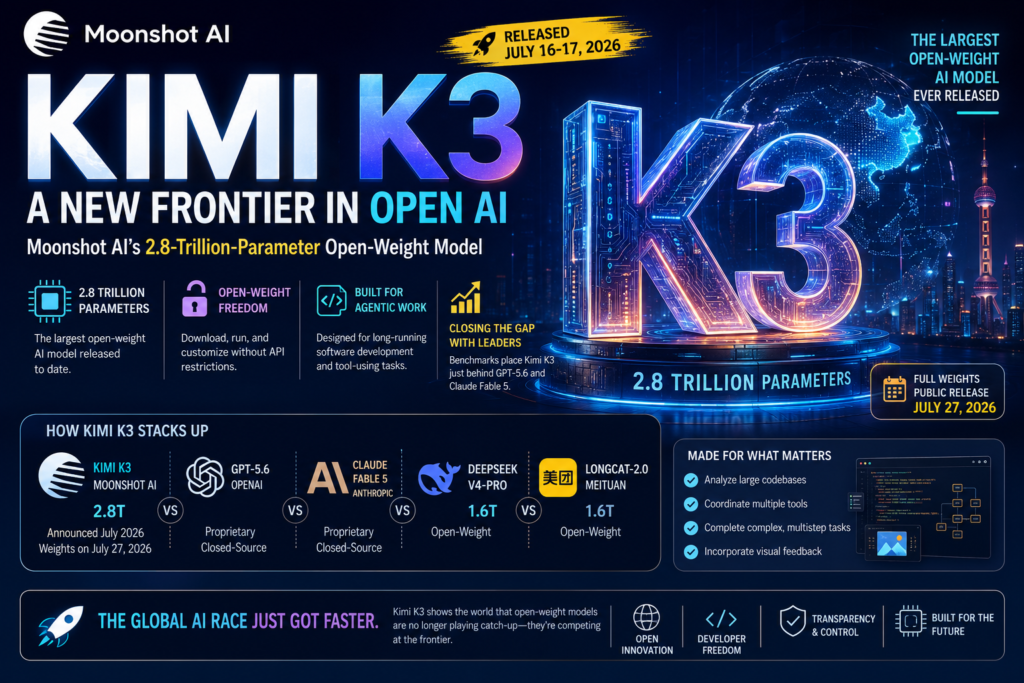
Kimi K3 is a 2.8-trillion-parameter open-weight AI model released by Chinese startup Moonshot AI on July 16-17, 2026. It is currently the largest open-source AI system ever released, and independent benchmarks place it just behind top proprietary models from Anthropic and OpenAI — a gap that, until recently, most analysts assumed would take Chinese labs months longer to close.
If you’re trying to understand what Kimi K3 actually is, why it matters, and how it stacks up against rival systems, this guide breaks it all down in plain language.
What Is Kimi K3?
Definition: Kimi K3 is a large language model built by Moonshot AI, a Beijing-based startup backed by Alibaba, designed around long-running autonomous software development tasks rather than simple chat responses.
Expansion: Unlike a typical chatbot model, Kimi K3 is built to analyze large codebases, coordinate multiple programming tools, and carry out multistep tasks toward a defined end goal — reportedly incorporating visual feedback as part of its workflow. Moonshot unveiled the model late on Thursday, July 16, 2026, just ahead of the World Artificial Intelligence Conference in Shanghai, timing that itself signals how central Kimi K3 is to the company’s comeback strategy.
Two things make Kimi K3 stand out immediately:
- Scale — At 2.8 trillion total parameters, Kimi K3 is described by Moonshot as achieving “open frontier intelligence,” making it significantly larger than any previous open model released by a Chinese competitor.
- Openness — Kimi K3 is an open-weight model, meaning the underlying system can be downloaded, run, and customized by outside developers rather than accessed only through a paid, closed API.
Full model weights for Kimi K3 are scheduled for public release on July 27, 2026, according to researchers who reviewed Moonshot’s technical documentation.
Why Kimi K3 Matters for the Global AI Race
Closing the Gap With Anthropic and OpenAI
The headline story around Kimi K3 isn’t just its size — it’s how close its performance comes to the best closed-source systems in the world. Moonshot itself acknowledges that Kimi K3 still trails GPT-5.6 and Anthropic’s Claude Fable 5 in some areas, but says internal testing shows the gap has narrowed sharply on several key tasks. Independent evaluations from Artificial Analysis reportedly placed Kimi K3 just behind those proprietary frontier models on intelligence benchmarks — a notable result for a freely downloadable model.
This timing is significant. Anthropic only released its Fable 5 model in June 2026, and OpenAI’s GPT-5.6 had debuted only about a week before Kimi K3’s launch. For an open model to arrive within striking distance of both releases so quickly undercuts a long-standing assumption in the U.S. AI industry: that Chinese labs typically trail American frontier models by several months.
The release also lands roughly a month after Anthropic’s Fable and Mythos models were briefly withdrawn in the U.S. due to export-control concerns before access was restored — a backdrop that has only sharpened attention on how fast China’s open AI ecosystem is moving.
The Trillion-Parameter Arms Race in China
Kimi K3 didn’t emerge in isolation. It’s the latest — and largest — entry in an accelerating contest among Chinese AI labs to build ever-bigger open models:
- Meituan’s LongCat-2.0 and DeepSeek’s V4-Pro previously led China’s open AI field at roughly 1.6 trillion parameters each.
- Zhipu AI’s GLM 5 series sits at around 744 billion parameters — sizable, but well below Kimi K3.
- MiniMax, the Hong Kong-listed AI firm, is reportedly developing its own 2.7-trillion-parameter model, expected to launch as early as the third quarter of 2026, alongside a separate frontier multimodal model called H3.
Several other domestic competitors have also crossed the trillion-parameter threshold in recent months. Together with players like Z.ai, these companies are releasing increasingly capable models at sharply lower cost than their Western counterparts — a trend reshaping assumptions about where AI leadership is heading.
Kimi K3 vs. Other Leading Open Models
Here’s how Kimi K3 compares to the open-weight models it just leapfrogged, based on parameter count and release status as of July 2026:
| Model | Developer | Parameters | Status |
|---|---|---|---|
| Kimi K3 | Moonshot AI | 2.8 trillion | Announced July 2026; weights due July 27, 2026 |
| MiniMax (unnamed model) | MiniMax | 2.7 trillion | In development; expected Q3 2026 |
| LongCat-2.0 | Meituan | 1.6 trillion | Previously China’s largest open model |
| DeepSeek V4-Pro | DeepSeek | 1.6 trillion | Previously tied for China’s largest open model |
| GLM 5 | Zhipu AI | 744 billion | Released prior to Kimi K3 |
Parameter count alone doesn’t determine real-world performance, but it’s a useful proxy for the scale of investment and ambition behind each release — and Kimi K3’s jump to 2.8 trillion parameters represents a significant leap over the field.
Key Technical Upgrades in Kimi K3
Question: What makes Kimi K3 different from earlier Moonshot models?
Direct answer: Kimi K3 incorporates two significant architectural upgrades aimed at improving computing efficiency, which together let the model complete longer, more complex tasks without the performance degradation that often affects massive models.
While Moonshot hasn’t disclosed every technical detail publicly, the company has emphasized that Kimi K3 is purpose-built for agentic, long-running work — the kind of multistep coding and reasoning tasks that require a model to plan, use tools, and course-correct over extended sessions rather than answer a single prompt. That focus on autonomous software development is a deliberate bet: as AI labs race toward systems capable of increasingly independent operation, including forms of recursive self-improvement, the ability to sustain coherent reasoning over long task chains has become one of the most competitive fronts in frontier AI development.
Open-Weight vs. Closed-Source AI Models: What’s the Difference?
Question: What does “open-weight” actually mean?
Direct answer: An open-weight model like Kimi K3 allows anyone to download, run, and modify the underlying model files themselves, while a closed-source model can only be accessed through a company’s own paid API or product.
This distinction matters more than it might seem:
- Access — Open-weight models can run on a company’s own servers or hardware, without depending on a third party’s uptime or pricing changes.
- Customization — Developers can fine-tune open-weight models for specialized tasks, industries, or languages in ways closed APIs typically don’t allow.
- Cost structure — Once downloaded, an open-weight model has no per-token API fee, though running it still requires significant compute infrastructure.
- Transparency — Researchers can inspect and test open-weight models directly, which supports independent safety and performance evaluation.
- Trade-offs — Closed-source models are typically easier to use out of the box, come with vendor support, and are updated centrally, while open-weight models place more responsibility for security, moderation, and maintenance on whoever deploys them.
Kimi K3’s release is significant precisely because it applies this open approach at a scale — 2.8 trillion parameters — that was previously the exclusive territory of closed, proprietary systems.
Moonshot AI’s Comeback Story
Kimi K3 also represents a turnaround for the company behind it. Moonshot AI was founded in 2023 by Yang Zhilin, a Tsinghua University graduate with prior research experience at Google and Meta. The company built early momentum in 2024 through its Kimi platform, which drew users for its long-text analysis and AI search capabilities, and by early 2026 had raised roughly $1.5 billion across multiple funding rounds.
That momentum stalled after DeepSeek’s low-cost R1 model disrupted China’s AI landscape in January 2025. Moonshot was among the hardest hit — Kimi’s ranking among China’s most-used AI apps slipped from third to seventh. In response, the company pivoted hard toward open-source releases, starting with Kimi K2 in July 2025 and accelerating with K2.5 in January 2026. Kimi K3 is the culmination of that strategy, and Bloomberg has reported the company was separately seeking $2 billion in new funding at a roughly $30 billion valuation ahead of a potential Hong Kong listing.
What Kimi K3 Means for Businesses and Developers
For companies evaluating AI infrastructure, Kimi K3’s release adds a new option at the very top of the open-model tier:
- Enterprises building on open models now have access to a system whose benchmarked performance approaches proprietary frontier models, potentially reducing dependence on closed APIs for advanced reasoning and coding tasks.
- Developers working on autonomous coding tools may find Kimi K3’s focus on multistep, tool-using tasks especially relevant, given that this was Moonshot’s stated design priority.
- Organizations concerned about cost may see open models like Kimi K3 as a way to control long-term AI spending, since there’s no per-query fee once the model is deployed on owned or rented infrastructure.
- Teams need to weigh trade-offs, since open-weight deployment still requires meaningful compute resources, security review, and ongoing maintenance that a closed API otherwise handles.
Whether Kimi K3 changes actual buying decisions will depend on independent benchmarking once the full weights are public on July 27, 2026, rather than on Moonshot’s own claims alone.
Frequently Asked Questions About Kimi K3
What company made Kimi K3? Kimi K3 was developed by Moonshot AI, a Beijing-based startup backed by Alibaba and founded in 2023 by Yang Zhilin.
How many parameters does Kimi K3 have? Kimi K3 has 2.8 trillion parameters, making it the largest open-weight AI model released to date as of July 2026.
When will Kimi K3’s weights be available? Full model weights for Kimi K3 are scheduled to be released publicly on July 27, 2026.
Is Kimi K3 better than GPT-5.6 or Claude Fable 5? No — Moonshot itself says Kimi K3 still trails GPT-5.6 and Claude Fable 5 in some areas, though independent tests reportedly show it performing close behind those proprietary models on several benchmarks.
What is Kimi K3 designed to do? Kimi K3 is primarily built for long-running autonomous software development work, including analyzing large codebases, coordinating programming tools, and completing multistep tasks with visual feedback.
How does Kimi K3 compare to other Chinese open models? Kimi K3, at 2.8 trillion parameters, surpasses previous Chinese open-model leaders including Meituan’s LongCat-2.0 and DeepSeek’s V4-Pro (1.6 trillion each) and Zhipu AI’s GLM 5 (744 billion), and is close to MiniMax’s in-development 2.7-trillion-parameter model.
The Bottom Line
Kimi K3 represents one of the most significant developments in the open AI ecosystem in 2026, not simply because of its unprecedented scale but because of what it symbolizes for the future of artificial intelligence. For years, the highest-performing AI models were available only through proprietary APIs controlled by a handful of technology companies. That landscape is beginning to shift as organizations increasingly embrace open-weight development, giving enterprises, researchers, and developers greater flexibility over how advanced AI systems are deployed and customized.
Moonshot AI’s latest release demonstrates that the gap between open and closed AI models continues to narrow. While independent testing over the coming weeks will ultimately determine how the model performs in production environments, the initial benchmark results suggest that open-weight systems are reaching a level of capability that was previously associated only with premium commercial offerings. This evolution could encourage more organizations to evaluate self-hosted AI infrastructure, particularly when data privacy, regulatory compliance, or long-term operating costs are major considerations.
Another important aspect of this launch is its broader impact on global AI competition. Chinese AI companies are rapidly accelerating innovation, with multiple organizations now developing trillion-parameter models that compete with established Western leaders. This growing competition is likely to benefit the entire industry by driving faster research, improving model quality, and encouraging more transparent development practices. Businesses evaluating AI strategies will have access to a wider selection of capable models instead of relying on only a few proprietary providers.
However, model size alone should never be the primary factor when selecting an AI platform. Practical performance depends on many variables, including reasoning quality, tool integration, inference efficiency, deployment costs, safety measures, multilingual capabilities, and the availability of developer support. Organizations should also consider infrastructure requirements, governance policies, and long-term maintenance before adopting any large-scale model. Independent benchmarks, community testing, and real-world deployments will provide a clearer picture than launch-day announcements.
For developers, researchers, and enterprise decision-makers, the release of Kimi K3 marks another milestone in the evolution of open artificial intelligence. It reinforces the idea that innovation is no longer limited to closed ecosystems and that open-weight models are becoming increasingly viable for sophisticated coding, reasoning, automation, and enterprise applications. As more independent evaluations become available following the public release of the model weights, the industry will gain a better understanding of where Kimi K3 truly stands among the world’s leading AI systems. Regardless of the final rankings, its arrival has already reshaped expectations for what the next generation of open AI can achieve and has intensified the pace of innovation across the global AI landscape.