Modern workflows are increasingly showcasing the endless possibilities of generative and agentic AI running directly on PCs. Whether it is tuning a chatbot to handle hyper-specific product-support questions or building a personal assistant to manage a complex executive schedule, the potential is massive.
However, a significant challenge remains: getting small language models (SLMs) to respond with consistent high accuracy for specialized, multi-step agentic tasks. To move beyond generic responses and into high-precision automation, developers are turning to fine-tuning.
The Power of Fine-Tuning: Customizing the Mind of the AI
Fine-tuning is like giving an AI model a focused training session. By providing examples tied to a specific topic or workflow, the model improves its accuracy by learning new patterns and adapting to the task at hand.
Choosing a fine-tuning method depends on how much of the original model needs adjustment. Today’s developers typically utilize three main techniques:
- Parameter-Efficient Fine-Tuning (LoRA/QLoRA): This updates only a small portion of the model, making it a faster, lower-cost way to enhance a model. It is perfect for adding domain knowledge, such as legal or scientific data, or refining a model’s reasoning and tone.
- Full Fine-Tuning: This method updates all of the model’s parameters. It is used for advanced scenarios, such as building AI agents that must strictly follow specific formats or stay within narrow safety guardrails.
- Reinforcement Learning: This is a complex technique where the model learns by interacting with its environment and receiving feedback. It is the gold standard for building autonomous agents that can orchestrate actions on a user’s behalf.
Unsloth: The Fast Track on NVIDIA GPUs
Fine-tuning is a memory-intensive workload that requires billions of matrix multiplications. To handle this efficiently, the Unsloth framework has become a primary tool for the open-source community.
Optimized specifically for NVIDIA GPUs—from GeForce RTX laptops to RTX PRO workstations—Unsloth boosts the performance of the Hugging Face transformers library by 2.5x. By translating complex math into custom GPU kernels, it allows developers to achieve professional-grade fine-tuning with significantly reduced VRAM consumption.
Introducing NVIDIA Nemotron 3: Efficient, Agentic, and Open
A major milestone in this space is the announcement of the NVIDIA Nemotron 3 family of open models. Built on a hybrid latent Mixture-of-Experts (MoE) architecture, these models are designed specifically for building agentic AI applications.
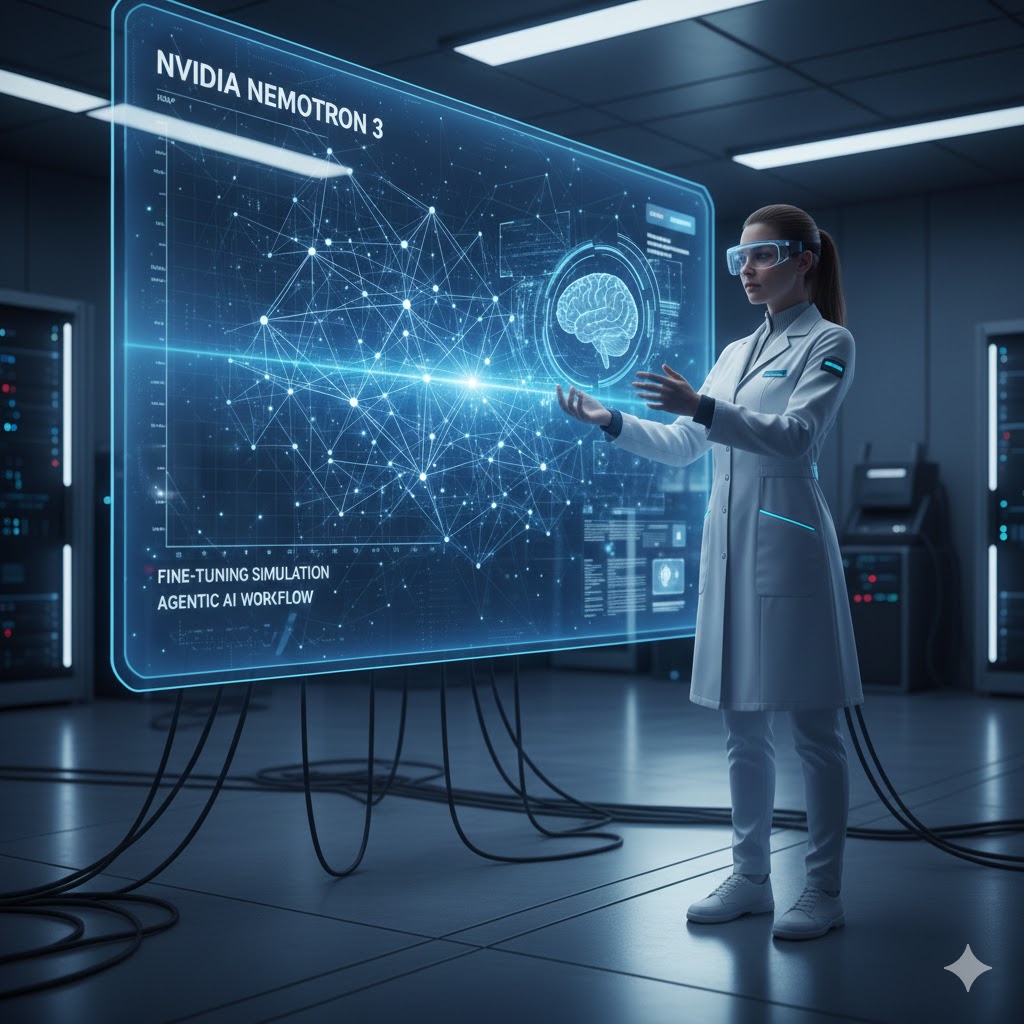
Nemotron 3 Nano (30B-A3B), available now, is the efficiency leader of the pack. Its design offers:
- Up to 60% fewer reasoning tokens, which slashes inference costs.
- A 1 million-token context window, allowing the model to process massive amounts of data for long, multi-step tasks.
While the Nano version is available today on Unsloth, higher-reasoning versions like Nemotron 3 Super and Ultra are expected in early 2026 for even more complex AI applications.
DGX Spark: The Desktop AI Supercomputer
For developers who need more power than a typical PC but want to maintain local control, NVIDIA introduced DGX Spark. Built on the Grace Blackwell architecture, it delivers a petaflop of AI performance in a compact form factor.
With 128GB of unified memory, DGX Spark allows developers to:
- Fine-tune larger models: Comfortably handle models with over 30 billion parameters that would crash consumer-grade GPUs.
- Run complex workflows: Execute full fine-tuning and reinforcement learning locally without waiting for cloud instances.
- Multimodal speed: Beyond text, it can generate 1,000 images in seconds using high-resolution diffusion models.
The Road Ahead for RTX AI
The ecosystem is expanding rapidly. Beyond language models, we are seeing advancements like FLUX.2 for optimized image generation and Nexa.ai’s Hyperlink, which delivers 3x faster on-device search.
As agentic AI moves from a buzzword to a functional tool, the combination of Nemotron 3’s efficiency, Unsloth’s speed, and NVIDIA’s local compute power is ensuring that the most powerful AI experiences aren’t just in the cloud—they’re right on your desk.