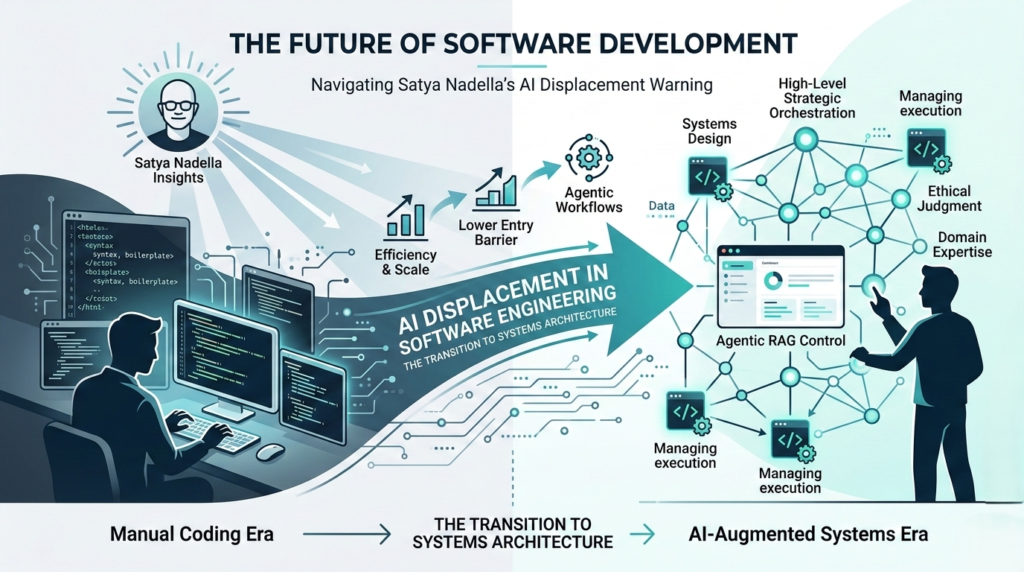
The landscape of technology is shifting beneath our feet. Recently, Microsoft CEO Satya Nadella sent ripples through the tech industry with a candid assessment of how artificial intelligence will reshape the workforce. While the conversation around automation often centers on blue-collar labor, Nadella’s latest insights target the heart of the digital economy: software engineering. The message is clear—AI displacement is no longer a theoretical “what if” for the distant future; it is a structural transformation happening in real-time.
For developers, project managers, and tech leaders, this shift presents a paradox. On one hand, AI tools like GitHub Copilot are skyrocketing productivity. On the other, the very skills that defined a successful career for the last two decades are being automated at an exponential rate. Understanding the nuances of AI displacement is essential for anyone looking to remain relevant in an era where code can be generated with a simple natural language prompt.
Understanding the Core of AI Displacement in Engineering
When Satya Nadella speaks about AI displacement, he isn’t necessarily predicting the end of the software engineer. Instead, he is highlighting a fundamental change in the “unit of work.” Historically, a developer’s value was tied to their ability to write syntax, debug complex logic, and manage boilerplate code. Today, Large Language Models (LLMs) handle these tasks in seconds.
The displacement occurs when the traditional “entry-level” tasks are absorbed by autonomous agents. If a junior developer’s primary job was to write unit tests or basic API endpoints, those roles are the most vulnerable. However, Nadella emphasizes that this shift also lowers the barrier to entry, potentially creating a “new class” of developers who focus on orchestration rather than just execution.
The Economic Reality of Automation
The financial implications of this transition are staggering. Industry analysts suggest that billions of dollars in labor costs are being reallocated as companies move from human-heavy development cycles to AI-augmented workflows. This brand of AI displacement isn’t just about cutting costs; it’s about increasing the velocity of innovation.
Why Technical Skills Alone Are No Longer Enough
In the past, mastering a specific framework like React or a language like Python was a golden ticket to job security. In the wake of AI displacement, these “hard skills” are becoming commoditized. Nadella’s commentary suggests that the future belongs to the “Systems Architect”—someone who understands how different components of an AI-driven ecosystem interact.
To thrive, professionals must pivot from being “code writers” to “problem solvers.” This involves:
- Prompt Engineering & Orchestration: Learning how to guide AI to produce high-quality, secure code.
- Architectural Oversight: Ensuring that AI-generated modules fit into a cohesive, scalable system.
- Security Auditing: Identifying vulnerabilities that AI might inadvertently introduce during the generation process.
The Skills Gap and the “Agentic” Shift
We are moving toward a world of “Agentic Workflows,” where AI doesn’t just suggest code but acts as an autonomous agent. As AI displacement removes the need for manual coding, the demand for human oversight in “Agentic RAG” (Retrieval-Augmented Generation) and autonomous loops will skyrocket.
AI Displacement: A Comparative Analysis of Roles
To better understand which areas are most affected, let’s look at how specific functions are evolving.
| Role Function | Traditional Approach | AI-Augmented Future | Displacement Risk |
| Boilerplate Coding | Manual writing of repetitive code. | 100% Automated via Copilots. | High |
| Debugging | Hours of manual log checking. | AI-driven root cause analysis. | Medium |
| System Design | Whiteboarding and manual mapping. | Human-led, AI-assisted modeling. | Low |
| Strategic Logic | Defining business rules in code. | High-level orchestration. | Low |
| Quality Assurance | Manual test script writing. | Autonomous agentic testing. | High |
The data shows that while AI displacement hits execution-heavy roles the hardest, it creates a vacuum for high-level strategic thinkers.
Actionable Strategies to Mitigate Career Risk
If you are concerned about AI displacement, the solution isn’t to fight the technology but to integrate it into your professional identity. Here are four actionable steps to future-proof your career:
1. Master the “AI Stack”
Don’t just use AI; understand its plumbing. Familiarize yourself with how RAG (Retrieval-Augmented Generation) works. Understand the difference between fine-tuning a model and using an autonomous agentic loop. When you understand the infrastructure, you become the person who manages the displacement rather than the one displaced by it.
2. Focus on “Domain Expertise”
AI is excellent at general coding but often lacks the specific context of a niche industry—be it FinTech, Healthcare, or Logistics. Deep domain knowledge combined with AI proficiency makes you indispensable. AI displacement struggles to replace the nuanced understanding of complex business requirements.
3. Transition to Systems Architecture
Move up the value chain. Start looking at projects from a “systems” perspective. How does the frontend communicate with the backend? How is data persisted? When you can design the “big picture,” the AI becomes your workforce, and you become the director.
4. Cultivate “Human-Centric” Skills
Communication, leadership, and ethical judgment are areas where AI remains deficient. Navigating the ethical implications of AI deployment is a role that will only grow in importance as AI displacement accelerates.
The Silver Lining: Democratization of Innovation
While the term “displacement” carries a negative connotation, Satya Nadella also points toward a more optimistic future. By removing the “drudgery” of coding, AI democratizes the ability to create. A person with a great idea but no formal coding background can now use AI to build a functional prototype.
In this sense, AI displacement is clearing the path for a massive wave of entrepreneurship. The “solopreneur” who uses a fleet of AI agents to run a software company is no longer a myth—it is a burgeoning reality. The friction between an idea and its execution is finally disappearing.
Conclusion: Adapting to the New Normal
The insights from Satya Nadella serve as a vital wake-up call. AI displacement is a force of nature in the tech industry, driven by the relentless pursuit of efficiency and scale. However, history shows that every major technological shift—from the industrial revolution to the birth of the internet—eventually creates more opportunities than it destroys.
The key to surviving and thriving in this new era is continuous learning. By staying ahead of the curve in fields like Agentic AI and technical SEO, and by maintaining a “systems-first” mindset, you can turn the threat of AI displacement into your greatest professional advantage. The tools are changing, the stakes are higher, but the potential for those who adapt has never been greater.