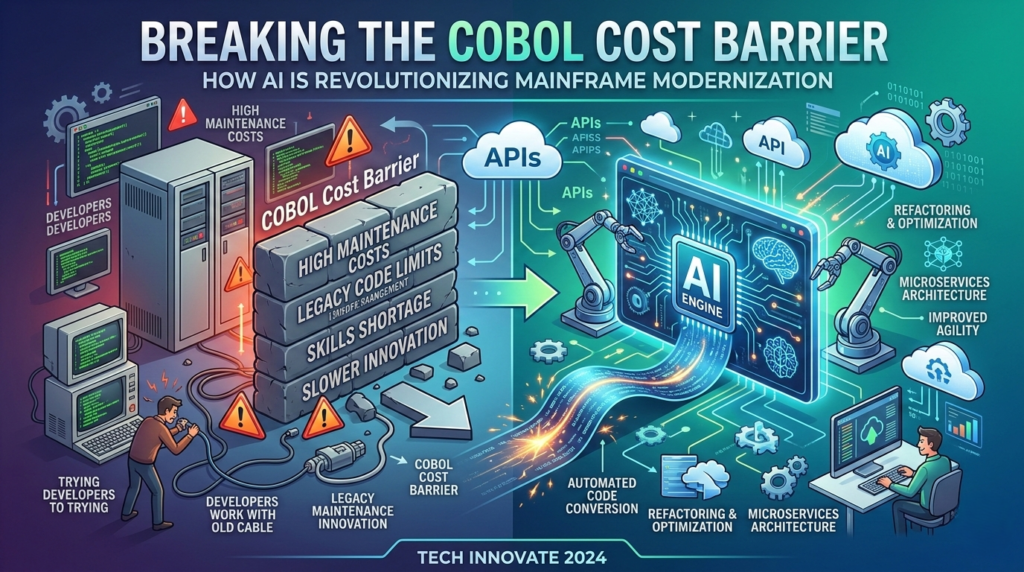
The Invisible Engine: Why COBOL Still Rules (and Risks) Global Finance
AI-driven COBOL modernization is the definitive solution for organizations stuck between aging infrastructure and the high cost of digital transformation. For years, legacy code modernization stalled because the manual labor required to understand the code cost more than rewriting it from scratch. Today, AI-driven COBOL modernization flips that equation, allowing enterprises to migrate to the cloud with unprecedented speed and accuracy.
It is a persistent myth in IT circles that COBOL is a “dead” language. In reality, COBOL (Common Business-Oriented Language) remains the invisible backbone of global commerce. Current industry estimates suggest that COBOL handles nearly 95% of ATM transactions in the United States and powers core banking systems for the majority of the world’s top financial institutions.
However, this reliance has created a “ticking clock” scenario. The “COBOL Talent Gap” is widening as the original architects retire, taking decades of institutional knowledge with them. Documentation has rarely kept pace with 40 years of patches. This is why AI-driven COBOL modernization has moved from a “nice-to-have” to a strategic necessity for the enterprise.
Why Traditional Modernization Stalled for Decades
Historically, legacy migration was a “Rip and Replace” nightmare. These projects often lasted five to ten years and cost tens of millions of dollars. Modernizing COBOL isn’t like updating a simple JavaScript library; you are reverse-engineering business logic written when hardware constraints—not user experience—were the primary concern.
Until recently, the cost of understanding the “black box” of legacy code was higher than the cost of leaving it alone. AI-driven COBOL modernization flips this equation by using Large Language Models (LLMs) to automate the discovery phase, which previously consumed 70% of project budgets.
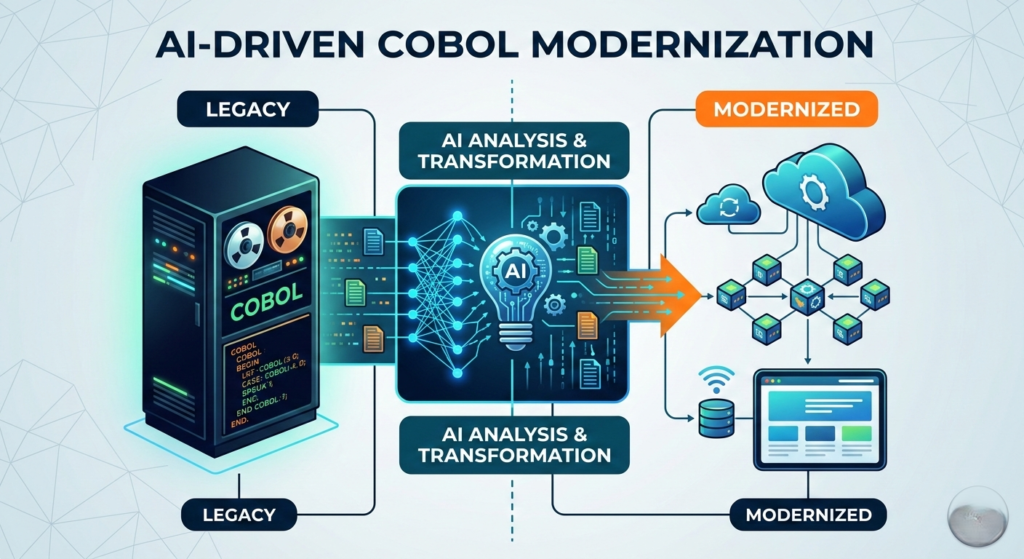
How AI Changes the Migration Equation
Generative AI and specialized agents like Claude Code have introduced a “Third Way” to digital transformation. By leveraging these tools, AI-driven COBOL modernization allows organizations to map, document, and migrate code with surgical precision.
1. Automated Exploration and Deep Discovery
The most dangerous part of a migration is the “unknown unknown.” AI excels at reading millions of lines of code to map hidden architectures:
- Traced Execution Paths: AI identifies entry points and subroutines that human analysts might miss over months of manual review.
- Implicit Dependency Mapping: COBOL often relies on global states or shared files. AI tracks how data moves across hundreds of files, identifying “tightly coupled” modules that represent high migration risks.
- Workflow Reconstruction: AI can actually write the documentation that was never created, producing clear descriptions of processing pipelines that have been running “in the dark” for years.
2. Intelligent Risk Analysis
Not all code is created equal. Through AI-driven COBOL modernization, your team can categorize the legacy footprint into three manageable buckets:
- Low-Hanging Fruit: Isolated components that can be modernized independently with minimal risk.
- Refactoring Candidates: Areas where logic has been duplicated dozens of times over the decades.
- High-Risk Cores: Modules with high coupling that require expert human oversight and a slower, more methodical approach.
The Strategic Roadmap: A Step-by-Step AI Framework
Transitioning from a mainframe to a modern, cloud-native stack requires a blend of machine speed and human judgment. Here is how a successful AI-driven COBOL modernization project is structured:
Phase 1: Strategic Planning with Expert Oversight
AI provides the raw data, but your senior engineers provide the context. In this phase, your team reviews AI-generated recommendations to prioritize components based on business value rather than just technical ease. This ensures that the most critical business functions are stabilized first.
Phase 2: Defining the “Truth” via Validation
Before a single line of code is moved, AI designs functional tests. By running the legacy COBOL and the proposed modern code side-by-side, the AI verifies that the outputs are identical down to the last decimal point. This “Continuous Validation” is the cornerstone of AI-driven COBOL modernization, ensuring no data is lost in translation.
Phase 3: Incremental Implementation (The Strangle Pattern)
The era of the “Big Bang” migration—where you flip a switch and pray—is over. Instead, organizations use an incremental approach:
- API Wrapping: Create interfaces around legacy components so they can talk to modern systems immediately.
- Logic Translation: Use AI to rewrite a single workflow into a modern language like Java or Go.
- Side-by-Side Testing: Run the new module in production alongside the old one to ensure parity.
- Decommissioning: Gradually phase out the legacy system until the mainframe is no longer required.
The New Economics of Legacy Code
The cost barrier to modernization has collapsed because the cost of understanding has collapsed. In the old consultant-heavy model, 70% of a budget was spent just trying to figure out what the code did. Today, AI-driven COBOL modernization reduces that overhead to a fraction of the time and cost.
By utilizing advanced AI agents, teams can now complete in two quarters what used to take two years. More importantly, they can do it without the “black box” risk that has kept CIOs up at night for decades. When you remove the manual labor of code analysis, your engineers are free to focus on what actually matters: innovation and user experience.
Conclusion: Start Small, Scale Fast
Legacy systems are no longer an anchor; they are a data goldmine waiting to be unlocked. AI-driven COBOL modernization provides the tools to extract that value without the traditional risks of system failure.
The economics of the mainframe have shifted. Organizations that continue to pay the “legacy tax”—the high cost of maintaining hardware and scarce talent—will be outpaced by those who use AI-driven COBOL modernization to become agile, cloud-ready enterprises.
Your First Step: Identify a single, well-defined workflow within your COBOL environment. Use an AI agent to document and analyze it. Once you see the clarity that AI-driven COBOL modernization brings to your legacy code, the path to the future becomes clear.