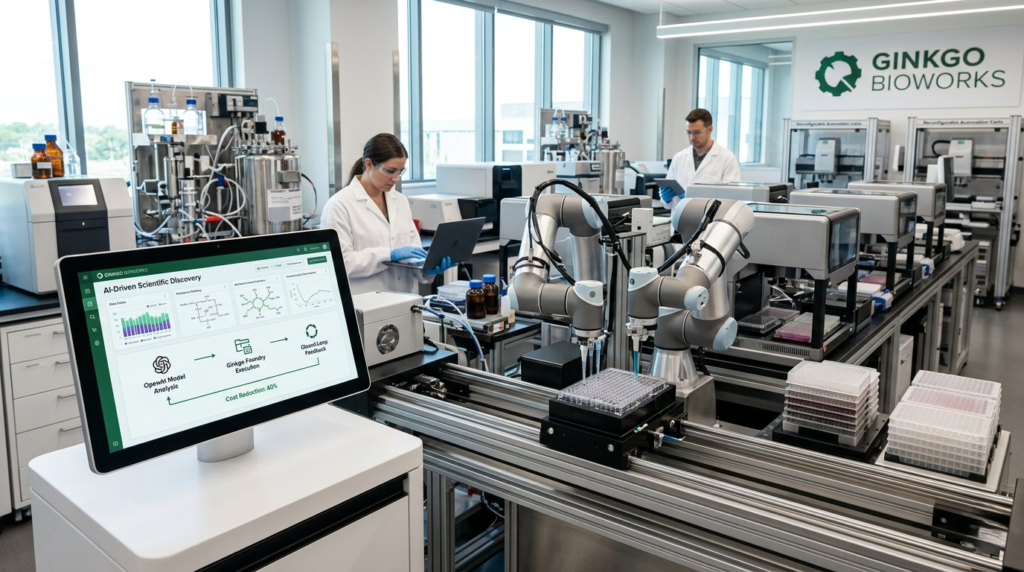
The traditional scientific method is undergoing a radical transformation. For decades, the bottleneck of biological innovation hasn’t been a lack of ideas, but the grueling manual labor of the “wet lab.” Scientists spend years pipetting, measuring, and repeating experiments, only to find that nature’s complexity often outpaces human endurance.
However, a groundbreaking collaboration between OpenAI and Ginkgo Bioworks has signaled the end of this era. By integrating OpenAI’s frontier reasoning models (specifically GPT-5) with Ginkgo’s massive automated laboratory infrastructure, the duo has demonstrated a “closed-loop” system capable of conducting autonomous research.
This isn’t just a minor improvement; it is a fundamental shift toward AI-driven scientific discovery. In their first major benchmark, this system successfully reduced the cost of cell-free protein synthesis by 40%—achieving in weeks what typically takes human researchers years of trial and error.
The Convergence of Intelligence and Automation
The partnership between OpenAI and Ginkgo Bioworks is built on a simple but powerful premise: AI provides the “brain,” and Ginkgo provides the “hands.” While AI has already revolutionized fields like mathematics and coding, biology is uniquely difficult because it requires physical verification. You cannot “debug” a protein in a digital simulator alone; you have to grow it.
The Brain: OpenAI’s GPT-5
In this collaboration, OpenAI deployed its most advanced reasoning model to act as a digital lead scientist. Unlike previous iterations, this model was granted:
- Web Access: To search for the latest peer-reviewed literature.
- Data Analysis Tools: To process complex biological datasets.
- Reasoning Capabilities: To formulate hypotheses, design 384-well plate layouts, and interpret results without human prompting.
The Hands: Ginkgo’s Cloud Laboratory
Ginkgo Bioworks operates a massive “foundry” in Boston, featuring Reconfigurable Automation Carts (RACs) and proprietary Catalyst software. This infrastructure allows for:
- High-Throughput Execution: Running thousands of experiments simultaneously.
- Robotic Precision: Removing the variance and error inherent in manual pipetting.
- Feedback Loops: Feeding raw data directly back into the AI for the next round of design.
The Benchmark: A 40% Breakthrough in Protein Synthesis
The team chose Cell-Free Protein Synthesis (CFPS) as their primary stress test. CFPS is a vital technology for drug discovery and diagnostics because it allows scientists to produce proteins quickly without needing living cells. However, it is notoriously expensive and complex to optimize.
Through AI-driven scientific discovery, the system executed over 36,000 unique experiments across six iterative cycles.
Performance Comparison: AI vs. Human Baseline
| Feature | Prior State-of-the-Art (Human) | OpenAI + Ginkgo (Autonomous) |
| Cost Per Gram (sfGFP) | $698 | $422 |
| Total Experiments | Hundreds/Thousands (cumulative) | 36,000+ (in 6 months) |
| Iterative Speed | Months per cycle | Weeks per cycle |
| Data Points Generated | Limited by manual recording | ~150,000 points |
| Reagent Cost Reduction | N/A | 57% Improvement |
This 40% reduction in production costs is a massive win for the industry. Lower costs mean more data, and more data means faster cures.
How the Closed-Loop System Works
The “Lab-in-the-Loop” model is the secret sauce of AI-driven scientific discovery. It operates as a continuous cycle where the human role is shifted from “doer” to “overseer.”
- Hypothesis Generation: GPT-5 analyzes existing literature and past experimental data to propose a new set of reaction compositions.
- Safety & Logic Check: Before a single robot moves, the AI’s design is run through a Pydantic validation model. This ensures the experiments are physically possible, reagents are in stock, and the design isn’t “hallucinated.”
- Physical Execution: Ginkgo’s robots execute the designs in 384-well plates.
- Data Ingestion: The results (titer, yield, cost) are digitized and fed back to GPT-5.
- Refinement: The AI analyzes why certain designs failed and why others succeeded, then starts Step 1 again with higher precision.
Actionable Insights: What This Means for the Future of R&D
The success of the OpenAI and Ginkgo Bioworks collaboration provides a blueprint for how other industries can adopt AI-driven scientific discovery.
1. Shift Toward “Programmable” Science
We are moving away from bespoke, manual experiments toward “programmable” biology. Scientists should focus on defining the intent (e.g., “Find a protein that binds to this receptor at half the current cost”) rather than the mechanics of how to mix the reagents.
2. The Importance of “Dry-Lab” Validation
A critical takeaway from this project was the use of software “firewalls” to check the AI’s work. By using programmatic validation, the teams prevented the AI from suggesting “impossible” experiments, saving thousands of dollars in wasted materials.
3. Democratizing Research
Ginkgo is already making these AI-optimized reaction mixes available via its “reagent store.” This allows smaller startups to access state-of-the-art biological tools that were previously only available to giant pharmaceutical companies.
Challenges and Biosecurity
While AI-driven scientific discovery offers immense potential, it also introduces risks. OpenAI and Ginkgo have been vocal about their “Preparedness Framework.” If an AI can design a lifesaving protein, it could theoretically be misused to design harmful biological agents.
The partnership includes rigorous monitoring and “red-teaming” to ensure that the autonomous capabilities are used solely for beneficial scientific advancement. This includes filtering requests and ensuring that the AI operates within strictly defined biological safe zones.
The Dawn of the “Self-Driving” Lab
The result of this partnership is essentially the world’s first “self-driving” lab. By removing the human bottleneck, we can explore the “chemical space” of biology at a scale previously thought impossible.
In the future, AI-driven scientific discovery will not just be about making things 40% cheaper. It will be about discovering entirely new classes of medicines, sustainable materials, and carbon-capture technologies that the human mind simply couldn’t have stumbled upon through manual experimentation alone.
As Reshma Shetty, co-founder of Ginkgo, noted: “Lower cost reagents for protein production enable more data generation and thus more scientific progress per dollar spent.” We are finally entering an era where the speed of science is limited only by the speed of our ideas—not the speed of our pipettes.
The Human-AI Hybrid: A New Role for Scientists
A common concern in AI-driven scientific discovery is whether “robot labs” will replace human biologists. However, the OpenAI and Ginkgo collaboration highlights a different reality. While GPT-5 handled the iterative “cognitive load”—analyzing 150,000 data points and designing 36,000 experiments—humans remained the ultimate architects.
In this new workflow, the scientist’s role shifts toward:
- Defining the Objective: Humans choose which “mountains” are worth climbing (e.g., curing a specific disease or finding a sustainable plastic alternative).
- Setting the Guardrails: Establishing the safety and ethical boundaries within which the AI must operate.
- Strategic Problem Solving: Handling the high-level brainstorming that happens before the “loop” even begins.
As Ginkgo co-founder Reshma Shetty noted, AI excels at exploring the details, but humans are still best at picking the scientific questions that matter most to society.