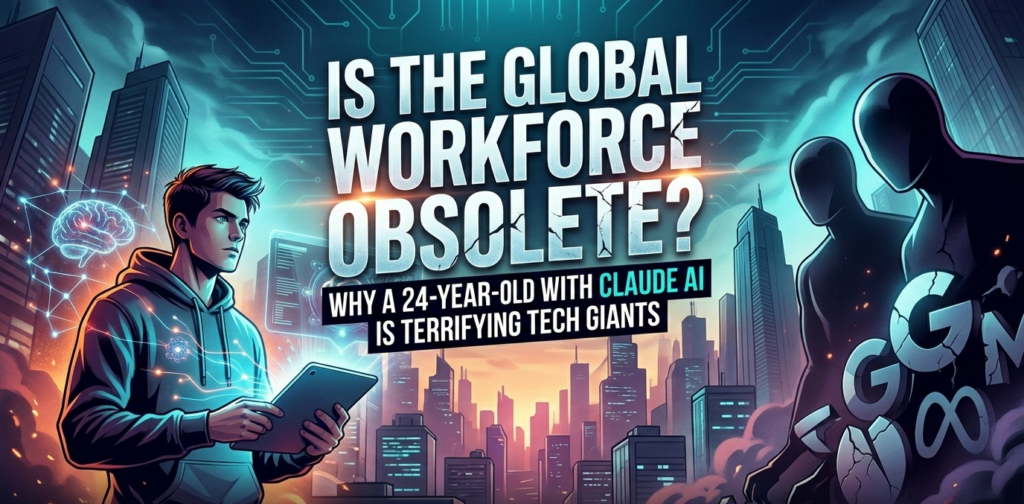
AI-driven workforce transformation is no longer a futuristic concept—it is a present-day disruption that is threatening the foundations of the world’s largest consulting firms. In a move that has sent shockwaves through the professional services industry, Tom Blomfield, a partner at the Silicon Valley powerhouse Y Combinator, recently issued a provocative warning: the entire 700,000+ workforce of Accenture could soon be outperformed by a single 24-year-old armed with Anthropic’s Claude AI.
This bold claim highlights the sheer velocity of the AI-driven workforce transformation currently unfolding. As artificial intelligence moves from simple text generation to autonomous “agentic” execution, the traditional business models of consulting, law, and engineering are being questioned at their very core.
The Viral Prediction: One Human vs. an Enterprise
The controversy erupted when Blomfield suggested that a young professional who mastered “Claude Code” in a single weekend could theoretically match the output of a global behemoth like Accenture. While the statement was designed to be “punchy” for social media, the underlying technical reality is sobering: advanced AI tools are compressing tasks that previously required thousands of billable hours into minutes of automated processing.
This shift represents the heart of the AI-driven workforce transformation. Historically, scaling a professional services firm meant a massive hiring spree. Today, scaling means leveraging “compute.” When a single individual can deploy autonomous AI agents to handle deep research, complex coding, and project management, the market value of a massive human headcount begins to look like a liability rather than an asset.
Claude AI and the “O-Ring” Automation
The engine behind this specific claim is the rapid evolution of Anthropic’s Claude. Jack Clark, co-founder of Anthropic, recently revealed that Claude now writes the “comfortably the majority” of the company’s internal code. He expects that by the end of 2026, AI will handle nearly all of it.
Clark refers to this as “O-ring automation.” In a complex system, the O-ring is the small part that can cause the entire system to fail if it isn’t perfect. By using AI to eliminate the “execution bottlenecks” (the “doing”), humans are finally freed to focus on high-level strategy (the “deciding”). However, for firms that bill clients by the hour for “doing,” this AI-driven workforce transformation poses an existential threat to their revenue.
Market Tremors: Why Investors Are Nervous
The market is already signaling its anxiety. In early 2026, the Indian IT sector—home to giants like TCS, Infosys, and Wipro—witnessed its steepest drop since the COVID era, losing approximately Rs 2 lakh crore in market value. This wasn’t due to a lack of demand, but a growing fear that the traditional “outsourcing” model is being rendered obsolete by AI-driven workforce transformation.
Investors are realizing that this pivot is happening faster than companies can adapt. If a 24-year-old can use Claude Code to build a software architecture that previously required twenty developers, the necessity of large-scale, multi-layered IT hierarchies comes under intense scrutiny.
The Irony: Accenture’s Own Bet on Claude
In a fascinating twist, Accenture is not standing still. In late 2025, the company announced a massive partnership with Anthropic to train 30,000 of its employees on Claude and Claude Code.
Accenture is attempting to lead its own AI-driven workforce transformation by embedding these tools into their client services. They are betting that a “human-in-the-loop” model—where a veteran consultant uses AI to work 10x faster—will still be more valuable than a lone individual. However, the question remains: if the AI is doing 99% of the work, will clients still pay for the consultant’s brand, or will they simply buy the software?
Key Tools Driving the Change
Several new releases from Anthropic are accelerating this AI-driven workforce transformation:
- Claude Code: A terminal-based tool that allows AI to fix bugs and build features autonomously within software repositories.
- Claude Cowork: An AI workspace designed for planning and executing multi-step business tasks.
- Automation Plug-ins: Tools that allow Claude to interact with 11 different software environments to complete workflows without human intervention.
These tools allow a single operator to act as a “Commander of Agents,” overseeing a fleet of digital workers rather than managing a team of humans.
What This Means for the Next Generation of Workers
For the 24-year-old mentioned in Blomfield’s tweet, the future is incredibly bright. But for the middle manager in a traditional hierarchy, the outlook is more complex. To survive this AI-driven workforce transformation, professionals must shift their focus:
- From Execution to Curation: It is no longer enough to be “good at coding.” You must be elite at directing AI to code.
- System Orchestration: The real skill is knowing how to stitch various AI tools together to solve a complex business problem.
- The Value of Judgment: As the cost of “doing” approaches zero, the value of “knowing what to do” becomes the ultimate premium.
The Global Impact of AI-Driven Workforce Transformation
We are entering an era where geographical location and company size matter less than technical agility. A small startup in a city like Bhubaneswar can now compete with a Fortune 500 company in New York in terms of output. This AI-driven workforce transformation is leveling the playing field, creating a “winner-takes-all” dynamic where those who master AI first will capture the most value.
The decline of the Nifty IT index and the warnings from Y Combinator are early tremors of a much larger earthquake. We are moving toward the era of the “Sovereign Contributor”—the individual who, powered by Claude, possesses the capabilities of an entire department.
Conclusion: Adapt or Be Automated
The warning from Tom Blomfield is a wake-up call for the entire tech industry. Whether or not one 24-year-old can actually replace 700,000 people today is a matter of debate, but the trajectory is undeniable. The AI-driven workforce transformation is accelerating.
Companies like Accenture are racing to integrate these tools to remain relevant, while the next generation is building entire empires from their bedrooms. As we move further into 2026, the goal for every professional is clear: ensure you are the one wielding the AI, rather than the one being replaced by it.
The era of massive headcounts as a measure of power is over. The era of the hyper-productive, AI-augmented individual has begun. Are you ready for the AI-driven workforce transformation, or are you still working in the manual era of the past?