The software development world is currently witnessing a profound paradox. While many technical leaders experiment with basic LLM prompts only to walk away unimpressed by “magic demos,” a quiet, structural revolution is occurring within high-performance engineering organizations. We aren’t just talking about a 10% gain in developer happiness or a minor reduction in “to-do” lists; we are talking about a total structural inversion of the entire development lifecycle.
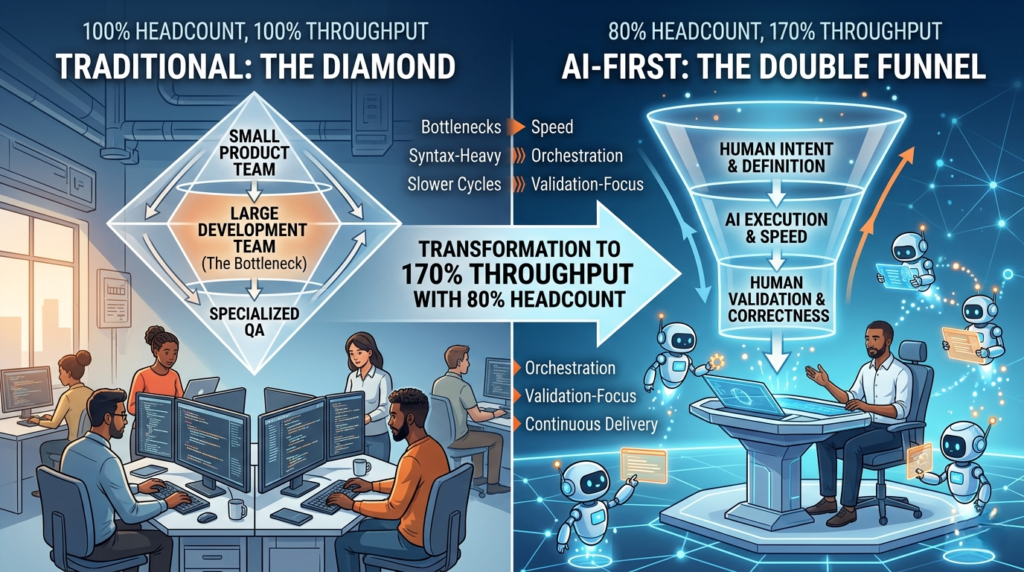
Recent real-world data from industry pioneers, specifically documented by Andrew Filev at Zencoder, has proven that shifting to a comprehensive AI-first engineering model can result in 170% throughput with only 80% of the original headcount. This isn’t a futuristic prediction or a marketing gimmick—it is a lived experience of turning an organization “inside out.”
When you move from traditional manual coding to systemic AI orchestration, the historical bottlenecks—slow Quality Assurance (QA) cycles, expensive prototyping, and rigid tech stacks—simply dissolve. In this comprehensive analysis, we explore how AI-first engineering is redefining productivity, quality, and the very geometry of the modern software development team.(AI-first engineering)
1. The Core Shifts: Why AI-First Engineering is a Structural Inversion
To achieve 170% throughput, you cannot simply “bolt on” AI tools to a broken, legacy process. You must fundamentally rethink the workflow from the ground up. In the traditional model, humans did the heavy lifting in the middle of the funnel—the actual typing of syntax, debugging of semicolons, and manual refactoring.
In the AI-first engineering era, that middle section is almost entirely automated. Humans have migrated to the “edges” of the process: Intent (the beginning) and Validation (the end). This shift represents the most significant change in engineering philosophy since the move from Waterfall to Agile.(Software development throughput, Engineering orchestration, AI-driven SDLC transformation, Developer productivity metrics )
From Big Design to Rapid Experimentation
Historically, change was prohibitively expensive. Engineering teams spent weeks, sometimes months, perfecting Product Requirements Documents (PRDs) and static Figma prototypes because a mistake discovered during the coding phase meant weeks of lost capital and human effort. Even with Agile methodologies, testing multiple divergent product ideas was often too costly for mid-sized teams.
Once you transition to AI-first engineering, that trade-off disappears. The cost of experimentation has effectively collapsed toward zero. An idea can move from a whiteboard sketch to a fully functional, production-grade prototype in a single day.
- The Accelerated Workflow: Idea → AI-generated PRD → AI-generated technical specification → AI-assisted implementation.
- Real-World Impact: Teams are no longer validating ideas with slide decks or “click-through” mocks. They are validating with live, working products.
The Inversion of Quality Assurance
The next major shift is the “Shift Left” philosophy on steroids. In a traditional organization, a small group of QA engineers tests what a large group of developers writes. This often creates a “traffic jam” at the end of the release cycle.
In an AI-first engineering environment, the leverage point moves to defining correctness. When AI generates the implementation, the human’s primary value is making the definition of “good” explicit and machine-readable. QA engineers are evolving into system architects who build specialized AI agents to generate and maintain acceptance tests directly from the requirements. If the agent cannot validate its work, it cannot be trusted to generate the code in the first place.
2. Comparing the Models: Traditional vs. AI-First Engineering
To understand how organizations achieve massive throughput gains, we must look at the mechanical differences in team organization.
| Feature | Traditional Software Development | AI-First Engineering |
| Primary Human Task | Writing and debugging syntax | Defining intent and validating logic |
| Team Geometry | “Diamond” shape (Large dev middle) | “Double Funnel” (Human-centric edges) |
| Prototyping | Static mocks and “slides” | Live, functional code prototypes |
| QA Focus | Manual/Automated testing at the end | Architecting validation agents at the start |
| Tech Stack Mobility | Rigid (Language lock-in is real) | Fluid (AI handles cross-language shifts) |
| Release Velocity | Quarterly or Bi-Monthly | Continuous or Every 2 Months (Major) |
| Throughput Metric | Linear to Headcount | Exponential to AI-Orchestration |
3. The “Double Funnel” Geometry of Modern Teams
For decades, the “Diamond” model reigned supreme in Silicon Valley and beyond:
- Narrow Top: A small product team defines the vision.
- Wide Middle: A large engineering team builds the code (the bottleneck).
- Narrow Bottom: A specialized QA team validates the output.
In an AI-first engineering paradigm, the geometry flips into a Double Funnel. Humans engage more deeply at the beginning to explore options, define constraints, and set the ethical/technical guardrails. The middle section—the execution—is handled by AI at lightning speed, making that part of the funnel much narrower and more efficient. Finally, humans engage deeply again at the end to validate that the outcomes match the business intent before they land in production.
This model looks less like an assembly line and more like a Control Tower. Humans set the direction, AI handles the high-speed execution, and people step back in to verify the results. This structural inversion is exactly why a team of 30 can now outperform what a team of 60 used to struggle to ship.
4. Actionable Insights: The Roadmap to 170% Throughput
If you are a technical leader looking to replicate these results, the path requires more than just providing a GitHub Copilot subscription to your devs. It requires a systemic overhaul of how you value labor and define “engineering.”
Step 1: Codify Your AI Workflows
You cannot leave AI usage to individual discretion if you want to see organizational-level gains. High-performing teams create codified AI workflows that are embedded into the CI/CD pipeline. These include:
- Automated Requirements-to-Test: Using LLMs to generate test suites before a single line of feature code is written.
- Agentic Reviewers: Specialized AI agents that scan PRs for security vulnerabilities and style consistency before a human even sees the code.
- Autonomous Documentation: Ensuring every code change triggers an AI-driven update to the internal documentation and external API guides.
Step 2: Empower “Vibe Coding” and Cross-Functional Contributions
One of the most startling results of the AI-first engineering transition is the blurring of roles. When the technical barrier to entry (syntax) drops, non-engineers can contribute production-ready code.
- The Creative Director as Developer: In an AI-first org, a Creative Director can maintain a product-scale website with hundreds of custom components directly in the codebase.
- The PM as Bug-Fixer: During a release-time “crunch,” Project Managers and UX designers can jump into action, fixing UI layout issues with AI assistance and submitting production-ready PRs.
Step 3: Move to a Higher Level of Abstraction
Engineers should no longer view themselves as “syntax specialists.” Instead, they must become Orchestrators.
- Meta-Layer Thinking: Instead of writing functions, engineers spend their time tuning agentic instructions, defining “skills” for their AI agents, and setting the bounds of agent autonomy.
- Validation as a Shared Skill: Defining correctness becomes a cross-functional skill shared by PMs, Tech Leads, and Data Engineers, rather than a role confined to the QA department.
5. Overcoming the “Unimpressed” Phase
Many leaders try AI tools, see a few hallucinated code snippets, and walk away. The secret to 170% throughput isn’t the AI’s ability to write a single function; it’s the AI’s ability to maintain the integrity of the system at speed.
When your quality assurance couldn’t keep up with your engineers’ velocity in the past, quality dropped, leading to technical debt and user frustration. In an AI-first engineering model, you tool the AI to write the unit and end-to-end tests as it writes the code. This creates a self-reinforcing cycle where:
- Coverage Improves: Every feature comes with its own automated validation.
- Bugs Drop: The AI identifies logical inconsistencies during the generation phase.
- User Loyalty Increases: Stable, high-quality releases turn customers into fans.
- Business Value Multiplies: The engineering team becomes a revenue driver, not a cost center.
The Paradox of AI-First Engineering
It actually feels less like coding and more like thinking. You are no longer bogged down by the “how” (syntax); you are focused entirely on the “what” and the “why.” This is the core of the new era of human intelligence, powered by AI.
6. Technical Resilience and Language Agility
One of the most overlooked benefits of AI-first engineering is the ability to pivot technically without the traditional “re-skilling” tax. In a traditional environment, moving a project from Kotlin to TypeScript might take months of retraining and significant loss in velocity.
In an AI-first environment, these transitions are remarkably fluid. Because the AI understands the underlying logic and requirements, it can refactor or even rewrite entire systems in new languages while maintaining the functional requirements. This allows organizations to:
- Adopt the best tool for the job immediately.
- Stay modern without fearing “legacy” codebases.
- Scale integrations across 70+ programming languages without hiring 70 different specialists.
7. Conclusion: The Engineering Control Tower
The shift to AI-first engineering is the next major leap in the history of computer science abstraction. It follows the path from punch cards to assembly, from high-level languages to the cloud. We are moving into an era where the machines build the scaffolding, but the humans act as the architects and the “Control Tower.”
By focusing on Validation, Intent, and Orchestration, organizations can move twice as fast with fewer resources. It is not about replacing the human element; it is about elevating it to a higher level of creative and strategic thinking. The 170% throughput is not a ceiling—it is the new baseline for those brave enough to turn their development process inside out.
Frequently Asked Questions: The Master Guide to AI-First Engineering
1. What exactly is “AI-First Engineering,” and how does it differ from simply using AI tools?
Most developers use AI tools as a “glorified autocomplete”—they use GitHub Copilot or ChatGPT to help write a function or debug a single line of code. This is AI-augmented development.
AI-First Engineering is a structural paradigm shift. It means the entire software development lifecycle (SDLC) is designed around the capabilities of AI agents. Instead of humans doing the manual labor of coding and AI assisting them, the AI handles the bulk of the implementation while humans shift to the “meta-layer.” In this model, the process is built to be “machine-first,” where code is generated, tested, and validated by autonomous agents under human orchestration. The focus moves from writing code to defining the logic and validation parameters that the AI must meet.
2. How can an organization realistically achieve 170% throughput with 80% headcount?
This metric sounds like a “magic number,” but it is a logical result of removing the primary bottleneck in software development: the manual implementation phase. In a traditional 100-person team, roughly 60-70 people are focused on the “middle” of the diamond—writing, refactoring, and manually testing code.
By shifting to an AI-first model:
- The Middle Shrinks: AI can generate the code that previously took weeks in a matter of minutes.
- The Velocity Increases: With automated PR reviews and AI-generated unit tests, the “waiting time” between development and QA is virtually eliminated.
- Higher Quality: Because the AI can generate 100% test coverage for every PR it creates, the “rework” loop (fixing bugs found in production) is dramatically reduced. You aren’t asking 80 people to work 170% harder; you are removing the 50% of their time that was previously wasted on repetitive, low-value syntax tasks.
3. Does “AI-First Engineering” mean we no longer need senior developers?
Quite the opposite. Senior developers become more critical than ever. In an AI-first world, the “Junior” task of writing boilerplate code is gone. What remains are the high-level architectural decisions, system design, and complex problem-solving.
A Senior Engineer in an AI-first org acts as a System Architect and Orchestrator. They are responsible for:
- Defining the “System of Truth” and correctness.
- Designing the agentic workflows that the AI will follow.
- Managing the security guardrails that prevent AI hallucinations from reaching production. The role evolves from “Chief Coder” to “Chief Orchestrator.”
4. What are the biggest risks of moving to an AI-first development model?
The risks are real and must be managed through strict AI-first engineering protocols:
- Hallucinations: AI can confidently generate code that looks correct but is logically flawed.
- Security Vulnerabilities: AI might suggest deprecated libraries or insecure patterns.
- Technical Debt: If the AI generates massive amounts of code that no human understands, you risk creating a “black box” system. The Solution: You must implement “Shift-Left Validation.” This means the AI is never allowed to submit a PR without also submitting a comprehensive suite of passing tests. The human’s job is to review the tests and the logic, not just the syntax.
5. How does the “Double Funnel” model change the daily routine of a Product Manager?
In the traditional “Diamond” model, a PM hands off a PRD and waits weeks for a demo. In the Double Funnel model, the PM’s daily routine is much more iterative.
- Morning: The PM defines a new feature requirement.
- Mid-morning: The AI generates a functional prototype based on the requirements.
- Afternoon: The PM “vibe codes” or adjusts the prototype with the AI, testing it with live data.
- End of Day: A production-ready version is ready for engineering validation. The PM is now involved in the “execution” phase because the technical barrier has been lowered.
6. Can AI-first engineering handle legacy codebases, or is it only for “Greenfield” projects?
It is actually more powerful for legacy code. One of the greatest costs in software is “code archeology”—trying to understand what a developer wrote five years ago. AI models are exceptionally good at:
- Reverse Engineering: Explaining what legacy code does in plain English.
- Refactoring: Migrating a 10-year-old COBOL or Java monolith into modern microservices.
- Testing: Generating unit tests for code that previously had none. For legacy systems, AI-first engineering acts as a bridge to modernization that was previously too expensive to cross.
7. What is “Vibe Coding,” and is it safe for production environments?
“Vibe Coding” is a colloquial term for developers (or non-developers) using natural language to iterate on a product until it “feels” right. While it sounds informal, in an AI-first engineering context, it is backed by Rigid Validation. You can “vibe” the UI or the user flow, but the underlying system must pass the Systematic Guardrails. As long as the AI-generated code passes the automated security, performance, and unit tests, the “vibe” becomes a valid method of rapid front-end development.
8. How do we measure “Throughput” in this new era?
Traditional metrics like “Lines of Code” or “Commits per Day” are now obsolete. If an AI can write 10,000 lines of code in a minute, those metrics mean nothing. In an AI-first engineering org, we measure:
- Lead Time to Value: How long does it take from an idea to a live, functional feature?
- Change Failure Rate: How often do AI-assisted deployments cause issues?
- Verification Velocity: How quickly can the team define and verify “correctness” for a new feature?
9. Will this model lead to “Developer Burnout” due to the increased speed?
The opposite is typically true. Developer burnout is often caused by toil—the boring, repetitive parts of the job like fixing merge conflicts, writing boilerplate, and chasing down syntax errors. AI-first engineering removes the toil. Developers spend more time in “Flow State,” solving interesting architectural problems and designing new systems. The “170% throughput” comes from working smarter, not working more hours.
10. How should an engineering lead start the transition to an AI-first model?
Do not try to change everything overnight. Follow this 3-step roadmap:
- Pilot the “Validation Layer”: Start by using AI to generate tests for every manual PR your team writes. Get the team used to AI as a “Validator.”
- Automate the “Boring” Middle: Allow AI to handle routine refactors and documentation.
- Implement the “Double Funnel”: Begin moving your senior architects to the “Intent” phase (PRDs/Specs) and “Validation” phase (Testing/Guardrails), letting the AI bridge the gap in the middle.
11. Is AI-first engineering compatible with SOC2, HIPAA, or other compliance standards?
Yes, but it requires Human-in-the-loop (HITL) validation. Compliance isn’t about who wrote the code; it’s about how the code is verified. In an AI-first environment, you simply bake the compliance checks into the AI’s orchestration layer. The AI becomes a compliance enforcer, checking every PR against a checklist of security and privacy requirements before a human gives the final sign-off.(Developer productivity metrics)