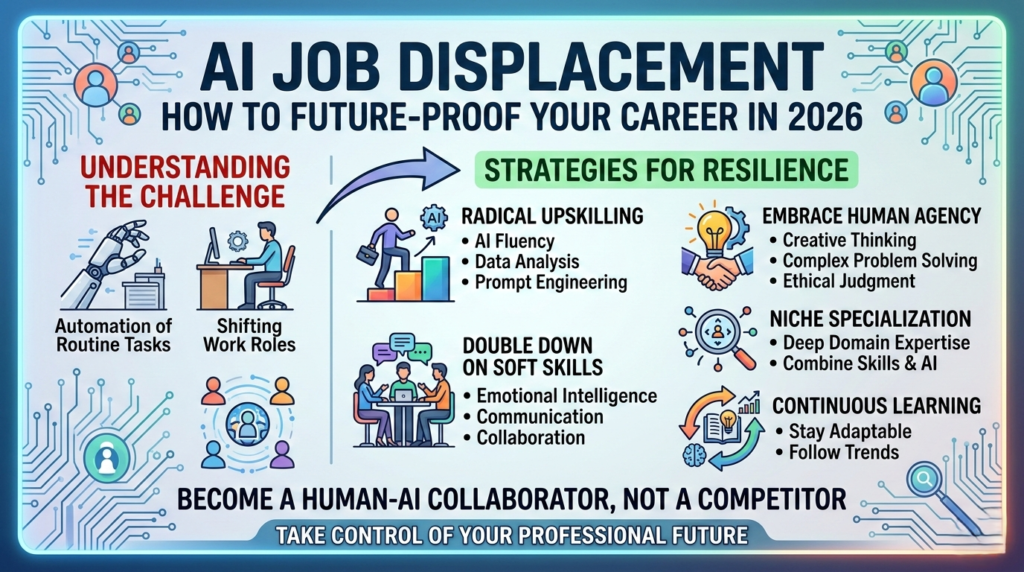
The dawn of the “Second Machine Age” is no longer a distant prophecy—it is our current reality. As of early 2026, the conversation around Artificial Intelligence has shifted from “What can it do?” to “What is left for us?” For many professionals, particularly in white-collar sectors, the rise of generative agents and autonomous workflows has sparked a legitimate fear of AI job displacement.
However, history shows that technological shifts don’t just eliminate roles; they redefine value. According to insights from futurist Robert B. Tucker, the secret to surviving this transition isn’t in competing with the machines, but in mastering the “Human Agency” that machines cannot replicate.
In this guide, we will explore actionable strategies to protect your livelihood and turn the threat of AI job displacement into a catalyst for professional growth.
Understanding the Reality of AI Job Displacement
To defend your career, you must first understand the “enemy.” AI job displacement is rarely a sudden, total replacement of a human by a robot. Instead, it is a gradual erosion of tasks. AI begins by automating the routine, then moves to the analytical, and eventually touches the creative.
Data from the World Economic Forum and recent Forbes insights suggest that early-career roles in high-exposure occupations—like market research, basic coding, and administrative support—are seeing the fastest shifts. But displacement isn’t a death sentence for your career; it is a signal to pivot.
The Three Pillars of Career Resilience
If you want to stay indispensable, you must focus on three core areas that provide a buffer against AI job displacement.
1. Radical Upskilling and AI Fluency
Being “good at your job” is no longer enough. You must become “AI-fluent.” This doesn’t mean you need to become a data scientist, but you must understand how to orchestrate AI tools to amplify your output. Those who view AI as a collaborator rather than a competitor are far less likely to face AI job displacement.
2. Strengthening “Human Agency”
Robert B. Tucker emphasizes the concept of “Human Agency”—the ability to take initiative, make ethical judgments, and navigate complex social dynamics. While an LLM can write a report, it cannot navigate the office politics required to get that report approved by a board of directors.
3. Niche Specialization
Generalists are vulnerable. Specialists who combine deep domain expertise with AI proficiency create a “moat” around their roles. By mastering a specific niche, you make the cost of replacing you with an AI system higher than the value of keeping you.
Human vs. AI: Where Does the Value Lie?
The following table compares the strengths of Artificial Intelligence versus the unique value of human professionals. Understanding these differences is key to avoiding AI job displacement.
| Feature | Artificial Intelligence (AI) | Human Professional |
| Processing Speed | Instantaneous across massive datasets. | Slower, but context-aware. |
| Creativity | Generative; based on existing patterns. | Radical; capable of “out-of-the-box” leaps. |
| Empathy | Simulated; lacks genuine connection. | Authentic; builds trust and relationships. |
| Judgment | Logic-based; prone to “hallucinations.” | Nuanced; considers ethics and long-term impact. |
| Adaptability | Requires retraining or new prompting. | Can pivot instantly to unscripted changes. |
Actionable Steps to Protect Your Career
To mitigate the risks of AI job displacement, you need a proactive plan. Use these five steps to ensure your skills remain in high demand.
- Audit Your Tasks: List your weekly responsibilities. Identify which are “routine” (vulnerable) and which require “complex negotiation” or “original thought” (safe).
- Master the Tools of Your Trade: If you are a marketer, master AI-driven PPC. If you are a developer, lead the way in “vibe coding” and agentic workflows.
- Build Your Personal Brand: In a world of AI-generated content, “Proof of Human” becomes a premium. Use LinkedIn and professional networks to showcase your unique voice and leadership.
- Focus on Soft Skills: Double down on communication, conflict resolution, and emotional intelligence. These are the last frontiers that will face AI job displacement.
- Adopt a Growth Mindset: The tools will change every six months. Your ability to learn how to learn is your greatest asset.
Why Strategy Beats Panic
Panic leads to stagnation, but strategy leads to evolution. The threat of AI job displacement is a call to move up the value chain. As AI takes over the “drudge work”—the data entry, the basic drafting, the scheduling—humans are freed to focus on high-level strategy and innovation.
For example, in the legal profession, AI can scan thousands of documents in seconds. This doesn’t mean lawyers are obsolete; it means the value of a lawyer has shifted from “the person who finds the data” to “the person who interprets the data to win the case.” By embracing this shift, you position yourself as a leader in the new economy rather than a victim of AI job displacement.
The Future of Work: A Symbiotic Relationship
The goal is not to beat the machine; it is to run the machine. We are entering an era of “Human-AI Symbiosis.” In this environment, the most successful individuals will be those who can “prompt” the future into existence.
While AI job displacement will undoubtedly change the landscape of the 2026 workforce, it also opens doors to new roles that we haven’t even named yet. Whether it’s an “AI Workflow Architect” or a “Human-Centered Design Strategist,” the opportunities are vast for those who stay curious.
Final Thoughts
The narrative of AI job displacement is often told through a lens of loss. But for the proactive professional, it is a narrative of liberation. By shedding the repetitive tasks that have defined white-collar work for decades, we have the chance to reclaim the truly “human” parts of our careers. Stay adaptable, stay curious, and most importantly, stay human.