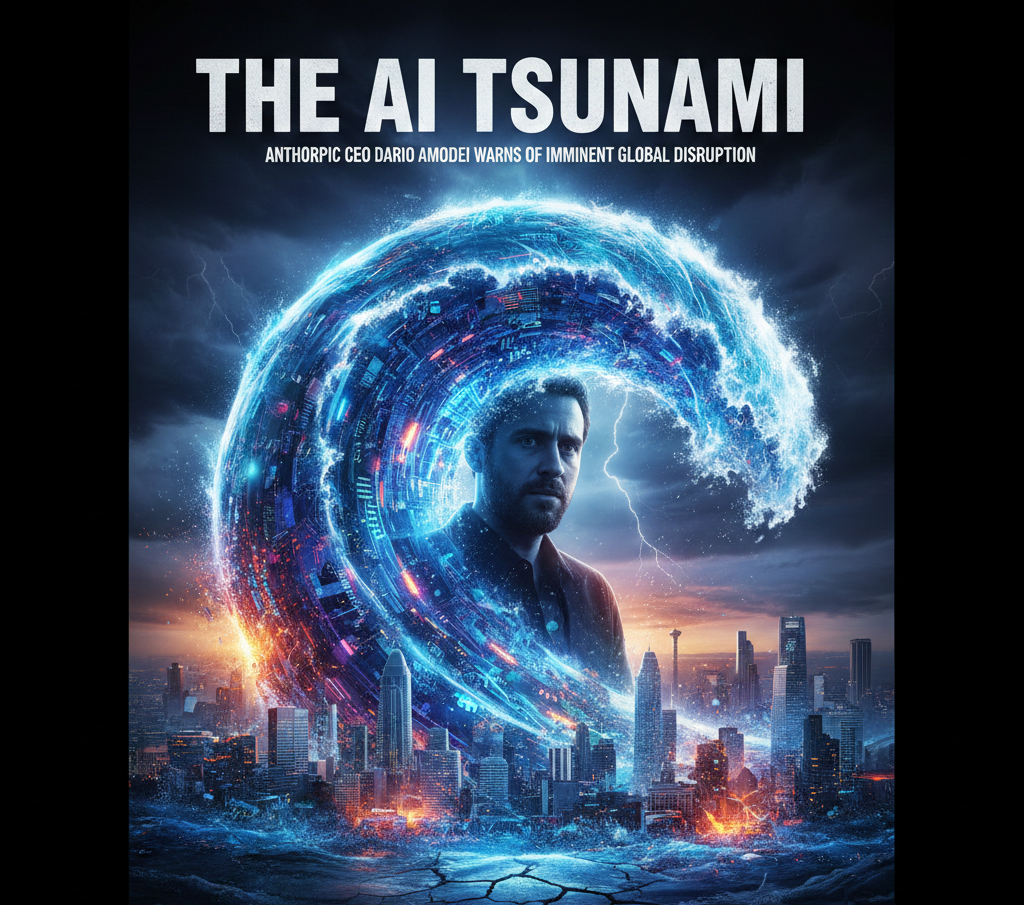
The AI tsunami Dario Amodei predicted is no longer a future warning—it is the defining reality of 2026. In a viral session of the Nikhil Kamath podcast, Anthropic CEO Dario Amodei declared that the world is standing on a shoreline, watching a massive wave approach while mistakenly dismissing it as a “trick of the light.” This AI tsunami is powered by the rapid arrival of human-level intelligence, a milestone Amodei believes society is “dangerously underprepared” to handle.
As we navigate the fallout of the Claude Crash and the Anthropic Effect, understanding the AI tsunami Dario Amodei described is essential for every professional, investor, and policymaker.
The Claude Crash and the 2026 “Anthropic Effect”
The first major impact of the AI tsunami hit the global markets in February 2026. Dubbed the “Claude Crash,” a massive sell-off in IT and SaaS stocks occurred after Anthropic unveiled the capabilities of Claude Opus 4.6 and Claude Sonnet 4.6.
The Anthropic Effect refers to the sudden realization by investors that agentic AI tools like Claude Cowork are no longer just assistants—they are autonomous digital workers. This shift has triggered a “SaaSpocalypse,” as traditional software-as-a-service models are being replaced by AI systems that execute multi-step business workflows independently (AI tsunami Dario Amodei).
Key Market Triggers of the AI Tsunami:
- Claude Cowork Plugins: Role-specific agents that handle legal, finance, and HR tasks.
- Claude Code Security: A tool that caused a “flash crash” in cybersecurity stocks by automating vulnerability detection.
- SaaS Disruption: The transition from “per-seat” pricing to AI-driven “outcome-based” models.
Why Dario Amodei Says “Coding is a Dying Skill”
On the Nikhil Kamath podcast, the Anthropic CEO was blunt about the future of technical labor. He noted that the AI tsunami is hitting software engineering first. With Claude 4.6 achieving near-perfect scores on complex engineering benchmarks, Amodei warned that “coding as a manual task is going away.”
“The AI tsunami is so close we can see it on the horizon,” Amodei told Kamath. “Tasks like code, math, and science are becoming increasingly AI-focused. Doing this end-to-end will happen soon.”
The “Runway” for Different Industries
| Industry | Risk Level from AI Tsunami | Timeline to Disruption |
| Software Engineering | Critical | Immediate (2026) |
| Cybersecurity | High | Late 2026 |
| Legal & Finance | High | 12–18 Months |
| Human-Centered Roles | Low | 3+ Years |
Inside Claude 4.6: The Engine of the AI Tsunami
The AI tsunami Dario Amodei speaks of is fueled by massive technical leaps in the Claude 4.6 model family. These features represent the transition from “chatbots” to human-level intelligence:
- 1M Token Context Window: Claude Opus 4.6 can now process an entire company’s codebase or a decade’s worth of legal files in a single request.
- Adaptive Thinking: This new feature allows the model to pause and “reason” through complex problems, much like a human expert.
- Computer Use: Claude can now move cursors, type, and navigate browser tabs to complete office work autonomously.
- Synthetic Data Generation: In math and science, the AI tsunami is accelerating because models are now creating their own training data to solve problems humans haven’t yet mastered.
Geopolitical Implications of Human-Level Intelligence
Beyond the economy, the AI tsunami Dario Amodei described has massive geopolitical consequences. Amodei expressed concern over the “absurd concentration of power” in the hands of a few companies. As human-level intelligence becomes the primary driver of national GDP, the “race to the top” between global superpowers is intensifying.
Anthropic has taken a unique stance by advocating for government regulation, even if it slows their own growth. Amodei insists that “steering the AI tsunami in the right direction” is the only way to prevent a catastrophic societal breakdown.
Conclusion: Preparing for the Wave
The AI tsunami Dario Amodei detailed on the Nikhil Kamath podcast is a call to action. We are moving toward a world where “geniuses in a data center” can outperform most humans at technical tasks. Whether you are an engineer facing the reality of a “dying skill” or a business leader navigating the Claude Crash, the message is clear: the wave is here.
To survive the AI tsunami, we must focus on the “last real human edge”—empathy, interpersonal relations, and high-level strategic architecture.