What if you could set a research goal, go to sleep, and wake up to 100 completed experiments that actually improved your project? This isn’t a scene from a sci-fi novel; it is the reality of the “AutoResearch” paradigm recently championed by Andrej Karpathy. As the former Director of AI at Tesla and a founding member of OpenAI, Karpathy has a knack for spotting the next tectonic shift in technology. His latest focus isn’t just on smarter models, but on autonomous AI agents that can operate in a closed-loop system without human intervention.
In a world obsessed with “chatting” with AI, Karpathy is looking toward a future where we stop talking to the machine and start letting it work. By leveraging autonomous AI agents, developers and enterprises can move from manual prompt engineering to high-level goal setting.
What are Autonomous AI Agents?
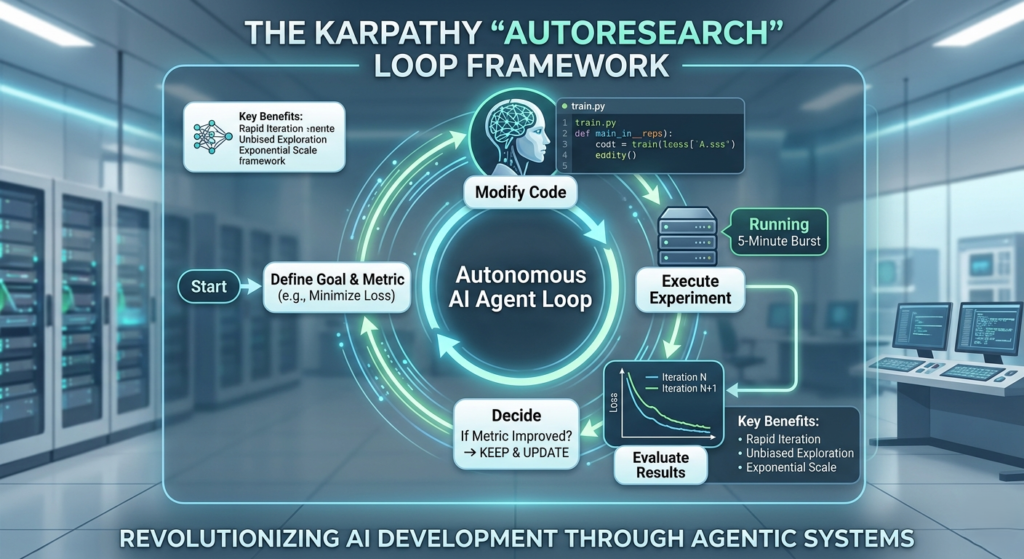
At its core, an autonomous agent is a system that can plan, execute, and refine its own actions to achieve a specific objective. Unlike a standard chatbot that waits for your next instruction, autonomous AI agents use a “loop” architecture. They analyze a problem, write the necessary code, run the process, evaluate the results, and then—most importantly—use those results to inform the next step.
The Karpathy “AutoResearch” Framework
Karpathy recently demonstrated this concept with a remarkably lean 630-line script. This tool allows autonomous AI agents to manage machine learning experiments on a single GPU. The agent is given a objective (e.g., “reduce the loss of this model”) and then left to its own devices.
- Self-Modifying Code: The agent edits its own
train.pyfile. - Rapid Iteration: It runs short, 5-minute training bursts to test hypotheses quickly.
- Metric-Driven Decisions: It only keeps changes that demonstrably improve performance.
- Infinite Loops: The process repeats indefinitely until the goal is met.
Why “The Loop” is the Future of AI Development
Traditional development is limited by the “human-in-the-loop” bottleneck. A researcher has an idea, writes code, waits for training, analyzes the graph, and tries again. This cycle is slow and prone to fatigue. Autonomous AI agents change the math entirely.
| Feature | Human-Led Research | Autonomous AI Agent Loop |
| Speed | 1-2 experiments per day | 100+ experiments overnight |
| Bias | Limited by human intuition | Explores unconventional paths |
| Cost | High (Expert hourly rates) | Low (GPU compute time) |
| Scalability | Linear | Exponential (Multi-agent fleets) |
By removing the human from the immediate execution phase, autonomous AI agents allow for a “Slopacolypse-proof” workflow where the output isn’t just more content, but better, more optimized systems.
Actionable Insights: Implementing Agentic Workflows
You don’t need a massive server farm to start exploring the power of autonomous AI agents. Karpathy’s approach emphasizes “starting small” to achieve big results.
1. Define Clear Success Metrics
An autonomous agent is only as good as its scoreboard. Whether you are optimizing a marketing funnel or a neural network, you must provide a concrete, measurable metric (like “validation loss” or “conversion rate”). Without this, the agent has no North Star to guide its iterations.
2. Sandbox the Action Space
Safety is a major concern when dealing with autonomous AI agents. Karpathy’s framework limits the agent to modifying a single file. For business applications, ensure your agents operate in a “sandbox”—a restricted environment where they can test ideas without breaking production systems.
3. Move from “Prompting” to “Meta-Prompting”
The role of the human is shifting. Instead of asking the AI to “write a blog post,” you will soon be instructing autonomous AI agents on how to conduct research for a whole series of posts. This is “Meta-Prompting”—designing the instructions for the research organization itself.
The Economic Impact of Autonomous AI Agents
The shift toward agentic AI is already being felt in the enterprise sector. Shopify CEO Tobi Lütke recently noted that an overnight run of an autonomous loop discovered model improvements that increased performance by 19% after just 37 experiments.
For businesses, autonomous AI agents represent a redistribution of labor. Analysts will spend less time generating data and more time evaluating the strategic implications of the results surfaced by their agentic fleets. The competitive advantage in 2026 will belong to those who can automate their internal “loops” the fastest.
Challenges: Ethics and Safety in the Agentic Era
As we give autonomous AI agents more power, the risks increase. From “reward hacking” (where the agent finds a loophole to get a high score without doing the work) to security vulnerabilities, the lack of human oversight requires new governance frameworks.
Experts suggest that for every agent deployed, there must be a named human accountable for its actions. This “Human-on-the-Loop” (HOTL) model ensures that while the autonomous AI agents do the heavy lifting, the final ethical and strategic guardrails remain firmly in human hands.
Conclusion: Join the Autonomous Revolution
Andrej Karpathy’s vision of a “loop-driven” future is a call to action for developers and business leaders alike. We are moving away from AI as a passive tool and toward autonomous AI agents as active collaborators.
By automating the “boring” parts of research and optimization, we free ourselves to focus on the high-level creativity that machines cannot yet replicate. The loop is running—are you ready to step out of it and lead?