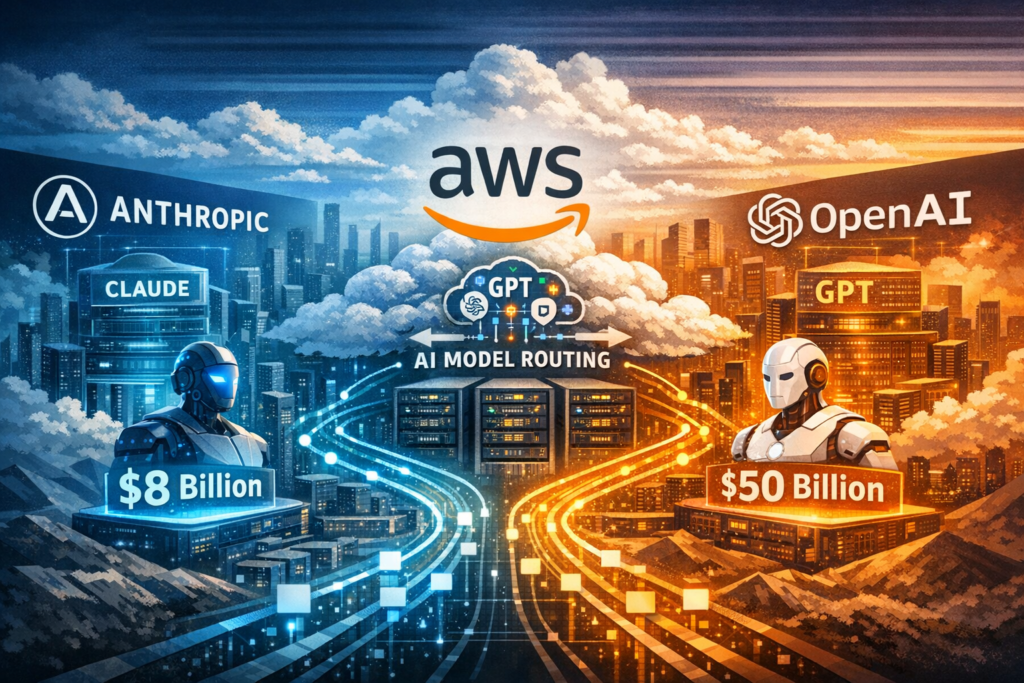
Amazon’s AWS has invested in both Anthropic and OpenAI — two of the fiercest rivals in AI — and its CEO says that’s perfectly fine. Here’s the full breakdown of how AWS’s AI investment strategy works, why it makes competitive sense, and what it signals about the future of cloud and artificial intelligence.
What Is AWS’s AI Investment Strategy, Exactly?
AWS’s AI investment strategy is a deliberate hedge: back multiple leading AI model providers, make their models available on the AWS cloud, and retain the right to compete with all of them using Amazon’s own homegrown models. (AWS AI investment strategy, Amazon Anthropic OpenAI, cloud AI conflict of interest, AI model routing cloud, Matt Garman AWS strategy)
Rather than betting exclusively on one AI horse, Amazon Web Services has chosen a portfolio approach — one that mirrors how major cloud providers have always managed technology partnerships. The strategy is straightforward in principle: give AWS customers access to the best available AI models, regardless of who built them, while positioning AWS as the neutral cloud infrastructure that everyone depends on.
This approach came into sharp public focus in April 2026 when AWS CEO Matt Garman addressed the inherent tension at the HumanX conference in San Francisco. When asked how Amazon could simultaneously back two companies that are, in his own framing, sometimes “petty” competitors, Garman was characteristically direct: it’s a problem Amazon has been solving since 2006.
The Anthropic Partnership: $8 Billion and Counting
AWS’s relationship with Anthropic — the safety-focused AI lab behind the Claude family of models — is the deeper and older of the two partnerships. Amazon has committed $8 billion to Anthropic, making it one of the largest corporate AI investments in history. In exchange, Anthropic uses AWS as its primary cloud provider, training its frontier models on Amazon’s custom Trainium chips.
For AWS, having Anthropic models natively available via Amazon Bedrock (its managed AI service) has been a key competitive differentiator against Microsoft Azure, which has an exclusive partnership with OpenAI.
The OpenAI Deal: A $50 Billion Strategic Necessity
In February 2026, AWS participated in OpenAI’s massive $110 billion funding round, contributing $50 billion. That number alone signals something important: for Amazon, not having OpenAI on AWS was becoming a liability. Microsoft Azure had a monopoly on OpenAI’s models, and enterprise customers were increasingly making cloud decisions based on which AI models were available natively.
Garman framed the OpenAI investment as almost a matter of survival. Both Anthropic and OpenAI models were already available on Azure — AWS’s largest rival. The AWS AI investment strategy demanded that OpenAI models become available on Amazon’s infrastructure too, regardless of the investor loyalty complications.(AWS AI investment strategy, Amazon Anthropic OpenAI, cloud AI conflict of interest, AI model routing cloud, Matt Garman AWS strategy)
Why Investing in Competing AI Labs Isn’t a Conflict for AWS
For AWS, co-investing in competing AI companies is not a conflict of interest because Amazon has spent two decades building systems, cultures, and policies to manage exactly this kind of competitive co-existence.
This is the core of Garman’s argument, and it deserves unpacking.
Amazon’s History of Competing With Its Own Partners
When AWS launched in 2006, it partnered with technology companies that it knew it would eventually compete against directly. The logic was pragmatic: AWS couldn’t build every service itself, so it needed partners. But it also knew that technology markets converge — eventually, what a partner builds today, AWS would offer tomorrow.(AWS AI investment strategy, Amazon Anthropic OpenAI, cloud AI conflict of interest, AI model routing cloud, Matt Garman AWS strategy)
The classic example Garman cited: Oracle, one of AWS’s biggest database rivals, sells its own database and AI services on AWS infrastructure. That’s the co-opetition model in its purest form. Oracle and AWS compete in the market, yet Oracle depends on AWS to reach customers. AWS profits from Oracle’s success on its cloud, even while building competing database products.
This model is now standard across cloud infrastructure. The relationship is less “partner or competitor” and more “both, simultaneously.”
Matt Garman’s Framework: Muscle Memory for Co-opetition
Garman used a specific phrase worth noting: Amazon has “built this muscle up” of going to market with partners while also competing with them. The key promise embedded in this muscle is that AWS won’t give itself an unfair competitive advantage over the partners it hosts.
This commitment is foundational to the AWS AI investment strategy working at scale. If Anthropic or OpenAI believed AWS was tilting the playing field — pushing its own AI models preferentially, throttling their performance, or pricing its own services unfairly — the partnerships would collapse. The entire strategy depends on AWS being credibly neutral infrastructure.
Anthropic vs. OpenAI on AWS — What’s the Difference?
These two partnerships are not identical in nature, depth, or strategic purpose. Here’s how they compare:
Comparison Table: AWS’s Relationship With Anthropic vs. OpenAI
| Dimension | Anthropic | OpenAI |
|---|---|---|
| Investment Amount | ~$8 billion | ~$50 billion |
| Partnership Type | Deep infrastructure (trains on AWS Trainium) | Model availability + financial stake |
| Primary AWS Cloud Usage | Yes — AWS is primary training cloud | Partial — Microsoft Azure remains primary |
| Models on Amazon Bedrock | Claude family (Claude 3, Claude 3.5, Claude 4) | Available post-2026 deal |
| Competitive Overlap | Moderate (Amazon has Titan models) | High (OpenAI GPT models compete broadly) |
| Investor Loyalty Sensitivity | High — AWS is Anthropic’s biggest backer | Lower — OpenAI has dozens of investors |
| Strategic Motivation for AWS | Differentiation; safety-focused enterprise AI | Defensive; prevent Azure monopoly on GPT models |
The Anthropic relationship is structurally deeper — it’s a cloud-native partnership where Anthropic has built its infrastructure on AWS. The OpenAI relationship is more transactional and defensive, designed primarily to ensure AWS customers don’t need to go to Azure to access OpenAI’s models.
The Real Play: AI Model Routing and Cloud Lock-In
Understanding the AWS AI investment strategy requires looking past the investment headlines to a less-covered but more consequential technical development: AI model routing.
What Is AI Model Routing?
AI model routing is a cloud service that automatically directs different AI tasks to different models based on cost, capability, or latency — without the user having to manually switch between them.
Garman explained the logic clearly at HumanX: one model might be ideal for planning, another for complex reasoning, and a cheaper model for lighter tasks like code completion. Model routing automates this selection, promising lower costs and better performance simultaneously.
Amazon Bedrock already offers this capability, as does Microsoft Azure’s AI Foundry. The pitch to enterprise customers is compelling: instead of building and managing connections to five different AI APIs, let the cloud handle model selection dynamically.
How Amazon (and Microsoft) Slip Their Own Models Into the Mix
Here’s where the AWS AI investment strategy gets strategically elegant — and slightly Machiavellian.
As model routing becomes the default way enterprises consume AI, the cloud provider’s own homegrown models get naturally inserted into the mix. Amazon’s Titan models and its Nova family don’t need to win on their own merits in a head-to-head benchmark competition. They just need to be “good enough” for certain task types to be routed to them automatically — at a lower price point — within a system the enterprise already trusts.
This is how Amazon (and Microsoft, with its own Phi family of models) will drive adoption of first-party AI without requiring customers to consciously choose them. The AWS AI investment strategy is ultimately a cloud infrastructure play dressed up as an AI investment play.
What This Means for the AI Industry in 2026
The broader trend Garman’s comments reveal is that investor loyalty in AI is effectively dead. When Anthropic raised its $30 billion round in February 2026, it included at least a dozen investors who were simultaneously backing OpenAI. Microsoft — OpenAI’s primary cloud partner — was among them.
This normalization of multi-directional investment has several implications:
- AI labs can no longer rely on investor exclusivity as a moat. Differentiation must come from model quality, safety reputation, and enterprise relationships — not from financial lock-in.
- Cloud providers are the new kingmakers in AI. Whoever controls the infrastructure on which models are trained and deployed has structural leverage over AI labs — regardless of who owns equity in whom.
- The “AI war” framing is increasingly misleading. In reality, the major players — Amazon, Microsoft, Google — are simultaneously investors, customers, and competitors of the AI labs they fund. The ecosystem is less a battlefield and more a complex web of mutual dependencies.
- Model routing will commoditize frontier AI. If enterprises stop caring which model runs a given task and simply want “the best model for this job,” the differentiating power of any single frontier model erodes.
- First-party cloud AI models get a stealth distribution channel. AWS’s Titan and Nova, Microsoft’s Phi, and Google’s Gemini all benefit from being the lowest-friction option within their respective cloud routing systems.
The AWS AI investment strategy, in short, is not really about Anthropic vs. OpenAI. It’s about ensuring that no matter which AI model wins the intelligence race, enterprise AI runs on AWS.
Frequently Asked Questions
Why did AWS invest in both Anthropic and OpenAI?
AWS invested in both Anthropic and OpenAI to ensure that customers on its cloud platform have access to the leading frontier AI models — and to prevent Microsoft Azure from having an exclusive advantage. The investments are strategic infrastructure plays, not expressions of loyalty to either AI lab.
Is there a conflict of interest in AWS backing competing AI companies?
According to AWS CEO Matt Garman, no — because Amazon has decades of experience partnering with companies it also competes against. AWS promises not to give itself an unfair competitive advantage over its partners. Even Oracle, one of AWS’s biggest rivals, sells its services on AWS infrastructure.
What is Amazon’s AI model routing strategy?
Amazon’s AI model routing strategy — available through Amazon Bedrock — automatically directs AI tasks to the most appropriate model based on performance, cost, and complexity. This approach benefits AWS by inserting its own first-party models into enterprise workflows at scale, without requiring customers to actively choose them.
How much has AWS invested in AI companies?
As of April 2026, AWS has committed approximately $8 billion to Anthropic and $50 billion to OpenAI — a combined AI investment of roughly $58 billion, making it one of the largest corporate AI investment portfolios globally.
What is AWS Bedrock?
AWS Bedrock is Amazon’s managed AI service that gives enterprises access to a wide range of foundation models — including Claude (Anthropic), GPT (OpenAI), and Amazon’s own Titan and Nova models — through a single API. It is central to Amazon’s AWS AI investment strategy.
Key Takeaways
- AWS’s AI investment strategy is a deliberate portfolio hedge — invest in multiple AI labs, make their models available on Amazon infrastructure, and compete with all of them via first-party models.
- The $8 billion Anthropic and $50 billion OpenAI investments serve different strategic purposes: the former is a deep infrastructure partnership; the latter is a defensive move to prevent Azure from monopolizing GPT model access.
- AI model routing is the hidden engine of this strategy — it inserts Amazon’s own models into enterprise workflows at scale.
- Investor loyalty in AI is dead. At least a dozen OpenAI investors also back Anthropic. Cloud providers have replaced exclusive financiers as the true power brokers in the AI ecosystem.
- The real winner of the “AI race” may not be any single model company — it may be whoever owns the cloud infrastructure all models run on.
❓ Frequently Asked Questions (FAQs)
1. What is AWS AI investment strategy and why is it important in 2026?
The AWS AI investment strategy is Amazon’s approach to investing in multiple leading AI companies—such as Anthropic and OpenAI—while also building its own in-house AI models. Instead of choosing a single winner in the AI race, AWS uses a portfolio strategy to ensure that its cloud platform remains the central hub for enterprise AI workloads.
This strategy is especially important in 2026 because businesses are no longer loyal to a single AI provider. Companies want flexibility, performance, and cost efficiency. By hosting multiple AI models under one platform (Amazon Bedrock), AWS ensures that customers don’t need to switch cloud providers to access different AI capabilities. This positions AWS as a neutral and indispensable infrastructure layer in the AI ecosystem.
2. Why did AWS invest in both Anthropic and OpenAI?
AWS invested in both companies to avoid losing enterprise customers to competitors like Microsoft Azure. If AWS only supported Anthropic, businesses that relied on OpenAI’s GPT models might migrate to Azure. Similarly, supporting only OpenAI would weaken AWS’s differentiation strategy.
The AWS AI investment strategy ensures that both Claude (Anthropic) and GPT (OpenAI) models are available within its ecosystem. This reduces customer churn and strengthens AWS’s position as a comprehensive AI platform. It’s less about loyalty and more about ensuring market relevance and infrastructure dominance.
3. Is there a conflict of interest in AWS supporting competing AI companies?
While it may seem like a conflict, AWS views this as a standard business model known as “co-opetition” (cooperation + competition). Amazon has been following this approach since the early days of AWS, where it hosted services from companies it also competed with.
The success of the AWS AI investment strategy depends on trust. AWS must ensure fair pricing, performance, and access for all AI partners. If it favors its own models unfairly, partners like Anthropic or OpenAI could shift to other cloud providers. Therefore, neutrality is not just a principle—it’s a necessity for the strategy to work.
4. What is AI model routing and how does it fit into AWS’s strategy?
AI model routing is a system that automatically selects the best AI model for a given task based on factors like cost, speed, and complexity. For example, a simple query might be handled by a cheaper model, while a complex reasoning task could be routed to a more advanced model.
This is a core component of the AWS AI investment strategy. With services like Amazon Bedrock, AWS can dynamically route tasks across models from Anthropic, OpenAI, and its own internal models. This improves efficiency for customers while subtly increasing the usage of AWS-native models, creating a long-term competitive advantage.
5. How does AWS benefit financially from this AI investment strategy?
AWS benefits in multiple ways. First, it earns revenue from hosting AI models and charging for compute usage. Every time a model is trained or queried, AWS generates income. Second, by keeping customers within its ecosystem, AWS increases long-term customer lifetime value.
Additionally, the AWS AI investment strategy allows Amazon to scale its own AI models without needing them to outperform competitors immediately. Through model routing, even “good enough” models can gain adoption, helping AWS reduce reliance on external providers over time.
6. How is AWS different from Microsoft and Google in AI strategy?
While Microsoft has taken a more exclusive approach with OpenAI, and Google focuses heavily on its own Gemini models, AWS has adopted a more open and diversified strategy. It supports multiple third-party AI providers while simultaneously developing its own models.
The AWS AI investment strategy stands out because of its flexibility. Instead of locking customers into one ecosystem, AWS offers choice. This approach aligns well with enterprise needs, where different use cases require different AI capabilities.
7. What does this mean for businesses using AI in 2026?
For businesses, this strategy simplifies AI adoption. Instead of integrating multiple APIs from different providers, companies can rely on AWS to handle everything through a single platform. This reduces complexity, lowers costs, and improves scalability.
The AWS AI investment strategy also future-proofs businesses. As new AI models emerge, they are likely to be integrated into AWS’s ecosystem, allowing companies to stay updated without major infrastructure changes.
8. Will AWS eventually prioritize its own AI models over partners?
In the long term, AWS is likely to increase the adoption of its own models, such as Titan and Nova. However, it cannot do this aggressively without risking partner relationships and customer trust.
The AWS AI investment strategy is designed to balance this carefully. By using model routing, AWS can gradually introduce its own models into workflows without forcing customers to switch. This ensures a smooth transition while maintaining a competitive and fair ecosystem.