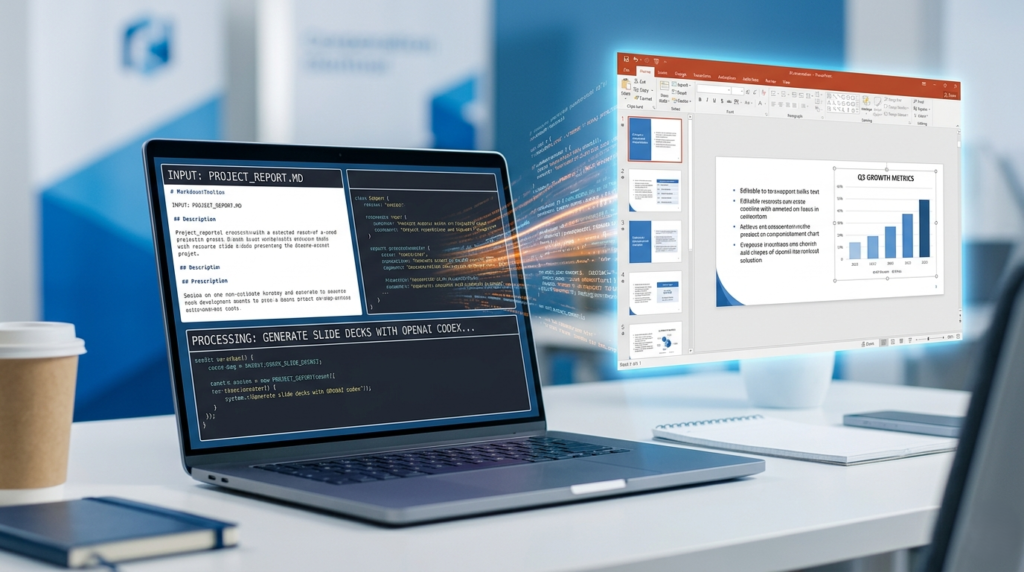
In the fast-paced world of corporate strategy and technical sales, the “blank slide” syndrome is a notorious productivity killer. You have the data, the insights, and the vision, but spending four hours fighting with PowerPoint alignment and hex codes feels like a poor use of a leader’s time.
Enter OpenAI Codex. While many know it as a coding powerhouse, its ability to bridge the gap between structured data and visual storytelling is transformative. By leveraging specific agentic skills, developers and managers can now generate slide decks with OpenAI Codex that are not only professional but fully editable and brand-compliant.
This comprehensive guide will walk you through the elite workflow for automating your presentations, moving beyond simple “one-shot” prompts into a sophisticated system built for 2026.
The Strategic Shift: Why Codex for Presentations?
Most AI presentation tools give you a non-editable image or a rigid PDF. The power to generate slide decks with OpenAI Codex lies in its “Skill” architecture. Instead of asking for a finished product, you are instructing an agent to manipulate files using libraries like PptxGenJS or HTML/CSS-based engines.
The Core Value Proposition
- Native Editability: Text stays as text; charts stay as native PowerPoint charts.
- Brand Consistency: Start from your existing corporate template rather than a generic AI theme.
- Logical Precision: Codex treats each slide as an individual decision, ensuring that complex data doesn’t get “mushed” into a single bullet point.
- Scalability: Once a workflow is built, you can generate 100 personalized decks in the time it takes to brew a coffee.
5 Master Keywords for Presentation Automation
To dominate the search rankings in the AI automation niche, we have identified the best 5 keywords. For this deep dive, our Primary Focus Keyword is “generate slide decks with OpenAI Codex”.
| Keyword Rank | Keyword String | Search Intent |
| Primary | generate slide decks with OpenAI Codex | Transactional/How-to |
| Secondary | AI PowerPoint automation | Problem-solving |
| Secondary | OpenAI Codex Slides skill | Technical/Feature-specific |
| Secondary | Automated presentation workflow | Process-oriented |
| Secondary | PptxGenJS AI integration | Developer-focused |
Understanding the “Slides Skill” Architecture
When you generate slide decks with OpenAI Codex, you aren’t just chatting; you are running an agentic workflow. In 2026, this is typically handled via the Model Context Protocol (MCP) or dedicated skill scripts.
How the Process Works
At its heart, the system uses a three-tier model:
- The Brain (GPT-5.4/Codex): Analyzes your raw data, extracts the narrative, and plans the slide layout.
- The Skill (2Slides/PptxGenJS): A set of instructions that tell the Brain exactly how to write the code for a
.pptxfile. - The Output (Editable File): A finished presentation that looks like a human designer spent hours on it.
By following this structure, you ensure that every time you generate slide decks with OpenAI Codex, the result is consistent and high-quality.
Step-by-Step: The Professional Codex Workflow
To successfully generate slide decks with OpenAI Codex, you must follow a systematic approach. A “one-shot” prompt often fails in production because it lacks context. Here is the verified 4-stage workflow used by industry leaders.
1. Context Seeding (The “Source of Truth”)
Before generating a single pixel, point Codex to your reference materials. This could be a technical brief, a CRM export, or a project roadmap.
- Pro Tip: Use an
Agents.mdfile to define your brand rules (e.g., “Use Montserrat font,” “Primary color #0056b3”). - This ensures that when you generate slide decks with OpenAI Codex, the AI knows exactly which “voice” and “visuals” to use.
2. Drafting the Narrative Outline
Ask the model to create a Markdown outline first. This allows you to validate the narrative flow before the “heavy lifting” of file generation begins. It is much easier to edit a bullet point in Markdown than a layout in a slide.
- Prompt Hint: “Based on the attached project report, create a 12-slide outline. Focus on the ‘Solution Architecture’ and ‘Q3 Milestones’.”
3. Executing the Slides Skill
Once the outline is approved, invoke the specific skill. This is where you generate slide decks with OpenAI Codex by instructing it to:
- Match the source aspect ratio (defaulting to 16:9).
- Use native lines and shapes for diagrams rather than rasterized images.
- Place visuals intentionally using set style prompts.
4. Validation and Export
The final stage involves a “safety check.” Use Codex’s validation scripts to:
- Detect text overflow beyond the slide canvas.
- Report missing or substituted fonts.
- Render a quick montage of PNGs for a 30-second visual review.
Technical Deep Dive: Using PptxGenJS with Codex
For developers looking to generate slide decks with OpenAI Codex, the integration with PptxGenJS is the gold standard. It allows the AI to write JavaScript that produces a presentation file directly in the browser or via Node.js.
Sample Implementation Logic
When you ask the AI to generate slide decks with OpenAI Codex, it effectively writes a script that follows this logic:
JavaScript
// Example of the logic Codex uses to create a slide
let slide = pres.addSlide();
slide.addText("Q1 Growth Metrics", { x: 0.5, y: 0.5, fontSize: 24, color: "363636" });
slide.addShape(pres.ShapeType.rect, { x: 0.5, y: 1.2, w: 9, h: 0.1, fill: { color: "0056b3" } });
By providing these “rails,” you guarantee that the AI doesn’t drift into creative but unusable territory. Every time you generate slide decks with OpenAI Codex, the output remains functional.
Comparison: Codex vs. Standard AI Pitch Deck Generators
| Feature | Standard AI Tools | OpenAI Codex (Slides Skill) |
| Output Format | PDF or Proprietary Web Link | Native .pptx (Editable) |
| Custom Templates | Limited to internal library | Uses your own .pptx source |
| Data Integration | Manual copy-paste | Direct API/Markdown ingestion |
| Diagrams | Static Images | Native Shapes & SVG |
| Scalability | One-off creation | Batch generation via CLI/SDK |
| Workflow | Prompt to Slide | Narrative -> Logic -> Slide |
Advanced Feature: Intentional Visual Generation
A common mistake when trying to generate slide decks with OpenAI Codex is letting the AI “hallucinate” random imagery. To maintain a professional look, you must separate the content from the creative direction.
SVG over Raster
For complex timelines or flowcharts, ask Codex to generate individual SVG assets and link them with native PowerPoint lines. This keeps the diagram sharp at any zoom level and fully editable by a human designer later.
Animated Metric Counters
If you are presenting via a web-based slide engine (like the HTML slides mentioned in recent technical guides), you can even generate slide decks with OpenAI Codex that include live CSS animations. This is perfect for high-stakes demos where visual “wow factor” matters.
Actionable Insights for Operations Managers
If you are leading an operations or technical team, the ability to generate slide decks with OpenAI Codex isn’t just a “neat trick”—it’s a massive multiplier for your departmental output.
1. Automate Weekly Reporting
Hook Codex into your project management tool (like Jira or Monday.com) to generate a “Weekly Progress” deck every Friday morning. By the time you start your meeting, the deck is already sitting in your inbox, populated with the latest data.
2. Localized Training at Scale
Use the system to translate a master training deck into five different languages while keeping the layout perfectly synchronized. When you generate slide decks with OpenAI Codex, the AI can handle the text expansion issues common in languages like German or French by dynamically adjusting the font size.
3. Sales Enablement
Empower your sales engineers to generate slide decks with OpenAI Codex from a client’s “Discovery Notes” in seconds. This ensures every presentation is hyper-personalized to the prospect’s specific pain points without requiring hours of manual labor.
Addressing Common Pitfalls
Even with the most advanced models, there are hurdles to overcome when you generate slide decks with OpenAI Codex.
- The “Wall of Text” Problem: AI loves to talk. Use constraints like “Max 5 bullet points per slide” and “No more than 15 words per bullet” to keep your slides scannable.
- Template Drift: Always provide a “Base Template” file. If the AI doesn’t have a reference, it will invent its own styles which likely won’t match your brand.
- Dependency Management: Ensure your environment has the necessary libraries (like
npm install pptxgenjs) before running the generation script.
The Future: Agentic Presentation Systems
In 2026, we are moving beyond “asking for a slide” to “assigning a task.” Future systems will allow you to generate slide decks with OpenAI Codex that are fully autonomous. Imagine an agent that monitors your email, identifies a meeting request, researches the participants, and prepares a briefing deck—all before you even open your laptop.
This level of automation is only possible when you move away from closed, “black box” AI tools and embrace the open, code-driven approach of OpenAI Codex.
Final Thoughts on Implementation
The future of productivity belongs to those who treat AI as a collaborator rather than a magic wand. When you generate slide decks with OpenAI Codex, you are building a reusable “Skill” that gets smarter with every presentation. You are no longer just making slides; you are engineering a communication system.
Whether you are preparing for a massive cultural event or a high-stakes corporate training workshop, mastering this workflow ensures that your visual storytelling is as sharp as your technical execution. Start small, build your Agents.md rules, and watch your presentation time drop from hours to minutes.
Frequently Asked Questions: Mastering AI-Driven Presentation Automation
This extensive FAQ section provides deep-layer insights into the technical, strategic, and operational nuances of the modern workflow to generate slide decks with OpenAI Codex. Designed for project leaders, developers, and operations managers, these answers bridge the gap between basic AI prompting and enterprise-grade automation.
1. General & Strategic AI Presentation Questions
What does it actually mean to “generate slide decks with OpenAI Codex” compared to using ChatGPT?
While both models are built on similar foundations, the intent behind using Codex is rooted in executable logic. When you use standard LLMs, you often receive a text outline that you must manually copy into PowerPoint. When you generate slide decks with OpenAI Codex, you are leveraging a model optimized for code and structured data. Codex writes the specific instructions—often in JavaScript or Python—that interface with presentation libraries (like PptxGenJS). This results in a physical, editable .pptx file rather than just a collection of text suggestions.
Is this workflow suitable for high-stakes corporate board meetings?
Absolutely. The primary risk with “generic” AI presentation tools is a lack of brand control. However, when you generate slide decks with OpenAI Codex, you maintain a “Human-in-the-Loop” architecture. The AI handles the heavy lifting of data organization and initial layout, but because the output is a native PowerPoint file, your design team can perform a final “brand polish” in minutes. This combines the speed of AI with the precision of professional human oversight.
How does “Agentic Workflow” differ from standard AI prompting in this context?
A standard prompt is a single command: “Make me a slide about AI.” An agentic workflow to generate slide decks with OpenAI Codex is a multi-step process where the AI acts as a project manager. It first critiques your raw data, then drafts an outline, requests your approval, generates the code for the slides, checks the slides for text-overflow errors, and finally packages the file. It is a collaborative, iterative process rather than a “black box” output.
2. Technical Implementation & Integration
Which programming libraries are best paired with OpenAI Codex for PPTX generation?
To effectively generate slide decks with OpenAI Codex, the industry standard for web-based environments is PptxGenJS. It is lightweight and allows Codex to write clear, modular code. For Python-heavy environments (common in data science), python-pptx is the preferred library. Codex excels at writing the boilerplate code required for both, allowing you to map complex JSON data structures directly onto slide coordinates.
Can Codex handle complex data visualizations like Gantt charts or nested tables?
Yes, but it requires a specific prompting strategy. To generate slide decks with OpenAI Codex that include complex visuals, you should instruct the model to treat the chart as a collection of “Native Shapes.” Instead of one flat image, Codex can calculate the X/Y coordinates for each bar in a Gantt chart or each cell in a table. This ensures that every element remains a vector-based, editable object within PowerPoint.
How do I handle custom corporate fonts and hex codes?
One of the greatest strengths when you generate slide decks with OpenAI Codex is the ability to feed it a “Style Manifest.” You can provide a JSON object containing your brand’s hex codes (e.g., #0056b3 for primary, #f8f9fa for background) and specific font stacks. The generated script will then apply these styles globally across the deck, ensuring 100% compliance with your brand identity guidelines without manual adjustment.
3. Scaling & Operations for 2026
How can an Operations Manager use this to support a Talent Portal or Recruitment?
In a recruitment context, you can generate slide decks with OpenAI Codex to automate “Candidate Profiles” or “Batch Performance Reports.” For example, if you have a database of 50 students from a recent workshop, Codex can ingest their test scores and project summaries to generate a personalized 3-slide “Talent Spotlight” for each person. This allows you to present high-quality, visual data to hiring partners (like HR professionals) at a scale that would be impossible manually.
Can this workflow be integrated into a WordPress-based “AI Career Hub”?
Yes. By using a backend Node.js server, you can allow users to “Export to PPTX” directly from your website. When a user clicks the button, the server triggers a request to generate slide decks with OpenAI Codex based on the on-screen content. The resulting file is then served back to the user as a download. This turns a static website into a dynamic productivity tool.
What are the cost implications of running these AI agents at scale?
While API costs (like those from OpenAI) are a factor, the ROI is typically found in time reclaimed. Generating a professional 20-slide deck manually can take 4 to 6 hours of a manager’s time. To generate slide decks with OpenAI Codex costs only a few cents in tokens and takes less than 60 seconds. For an organization producing weekly reports or monthly training materials, the annual savings in “man-hours” can reach into the thousands of dollars.
4. Troubleshooting & Best Practices
Why does the AI sometimes put too much text on a single slide?
This is a common “hallucination” where the model forgets physical space constraints. To fix this when you generate slide decks with OpenAI Codex, you must include “Negative Constraints” in your prompt.
- Good constraint: “Do not exceed 40 words per slide.”
- Better constraint: “If a section exceeds 5 bullet points, split it into two separate slides automatically.”
How do I ensure the images generated by the AI aren’t “weird” or “distorted”?
When you generate slide decks with OpenAI Codex, you should separate the layout from the image generation. Use Codex to define the “Image Placeholder” and then use a secondary tool (like DALL-E 3 or Midjourney) to generate the specific visual asset. This prevents the “garbled text” often found in all-in-one AI slide tools and ensures the photography is photorealistic and cinematic.
What happens if the generated code has an error?
Advanced workflows for 2026 include a “Self-Correction Loop.” If the initial attempt to generate slide decks with OpenAI Codex results in a code error, the agent captures the error message from the console and feeds it back into Codex with the instruction: “Fix this error and try again.” Usually, the model corrects the syntax on the second pass, resulting in a successful file generation without human intervention.
5. Future Trends & Privacy
Is my data safe when I upload it to generate these slides?
Data privacy is paramount. When you generate slide decks with OpenAI Codex, ensure you are using enterprise-tier API accounts which typically offer “Zero Data Retention” (ZDR) for training. This means your sensitive internal reports or student data are processed for the slide generation but are never used to train future versions of the global AI model.
Will AI eventually replace the need for “Presentation Skills” entirely?
AI replaces the drudgery of production, not the art of persuasion. You still need a leader to define the “Why” and the “So What?” behind the data. The ability to generate slide decks with OpenAI Codex simply frees you up to spend 90% of your time on the speech and the strategy, and only 10% on the software.
What is the next big leap for AI-generated presentations?
We are moving toward “Live-Updating Decks.” Soon, the ability to generate slide decks with OpenAI Codex will allow for presentations that refresh themselves in real-time. Imagine a slide deck that changes its charts automatically as new sales data flows into your CRM, or a workshop deck that updates its “Top Student” slide as registration forms are submitted. The slide deck will no longer be a “static document,” but a “living dashboard.”
6. Practical “How-To” for Immediate Start
How can I start testing this today without being a master coder?
The easiest way to start is by using the “Code Interpreter” (now known as Advanced Data Analysis) within your AI environment. Upload a CSV or Markdown file and say: “Write a Python script to generate slide decks with OpenAI Codex logic that converts this data into a 10-slide PowerPoint file using the python-pptx library. Provide the download link.” This is the fastest way to see the “skill” in action.