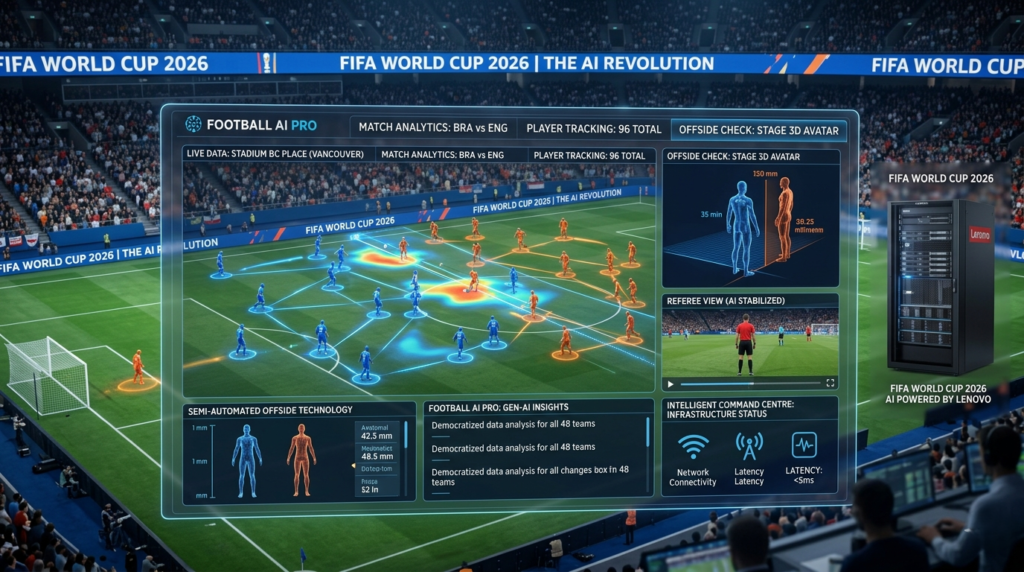
FIFA World Cup 2026 AI integration is no longer a futuristic concept; it is the cornerstone of the largest sporting event in history. With 48 teams, 104 matches, and three host nations, the sheer scale of the upcoming tournament demands a technological backbone that only artificial intelligence can provide.
To manage this unprecedented complexity, FIFA has pivoted from traditional local organizing committees to a centralized, tech-first approach. At the heart of this strategy is a landmark partnership with Lenovo. This isn’t just about faster computers; it is about a total digital overhaul that will redefine player performance, refereeing transparency, and fan engagement.
In this deep dive, we explore how the FIFA World Cup 2026 AI ecosystem—powered by Lenovo’s hybrid infrastructure—is setting a new gold standard for global sports.
The Core of the Strategy: Football AI Pro
One of the most buzz-worthy announcements is Football AI Pro. This generative AI knowledge assistant is built on FIFA’s proprietary Football Language Model. Unlike general-purpose AI, this model is trained on hundreds of millions of FIFA-specific data points, ensuring that the insights it provides are validated and tournament-relevant.
Democratizing Data for All 48 Teams
Historically, top-tier football nations had a massive advantage because of their budgets for data analysts. A debutant nation might not have the same resources. FIFA World Cup 2026 AI aims to level the playing field.
- Equal Access: Every team, regardless of budget, gets access to the same high-level analytical baseline.
- Multi-modal Analysis: The AI generates text, video, graphs, and 3D visualizations for pre- and post-match analysis.
- Multilingual Support: Coaches can prompt the system in their native languages, removing communication barriers in high-pressure environments.
Redefining Officiating with Next-Gen Technology
The “Referee View” and semi-automated offsides have often been points of contention for fans. The FIFA World Cup 2026 AI implementation seeks to bridge this “legitimacy gap” through better data visualization.
Improved Referee View
The updated Referee View utilizes AI-powered stabilization. Body cameras worn by referees often produced shaky, unwatchable footage in the past. By smoothing this footage in real-time, FIFA provides a “through-the-eyes” perspective that helps broadcasters explain difficult calls. This transparency is a cornerstone of the FIFA World Cup 2026 AI mission.
3D Player Avatars for Offside Accuracy
One of the most innovative uses of the FIFA World Cup 2026 AI is the creation of precise 3D player models.
- Rapid Scanning: Players undergo a one-second scan to create a detailed digital twin.
- Obstruction Handling: During fast-paced play, AI tracks these models even when players are partially obscured by others.
- Clearer Visuals: When a VAR decision is made, the 3D imagery shown to fans is more intuitive and anatomically accurate than the traditional “lines on a pitch.”
The Intelligent Command Centre: The Tournament’s Backbone
While fans see the avatars and the analytics, the real heavy lifting happens behind the scenes in the Intelligent Command Centre. This is where the FIFA World Cup 2026 AI infrastructure truly shines.
| Feature | Impact on the 2026 World Cup |
| Hybrid AI Architecture | Enables real-time data processing across three different countries. |
| Operational View | Connects venues, broadcasters, and logistics into a single “source of truth.” |
| Domain-Specific LLM | Uses the Football Language Model to provide validated tournament intelligence. |
| Edge Computing | Processes massive data loads locally at stadiums to reduce latency for live broadcasts. |
By utilizing the FIFA World Cup 2026 AI command centre, FIFA can directly manage operations that were previously distributed across local committees, ensuring a consistent experience from Vancouver to Mexico City.
Actionable Insights: What This Means for the Future of Sports
The FIFA World Cup 2026 AI rollout isn’t just a one-off experiment; it is a blueprint for the future of the sports industry.
1. The Rise of Domain-Specific Models
The success of the Football Language Model proves that “one-size-fits-all” AI is over. Future sports tech will rely on “small” LLMs trained on highly specific, proprietary data to ensure accuracy and reduce hallucinations.
2. Transparency as a Product
By using the FIFA World Cup 2026 AI to make officiating more transparent, FIFA is acknowledging that fan trust is a valuable commodity. Brands and organizations should look at AI not just as an efficiency tool, but as a way to communicate complex decisions more clearly to their “users.”
3. Democratization Through Infrastructure
Providing elite tools to all 48 teams suggests a shift in global sports. When data is democratized through the FIFA World Cup 2026 AI initiative, the competition becomes about strategy and talent rather than who has the biggest tech budget.
Conclusion: A New Era for the Beautiful Game
The FIFA World Cup 2026 AI revolution, fueled by the Lenovo partnership, represents the largest-scale deployment of artificial intelligence in sporting history. From 3D avatars that settle offside debates to a command centre that manages three nations as one, the 2026 tournament will be a masterclass in enterprise AI.
As we move toward kickoff, the FIFA World Cup 2026 AI strategy serves as a reminder that technology’s greatest role isn’t to replace the human element of the game, but to enhance the clarity, fairness, and excitement for the six billion people watching.